
The Cheese Blog

Coolattin: Irish Cheddar, Raw Milk, and Grazing Ladies

Despite the awe-worthy Gothic inspired architecture, amazing music and super nice people, I couldn't wait to leave Dublin for Wicklow County. Why? Cheese. We were visiting Coolattin Irish Cheddar producer Tom Burgess, someone whose cheese I hadn't yet tasted because none of the 70 wheels he made a week made it to the states, but I was aching to try.
Around the UK and Ireland, Burgess's cheddars have been making waves. In 2015 he won both Ireland's Best Cheddar and gold, silver, and bronze medals at the British Cheese Awards. Not too surprising that all the cheese was eaten up before it had a chance to hit California. Perhaps you're wondering with so little access to the cheese, how did I hear about the creamery?
Well because Mr Declan O'Brien, the man who did much of the ground work for the Cal Discoveries Irish Cuisine & Culture tour I guest-lectured on, played rugby with the cheesemaker.
And, that's how cheese writers learn about cheese, my friends!

Tom and his family invited our group to tour the dairy, then head to his gorgeous house to drink tea in the kitchen with his family. No biggie, just drinking raw milk from their herd in our tea while eating huge amounts of cheddar and snuggling with farm kittens in their house. The cheese was beautiful, and... almost as memorable, I had the opportunity to name a farm kitten (Susie)!
The story of Coolattin cheddar starts in 1987 with a fluctuating milk market.
Tom bought the farm in 1987 and like many farmers frustrated with with the EU milk market and quotas, decided to reclaim control of his herd's milk and pull it out of the system all together. Making cheese from that milk instead of selling it to processors would allow him to control where the milk was going, who was using it (him), and because cheese was a value-added product, he could set his own prices (many American dairy farmers have also made a similar move).
So Tom started experimenting with his herd's raw milk in his kitchen. Like all burgeoning cheesemakers, he had some misses, then, hits (you also wait six months or more before your creation is ready to sample), then found his groove. He took his young cheddars to farmer's markets to see if it would sell, and came back without any cheddar. A sign. Soon after, he hired English cheese consultant Christine Ashby, a Stilton and cheddar specialist who with worked at Montgomery's Cheddar, refined his wheels, then went commercial.




Tom has 3 rules he stands by for Coolattin Cheddar.
It's made from raw milk only.
He only makes Coolattin in the seven months of the year when his ladies can graze on fresh grass (tastes better, and according to Tom, "really freed up my time").
He will only milk his animals once a day to give them a little rest. Most cows are milked twice a day.
Coolattin cheddars are sweet, grassy, meaty (think rib-eye fat), and become more intense (but still sweet) with age. They're lovely.
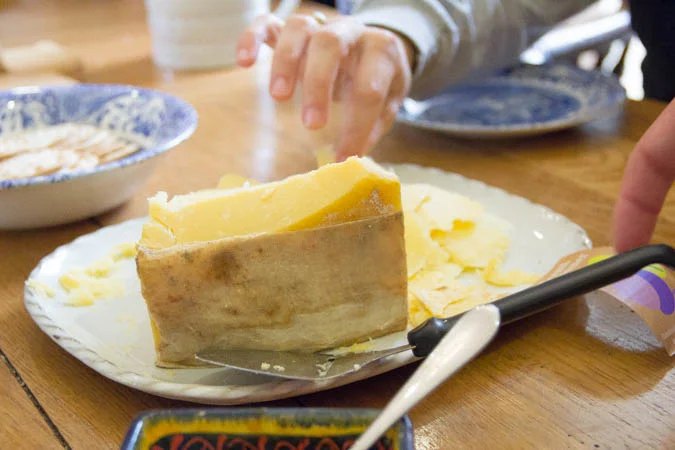
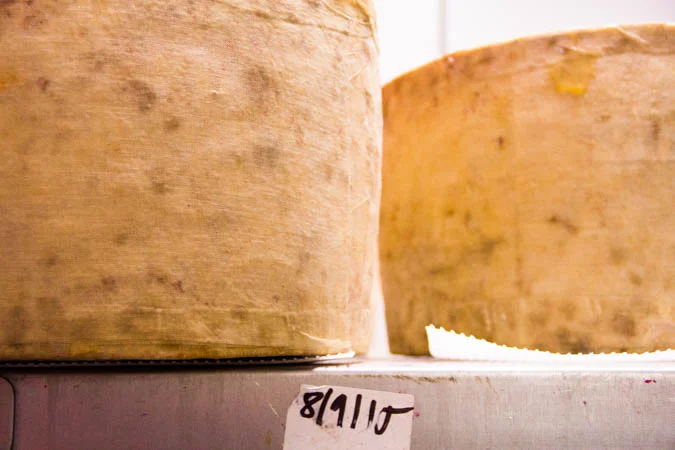
The wheels pictured here with natural (food-safe) red coating are his original style of Coolattin. With the urging of Slow Foods, Tom started making a bandage-wrapped style, below, and a year later that cheddar won gold, silver, and bronze at the British cheese awards. Score.

Tom has plans to grow, so let's cross our fingers that Coolattin makes it here soon. Right now he has the help of cheesemaker Ritchie (who also gives historical neolithic site tours in Wicklow), and his son just might be edging his way into the make room too. If you make it over Ireland, reach out. They're a kind family, they serve you raw milk with tea, the cheese samples are amazing, and come spring and summer there might be farm kittens.
Thank you for the visit, Burgess family!

Tom demonstrating how he uses the cheese harp (knife) to cut the custard-like fresh curd. This is the first curd cut before milling.
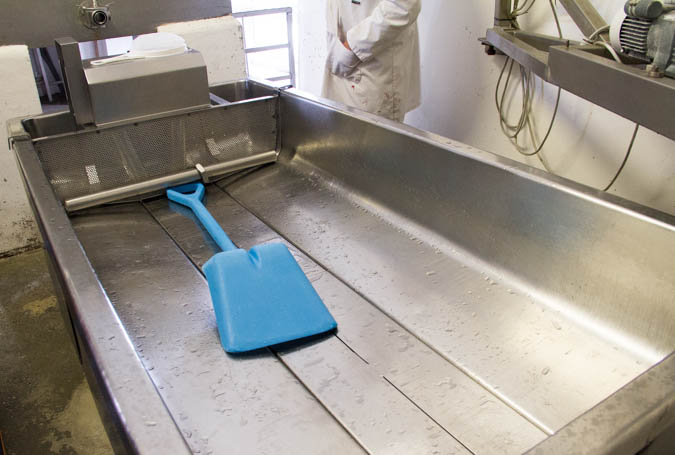
The shovel used to push lift curds into the milling machine.

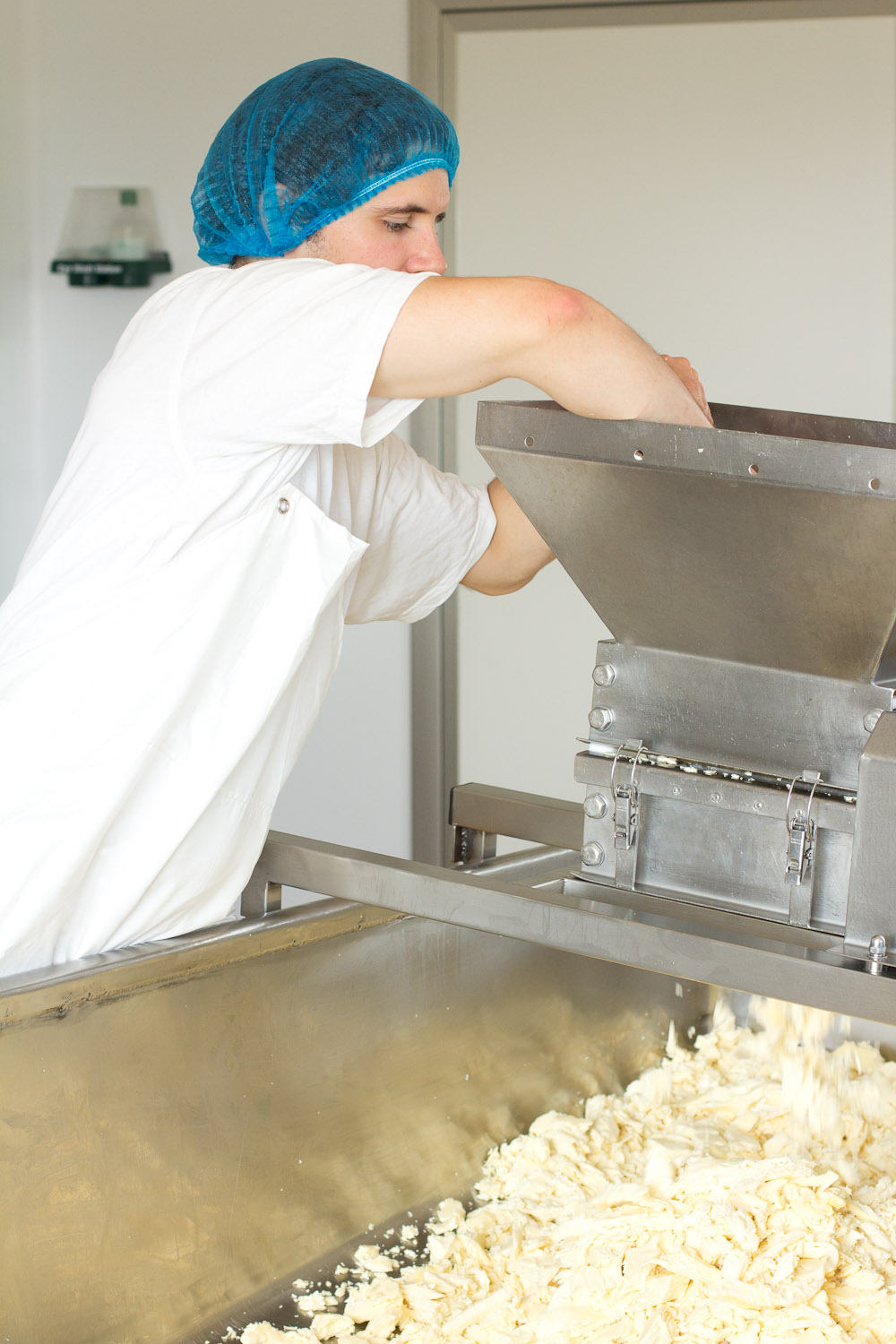
Tom took off the funnel top of the milling machine to show the mechanical magic inside. He puts the curds in, and the pegs chop them up to so they’re perfect to press into wheels.

Coolattin dairy – where The Cheese is made.

Susie, photo by Haley of Cal Discoveries UC Alumni Travel.

On Costumes, Hip Hop & His Most Surprising Cheddar: 5 Questions with Cheddar Author Gordon Edgar
A strong believer that the world needs humor along with its cheese and booze, I'm a big fan of Gordon Edgar's books. They're cultural and well-researched, super interesting, and funny. And Gordon himself is pretty awesome too. In honor of the publication of his second book, Cheddar: A Journey to the Heart of America's Most Iconic Cheese, Gordon agreed to an interview. Below I ask him about hip hop's use of cheddar in lyrics, cheese parties and cheddar costumes, and his favorite cheddar pairings (spoiler- a piece of cheese and his face).

Gordon sharing the aged cheddar love at Grafton, photo by Shelburne Farms
A strong believer that the world needs humor along with its cheese and booze, I'm a big fan of Gordon Edgar's books. They're cultural and well-researched, super interesting, and funny. And Gordon himself is pretty awesome too. In honor of the publication of his second book, Cheddar: A Journey to the Heart of America's Most Iconic Cheese, Gordon agreed to an interview. Below I ask him about hip hop's use of cheese in lyrics, cheese parties and costumes, and his favorite pairings (spoiler- a piece of cheese and his face).
I present you with 5 Questions with Gordan Edgar. Thank you, Gordon!

The cheese board from our tasting. I may have slightly misplaced our notes from that night after the wine was unleashed but I can tell you that we loved fig jam with English traditional versions.
1. You've been all over the country promoting, with events that included driving around Wisconsin in a school bus to holding vertical tastings of chedar to see how it ages. In what region have you felt the most cheddar enthusiasm and did it involve costumes?
The cheddar bus trip was an amazing experience. Jeanne Carpenter organized it and it brought out cheddar lovers from all over the place. We started at Larry’s Market and then got to go on tours at Henning’s, LaClare, and Widmer’s – three of my favorite places to go in Wisconsin – and then I blah blah’d at folks between stops. CCP Elizabeth Nerud even recited an impromptu cheese poem at the end of the night while we rolled back to Milwaukee.
Vermont was pretty incredible too. Three events in 24 hours! Grafton, Provisions, Shelburne Farms, Cabot and Jasper Hill all collaborated to help make it happen. I did a talk at University of Vermont where I was honored by Professor Paul Kindstedt showing up. Then almost killed myself – as Californians driving in Vermont black ice conditions are wont to do – driving to Provisions to talk with about almost 100 cheese professionals. As soon as that was done I went to Brattleboro for a cheddar
party were I read a poem with local journalist and ex-monger Wendy Levy that likely had not been read aloud for 125 years or so. Costumes would have been the only thing that could have made that better, I wish I had talked to you beforehand.
The last time costumes and cheddar came into play historically that I know of was in 1951, the cheddar centennial in Rome, New York that commemorated the 100 year anniversary of America’s first cheddar factory. Cheese dignitaries came in from across country and the Rome (New York) Theater Guild produced a play about the life of Jesse Williams, “Father of Cheese Factories.” Alas, there was no revival of the performance for the 150 year anniversary. Let’s get ready for 2051, people!
2. What is your top favorite cheddar combo of all time? Feel free to say butter, bread and a pan, or go grand.
Yeah, it really is piece of cheddar and my face. I had a co-worker who used to just come over to the cheese counter during her break, buy a ¼ lb of cheddar, unwrap it, and just start chomping for lunch every day. I was in awe the first time I saw that and still think it is the ultimate way to enjoy a cheese.
If I am going to do cheddar for dinner, I’d add tart apples, dark honey, and sourdough bread or rustic crackers. For cooking, a medium sharp cheddar along with a little brie and fridge odds and ends for mac and cheese. Mmmmmmm.
3. You know a lot about cheddar. Does the hip hop world adopting the word "cheese," or more often "cheddar" as a euphemism for money make since to you? Why or don't you think "cheddar" in particular fits? Would chevre work too?
I actually wrote about this for Cheddar, but cut that section because -- while I can claim great knowledge and nuance about punk -- I am more of a tourist to hip hop. In punk, historically speaking, cheese references are usually about the government cheese that was available during the ‘80s at a time when there was a major surplus of milk and dairy farmers were getting paid off to cull their herds and get out of the milk business. I have heard that the hip hop use of “cheddar” has the same roots, but I couldn’t swear that’s true.
There is a historic use of staple, common food as a stand-in for money: dough, bread, lettuce, etc. That’s why “cheddar” works in this context but chevre doesn’t right now. It’s still exotic to most people. So, until there’s a bigger hip hop scene in Sonoma or Napa counties, or goat cheese mainstreams to urban areas, chevre would probably be used to signify something else.

4. You've tasted a lot of cheese in your history of cheesemongering and writing. While tasting for this book, which cheddar surprised you the most and why?
One that surprised me after I wrote the book I was shocked by the Red Barn Weis Heritage Cheddar from Wisconsin. Jeanne Carpenter of Cheese Underground arranged a bus trip of three Wisconsin cheesemakers and I read from my book between stops [side note from Kirstin, Jeanne, you rock]. Then we did a class together at Metcalfe’s Market in Madison. I had never tasted this cheese until we were doing the class and I fell in love immediately.
When researching Cheddar, I was trying to track down who made the last clothbound cheddar in America before it went extinct so I could see how many years this country had to do without. Sid Cook of Carr Valley pointed out to me that it wasn’t that clothbound cheese went extinct, it was the cave-aging that did. Sid, and a few other producers, were still cloth-wrapping cheese but aging them in wax.
The Weis Heritage Cheddar is this style and one of the best and most distinctive cheddars made in this country. All the milk comes from family-owned and operated farms of under 70 cows and the dairies are all certified humane. Plus, as far as I can tell, Red Barn Family Farms make the last raw milk cheddar in Wisconsin.
5. Lastly, if your last, multi-coursed, meal on planet earth had to be made entirely of Cheddar, what would you eat?
Appetizer: Cheese crisps made of Rumiano mild cheddar topped with two year Grafton Cheddar medallions.
Main: Center cut of Quicke’s two year vintage clothbound cheddar served over two year Widmer spears and an extra sharp Tillamook cheddar dipping sauce on the side.
Dessert: Wedges of sweet-sharp Prairie Breeze.
This would be pretty intense, but now that I’ve written it down, I kind of want to try it.
Thank you again, Gordon! There is much to be said for a man who enjoys a center cut.
First Stop: Making Cheese in Wales
 The start of my two month trip to Wales, England and Ireland left me feeling spoiled. My first stop was to Hafod, a cheesemaker utilizing suuuuuper old cheddar-making methods- think 11 and 13 hour-long cheese making days- to produce earthy, layered Cheddars in east Wales. After spending a week with the wonderful Holden family, I wondered how I would be able to happily move on. Quite literally at times- I managed to throw my back out the day before leaving their place.
A combination of all that I learned from Sam and Rachel Holden in the make room (fueled by hourly tea breaks), Rachel's cooking, visiting Welsh secret gardens, and rubbing lard on cheddar wheels would be impossible to top, I thought. Luckily, I was proven wrong. Cheesemakers I visited in England, where I traveled after Wales, exceeded my expectations at every stop. I ate wonderfully, met more fabulous people, and, had more chances to witness animal fat and cheese form a close relationship (buttered Lancashire, be still my heart). Here are a few pics of my time at Hafod. I hope you enjoy. More to come.



Apricot Quickles - Quick-pickling in the name of cheese
 There's always something important I seem to forget to do when jamming- sanitize the ladle, buy a funnel so that the jam doesn't drip over the lip of the jar, mix the calcium with the water, or stir the pectin in with the fruit in the beginning so that there aren't huge chunks floating around with the peaches at the end. And since I only do it once or twice a year, every year I forget the same things. A buddy system would be a key, but most times my friends with jam experience aren't always available the weekend I happen to find a flat of FrogHollow peaches at a discount.
Because I'm a little nervous about the jam dripping over the lip of jar because I forgot to buy a funnel last year (and the year before), and don't quite understand how to wipe it off the lip (if everything needs to be sanitized, can you use a cloth, a paper towel to wipe it, or would you be endangering your jam gift-tees with paper towel lint bacteria??? Really, I want to know), I keep jamming casual- at least the first time I attempt it every year. Luckily, I have friends who are willing to take jars of sweet fruity goodness from me with specific directions- "refrigerate and eat within two months." It's kind of a bossy a gift, but hey, it's still delicious jam!

Considering my issues with jamming, one might understand why I have a fear of real pickling. That sh#*$'s serious. I had family members who were willing to show me the ropes (Aunt Becky and Teresa, here's looking at you), but the large amount of canning equipment necessary frightened me. Knowing that you had to have that much special equipment, be even more sanitization-minded than with jamming, and then also consider how to balance differences in acidity and water content in vegetables gave me chills and visions of impending bacterial contamination takeover.

So the way I roll with pickles? Quickly! With quick pickles! Or, with quickles, as my friend Abby named them. With quickles, you only have to pickle them, let them sit overnight, and then they're good to go in your fridge for a couple months. I can handle that.

Now the cheesy part-
Ever since I’ve noticed the balance that a tangy, lightly tart pickle offere to a piece of rich cheese, I’ve been in love with the coupling. The acid in the pickle offers a bright contrast to the concentrated umami and fat content of an aged cheese. And as has been proven for centuries with the ploughman’s lunch, pickles and Cheddar fancy each other’s company. I've paired these sweet pickles with Fiscalini and Montgomery Cheddar, rich semi-soft cheeses like Abbaye-de-Belloc, and even fresh goat cheese. These pickles, fresh chèvre, on a pulled pork on a sandwich? Yeah, I'd eat one of those.
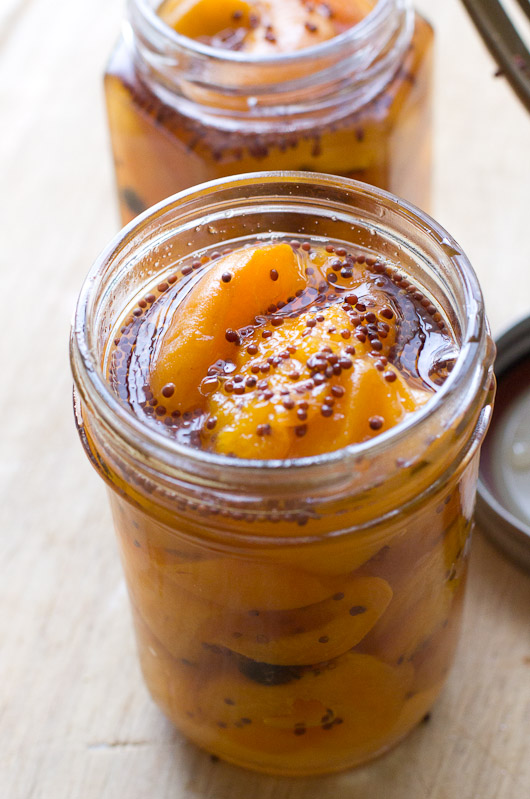
Apricot quickles
2 cups apple cider vinegar 1 ¼ cup white sugar 3 star anise 1 tablespoon mustard seed 2 whole allspice 1 ¼ lb apricots
Have 3 small mason jars cleaned and ready to fill.
In a medium sized saucepan, stir together the vinegar, sugar, anise, mustard and allspice. Bring to a boil. Once boiling, stir vigorously, lower the heat, and simmer for ten minutes. Add the apricots to the simmering water, and let cook for five to seven more minutes until the fruit is lightly softened.
Turn of the heat. Using a slotted spoon, remove the fruit from the pan and nestle into the jars. Tap the bottom of the jar against a countertop lightly to settle the fruit. Return the pickling liquid to the pan and bring once more to a boil, then simmer for five more minutes. Pour the liquid and the spices over the fruit in the jars, and let sit for at least twelve hours before eating.
American Cheese for Independence Day
