
The Cheese Blog
Carboncino: My Mixed-Milk Comfort Cheese
A goat, sheep, and cow's milk hybrid, Carboncino is a mild, creamy cheese with lemony notes, often mushroomy notes, and an ashed rind.
 Perhaps because my family has always based our trips around going to spots where we could pull over for a cheese tour or wheel, our car drives normally started in my home town of Sacramento, and ended in Sonoma or Marin. So even though I grew up in northern California, I had only been to the Mendocino coast once.
But two Sundays ago, I hopped in my car, packed my computer, a pilates roller to get those laptop writing kinks out, hiking boots, comfort cheese, other less necessary food provisions, and drove to a friend's cabin overlooking the sea. I wanted to work on a writing sample for a upcoming project (which I would love to share soon) near nature. The cheese? Well I brought it because I obviously needed it.
It was a gorgeous drive. Once past the Bay Area, Sonoma greeted me with rolling hills, vines, cows of all sizes and colors, and short, roaming trees. After I turned the Russian River corner leading to Jenner, my drive was flanked by Highway 1's drastic Pacific ocean views, cliffs, and redwoods. Then once I arrived to my little corner of Mendocino, I unpacked, grabbed my cheese and a plate, and pulled a chair onto the deck overlooking the ocean. I had underestimated the drive and was ready for fresh air and food.

The cheese I unpacked was Carboncino. Whenever I take a trip that I'd like to be as effortless as possible when I'm not writing, hiking, etc..., I bring comfort cheese. What is comfort cheese? Well, its basically whatever cheese offers you respite and simple pleasures when you need it to. What cheese do you like in your grattins, your grilled cheese, your mac n cheese, or just spread over a cracker with little else? That's your comfort cheese. It can change.
Last week Carboncino was mine. A couple weeks prior when I went on a hike I packed Comté (holds well in a back-pack). Other times I've brought Garrotxa, PennyRoyal's Boont Corners, and …. whatever felt good to me at the moment. This time I wanted something spreadable and unctuous.
A goat, sheep, and cow's milk hybrid, Carboncino is a mild, creamy cheese with lemony and often mushroomy notes, and an ashed rind. I've served it to picky family members, friends who like their cheese as soft as butter, and to myself when I want a cheese that's all about the simple pleasures.
It's made by Alta Langha, the same blessed mixed-milk people who make La Tur and Rochetta in Piedmont, Italy. I picked up this lovely disk from my friends at The Pasta Shop in Oakland. It's wonderful with a sparkling wine, an Italian Trebbiano or Vermentino, or a porch overlooking the sea.
What's your comfort cheese?
Breaking it Down: 80 Pounds of Parmesan
 Did you ever waltz by a wheel of Parmigiano Reggiano in a cheese or Italian goods shop and wander how they'd cut that huge, eighty pound wheel into tiny little chunks so you could take it home and grate it? As far as you knew, the FDA didn't allow chain saws in food establishments. Or maybe you never even realized Parm was such a sizable wheel since you bought it in small pieces. It was like that for me for a long while- kind of like the tuna fish equation. If you never saw the original fish's glorious hundred or so pounds, you'd never guess that what fit into that itty bitty canned disc came from a finned animal that could knock you, and your lifeboat, over in the water.
Well, my friends, someone's got to break down this huge beauty. It's done with daggers. The Sunday before last I co-taught the Ultimate Pairing class with Juliana Uruburu from Oakland's Pasta Shop at the Cheese School's Three Day Intensive course. When I heard that if I arrived a little early, I could witness the famed Parm break-down, I hoped on Bart as quickly as I could and stationed myself in front of that huge wheel of cheese above. Though I worked in cheese shops before, I had never been around on the day that The Wheel was broken down- something I sorely regretted.
Did you ever waltz by a wheel of Parmigiano Reggiano in a cheese or Italian goods shop and wander how they'd cut that huge, eighty pound wheel into tiny little chunks so you could take it home and grate it? As far as you knew, the FDA didn't allow chain saws in food establishments. Or maybe you never even realized Parm was such a sizable wheel since you bought it in small pieces. It was like that for me for a long while- kind of like the tuna fish equation. If you never saw the original fish's glorious hundred or so pounds, you'd never guess that what fit into that itty bitty canned disc came from a finned animal that could knock you, and your lifeboat, over in the water.
Well, my friends, someone's got to break down this huge beauty. It's done with daggers. The Sunday before last I co-taught the Ultimate Pairing class with Juliana Uruburu from Oakland's Pasta Shop at the Cheese School's Three Day Intensive course. When I heard that if I arrived a little early, I could witness the famed Parm break-down, I hoped on Bart as quickly as I could and stationed myself in front of that huge wheel of cheese above. Though I worked in cheese shops before, I had never been around on the day that The Wheel was broken down- something I sorely regretted.
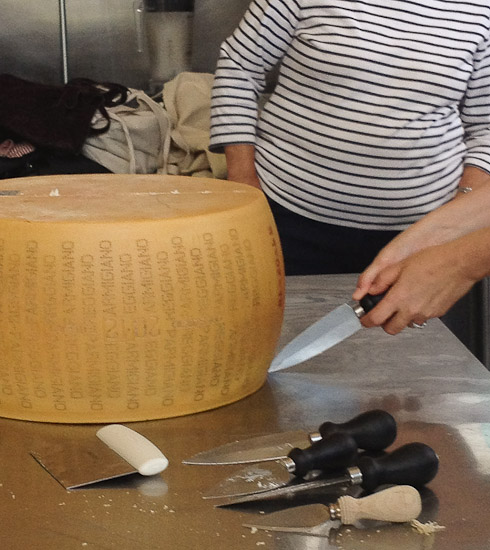 To soothe my regrets and to satisfy our Parm curiosities, here is a step-by-step photo break-down of Parmigiano Reggiano, being broken down by Juliana and the Three-Day Cheese Intensive Student Crew. Please, any cheesemongers who do this every month, every week, every Tuesday, feel free to comment any hints of the trade in the comment section! We'd love to learn more about your big wheel skills. Step 1: Score. Using that cheese dagger shown above, score a straight line all around the center of the wheel. This cheese belt will help to guide you as you dig in.
 Keep in mind: As shown by Juliana, use your whole body when you dig in with the daggers and break down any wheel of cheese. Cheesemongers can easily injure themselves if they only really on their hands, wrists, elbows, shoulders to provide the muscle. Breaking down a big wheel of cheese should be a whole body work-out.
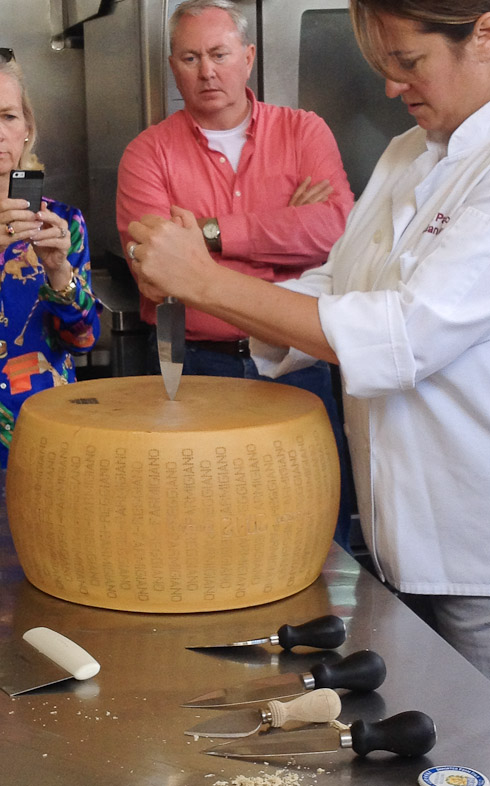 Step 2: The first attack. You go in first with the thinnest, longest dagger blade (in case you're wondering whether Juliana carries her own blades wrapped in linen around with her, she does. Don't mess with this woman) to create the initial fracture. Wiggle it around a little.
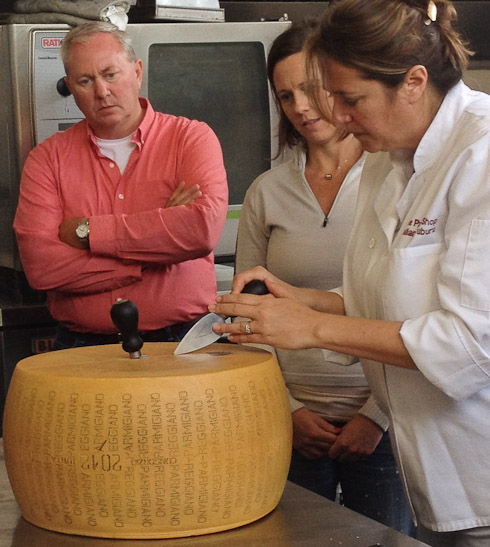 Step 3: Keeping the first blade in, reference where you earlier to scored to decide where to put the next knife. Juliana likes the next blade inserted to be shorter and wider. Not sure how other cheesemongers prefer their next hit.
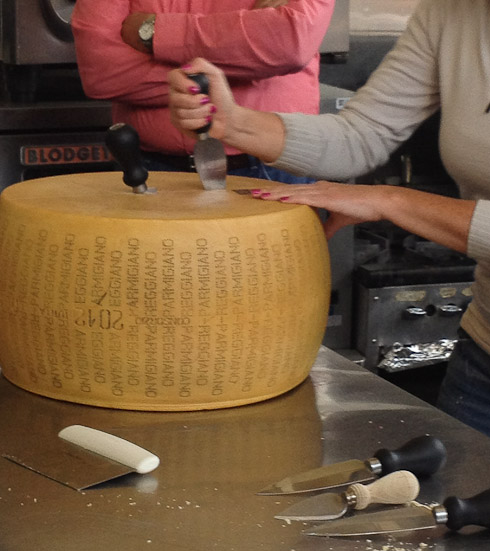 Step 4: Dig in. Insert that blade, and push it down all the way. More wiggling is encouraged. After you wedge the dagger in, push the handle away from you so the blade is helping to form a bigger crevice in the Parm.
 Step 5: Repeat: Insert, wiggle, pull, push away.
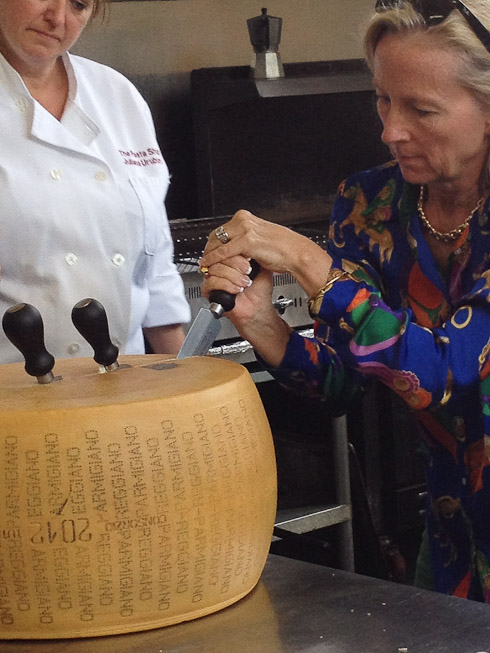 Step 6: Drag: Now get in there and round the edge. Pull that third dagger towards you and the bottom of the wheel that's resting on the table. Put your knees into it! Sometimes cheesemongers use much more than just three blades.
Step 7: Flip that wheel over and repeat. Dagger the other side and score again if need be. The point is to wedge a crevice into the cheese that will eventually part the cheese in two. Step 8: Failed to get a pic of this (sorry guys), but after both the top and bottoms are sufficiently daggered as shown, above, pull the wheel to the edge of the table and repeat Step 6 on the side of the cheese until you reach the very bottom of the wheel that rests on the table. By this point, you've formed a crevice on that extends throughout the entire cheese. Now you have a wedge that… breaks the wheel in two!
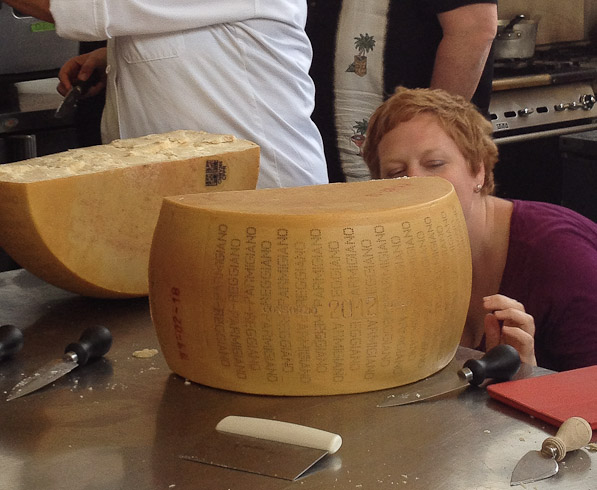 Step 8: Enjoy. Have you ever smelled a freshly cut wheel of Parm? Heaven. Even more heavenly? Tasting a fresh flake from that wheel. This is your reward.
A little advice: make friends with your local cheesemonger and ask to be there when they cut their next wheel of Parm. Some do it away from the main cheesemongering area, but many shops like to do it in front of customers so they can appreciate the glory. If your shop does it publicly, make sure to pay a visit one day when they're daggering so you can buy a chunk fresh from the wheel. It's a life changing sensory experience.
Parmesan foam with pears and hazelnuts
 In the middle of Turkey Month, otherwise known to some as November, I had the good fortune to be invited to a Parmigiano Reggiano event called Parmigiano Reggiano Academy. At first I wasn't sure I could go. I mean, I was busy researching shipping logistics and fine tuning details for the launch of a particular cheese club (ahem, read here!), trying to work with chefs schedules for writing articles, and, selling wine for Turkey Month at the shop whose wine bar I manage. I was a tad zonked. But then I thought, if I can't take a break for Parmigiano Academy, who am I, really?
If I said no to a night of wine pairing, eating, and tasting the difference between 12, 18, and 36 month-old Parm, I was sure the people handing out cheese geek cards would ask me to turn mine back in. A bigger fear was that they would ask me to turn back in the cape and leotard I plan to wear to CheeseCon (i.e. the American Cheese Conference). So,... I said yes.
And it was delicious.
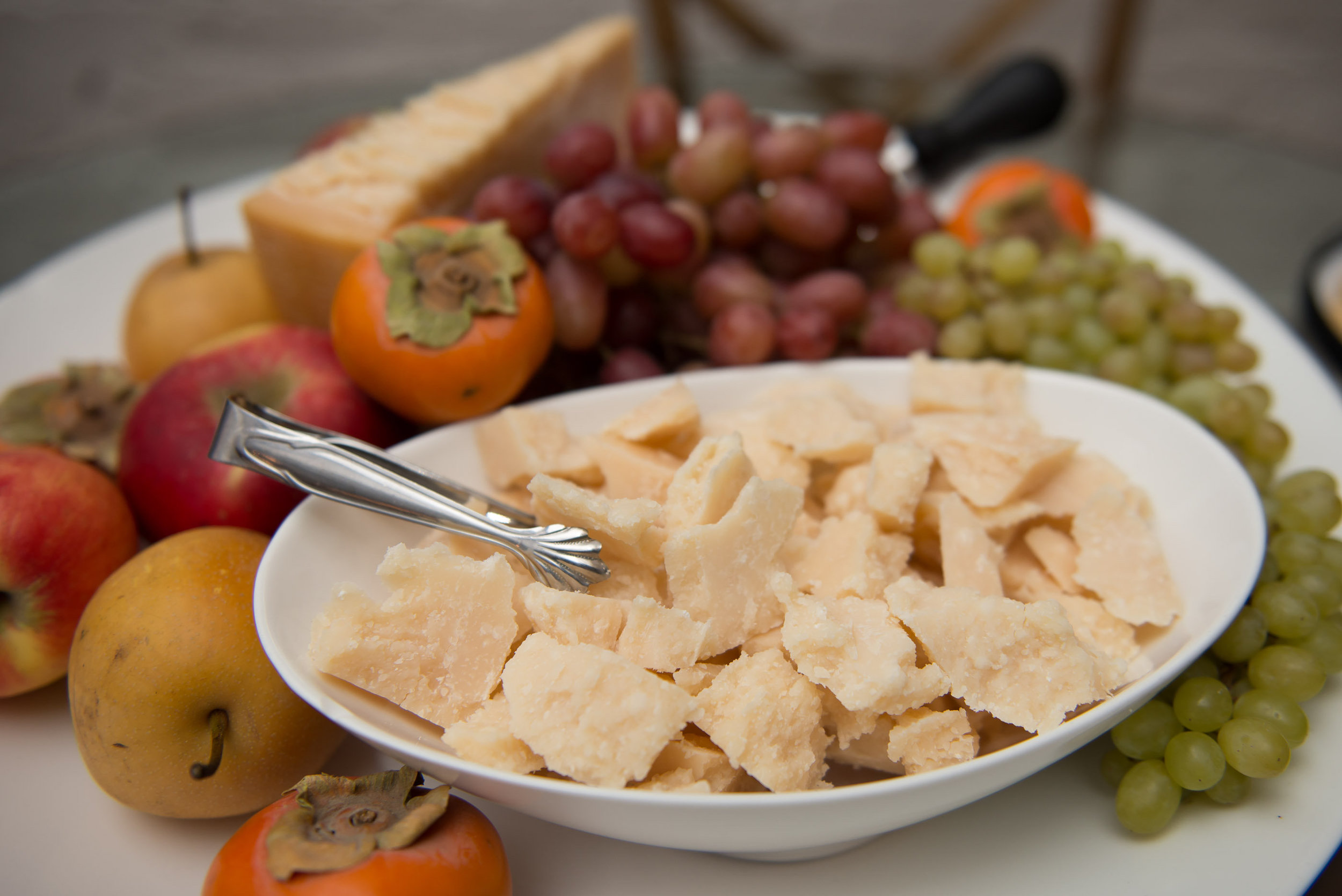
My favorite part of the event was the eating. Drinking- also lovely. I arrived, was handed a glass of wine, and we were sent around tables to explore the different Parm ages. I may have hit one table three times.
And then they passed the hors d'oeuvres. Cue holiday party.

Chef Jordan of Jordan's Kitchen created three dishes for the night. My favorite, and my Facebook and instagram followers favorite (says the "like" buttons), was sliced pears, rosemary, hazelnut, and parmesan foam.
This would be a fabulous dish for a holiday party served while people are walking around with a glass of sparkling in their hand. Chef Jordan served it in a ramekin, but I think I might serve it in a shooter glass, and small dice the pears after searing so a spoon isn't needed.
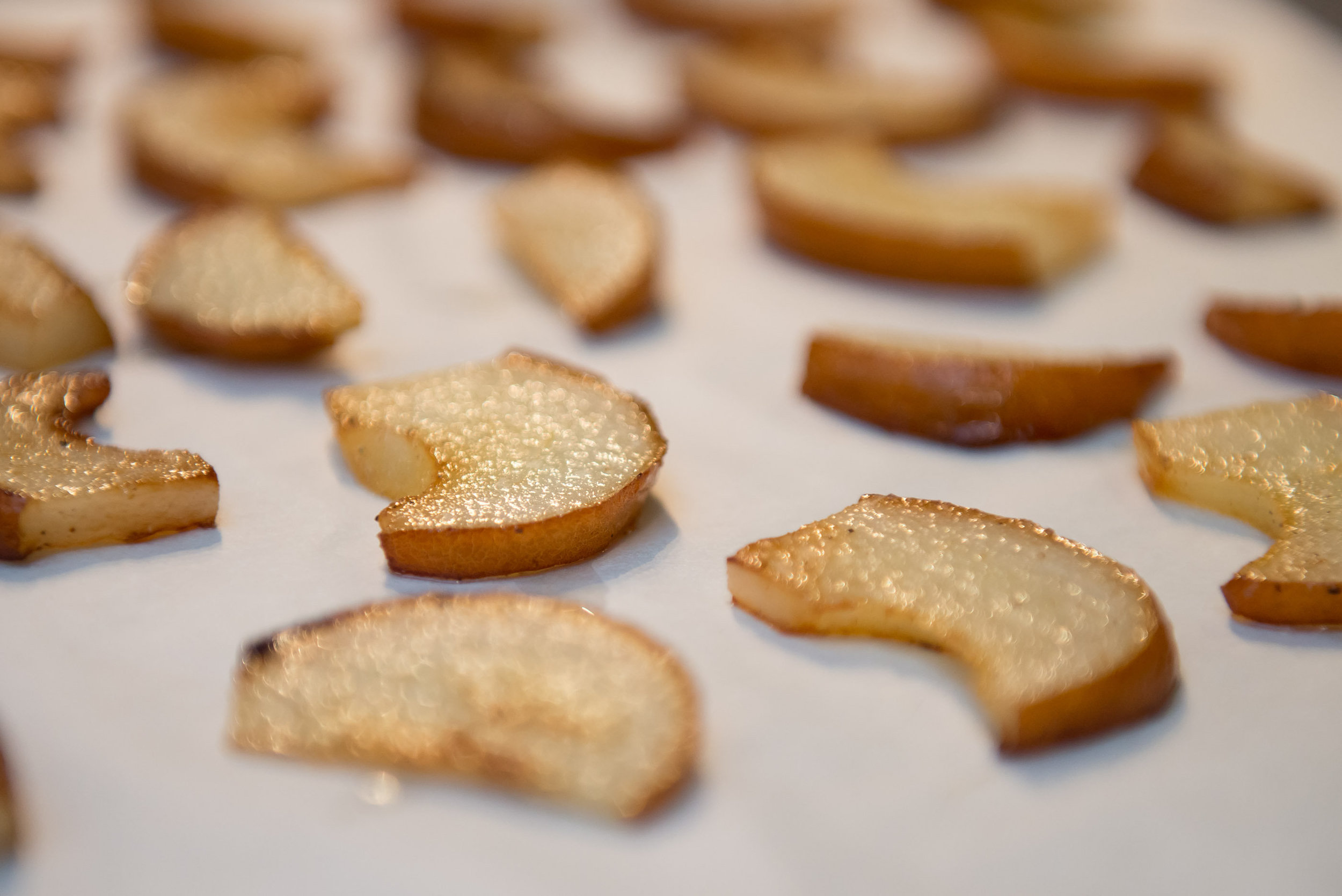
Thank you Parm Academy and Chef Jordan for sharing the recipe! Winter parties are calling.
Sliced pear with hazelnuts, rosemary and Parmigiano foam
2 pears, ripe but firm to the touch
¼ cup hazelnuts, toasted and chopped
1 ½ teaspoons rosemary, very finely chopped
2-3 tablespoons Balsamic vinegar
4 tablespoons Extra Virgin Olive Oil
Salt and freshly cracked black pepper to taste
Foam
1 cup cream
1 cup milk
2 cups Parmigiano, coarsely grated
Pinch of nutmeg
Pinch of freshly cracked black pepper
¼ - ½ teaspoon salt
1 teaspoon soy lecithin (INYIB note- deemed optional, but helps keep smooth, if don't use, make as close to serving as possible)
In a saucepan combine the cream, milk, cheese, nutmeg and black pepper and bring to a simmer. Simmer until the cheese is completely melted. Pour the mixture into a blender and puree until smooth. Strain the cheese sauce and season with salt to taste. Measure one and one half cups of the cheese sauce and return it to the saucepan. Stir in the soy lecithin and keep warm (INYIB note- soy lecithin is optional, but helps keep sauce smooth, if don't use, make as close to serving as possible).
Halve and core the pears and then slice them into one-quarter inch pieces (you should have about twenty four slices). Heat two sauté pans over medium heat and coat them with olive oil. Cook the pears on both sides until golden brown, about two minutes per side. Season with salt and black pepper to taste and remove to a paper towel to blot any excess oil. Using a hand held immersion blender, froth the cheese sauce until a nice, frothy foam develops. In a shallow bowl plate a teaspoon or two of the foam and top with a piece of the pear. Using a pastry brush, glaze the pear with a touch of Balsamic vinegar and top with chopped hazelnuts, and a pinch of rosemary.

All photos by Stephanie Secrest.
Lastly, have you heard I launched the "It's Not You, It's Brie" cheese club with Scardello Cheese? True story. Read more here.
Robiola di Roccaverano- A cheese & leaf love
If Martha Stewart ever got a hold of a Robiola di Roccaverano, I'm pretty sure she'd mandate every cheese be wrapped in leaves before being served in her presence. This leaf-on-cheese action is cuter than a toddler walking a puppy. It's more adorable than Zooey Deschanel watching a toddler walk a puppy. It proves that leaves and cheese are made to be together.

If Martha Stewart ever got a hold of a Robiola di Roccaverano, I'm pretty sure she'd mandate every cheese be wrapped in leaves before being served in her presence. This leaf-on-cheese action is cuter than a toddler walking a puppy. It's more adorable than Zooey Deschanel watching a toddler walk a puppy. It proves that leaves and cheese are made to be together.
Leaves are the perfect aging utensil. They make a delicate rind. They enhance flavors gently. And, as Martha would approve of, leaves are nature's perfect cheese wrapper. Best of all, when wrapped around a cheese, they make you feel like you're about to go on a long back-packing trip accross the Piedmont hills.
Even better than best of all? The likelihood that you'll find a leaf-wrapped Robiola near you is high. They come in all leafs from cabbage to chestnut.
This particular above beauty, Robiola di Roccaverano, is made in the Piedmont foothills. Some are mixed milk, but the one in the shot above is pure goat's milk. After the cheese is made, it's wrapped in chestnut leaves and left to mature. Underneath the leaf, a light rind typical of a Robiola forms- thin, ripply, white and golden- that's inspired by the loose leaf wrapping and the Geotrichum Candidum mold that's added to the milk after pasteurization. The flavors range greatly. When first made, it tastes lively and lemony. As the cheese ages, it picks up a lightly funky bite that says, "I came from a goat, and I am proud."
I love serving this style of cheese at parties, because even when cut in half (and that's how I often buy it, as some are a little pricey) the leaf is all the adornment this little cheese needs to make a plate pretty.
When putting the Robiola out to eat, keep the leaves on- let guests peel them back, it feels more like a party. Serve with dried or fresh fruit- dried cherries, figs, sliced prunes, or fresh figs or apples and a crusty, hearty bread. Added bonus, put a small dish of honey out for guests to drizzle over the cheese.
Other leaf-wrapped Robiolas to try:
Robiola di Capra in Foglie di Castagno
What's your favorite leaf wrapped cheese or Robiola?
Lastly, if you're in the bay area, I'd love to see you at an upcoming class!
Burrata Plea: Consider Fall. And Winter. And Finter.
As the weather grows colder in the rest of the country (the San Francisco bay area just seems to be getting hotter, let's leave us out of this), I've been reminded of one burrata thing. Burrata is not seasonal. Believe it or not, my summer caprese salad lovers, people make burrata in the fall. Even the winter. Sometimes even in that period between the two, known as finter.
 As the weather grows colder in the rest of the country (the San Francisco bay area just seems to be getting hotter, let's leave us out of this), I've been reminded of one burrata thing. Burrata is not seasonal. Believe it or not, my summer caprese salad lovers, people make burrata in the fall. Even the winter. Sometimes even in that period between the two, known as finter.
This post is a plea to keep the burrata love going.
Burrata, a fresh cheese from Southern Italy, is mozzarella on another level. It is a freshly stuffed sheet of mozzarella wrapped around mozzarella curds mixed with cream. Yes, cream. It is a great big fun ball of delicious creaminess. It is nearly impossible not to like. Most who do not like burrata also do not like puppies or kittens, even if they don't have to take care of them.
Over the summer I've had some great burratas around town- this is the time that chefs seem to serve it. Burrata loves tomatoes. Tomatoes love burratas. But a good burrata also likes other foods not in the nightshade family.
Three of my favorite burratas (all local- burrata is so fresh that it can go bad within days, so I get it as near home as I can) complete this post. But first, here are a few suggestions on how to keep the burrata love going past the summer season. Because it deserves it. Don't pull away.
In general, I'm okay with putting almost anything delicious with burrata as an appetizer. But always keep this cheese itself simple. If you doll up some veggies to go with it, spice the veggies, not the cheese. Just drizzle the burrata with olive oil, sprinkle with sea salt and freshly ground pepper. It is easily overwhelmed. This goes for all pairing suggestions below.
Figs- Either use fresh figs or reconsitute dried figs in wine poaching liquid (see picture above).
Roasted root vegetables- Serve burrata over a bed of warm roasted butternut sqaush and carrots cooked with olive oil, balsamic vinegar and thyme.
Bruschetta- Spoon over grilled or toasted bread rubbed with olive oil and a garlic clove.
Persimmons- Top a persimmon-frisée salad dressed in a tarragon and lemon vinaigrette with this cheese. Sprinkle with pomegranate seeds for crunch.
Garbanzo beans- Top chick peas dressed with rosemary, time and garlic with oil-cured black olives and burrata.
Three of my faves:
Gioia: The first local one I tried, from San Diego. A thin mozzarella sheet wraps the curds in tight. Comes in a one pound tub. Yes, you can eat all of it.
Maplebrook: Pictured above, from Vermont. This one has a thicker mozz shell than the Gioia and a slightly looser curd, and is just as delicious. Comes packed in water.
Di Stefano It also oozes in the right places. From southern California
How do you like serving your burrata? Any locals that you love?
Roccolo Cheese: The Holy Lombardic Trinity
Roccolo is a dream cheese. It is a holy trinity cheese. It is soft and firm and crumbly all in one. It tastes crazily varied from rind to center. It smells a little different in spots.
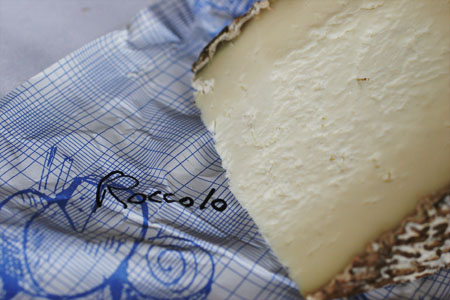 Roccolo is a holy trinity cheese. It is soft and firm and crumbly all in one. It tastes crazily varied from rind to center. It smells a little different in spots. In other words, its three distinct layers offer a cheese lover three cheeses for, well, .... more than a fraction of the price of a block of colby, but you get more than just orange and yellow cheese that tastes nearly the same no matter the hue.
Roccolo comes from Lombardy, Italy. Made by cheesemaking enterprise Arrigoni Valtaleggio, a large family company that helped to spearhead Tallegio imports, Roccolo is a a natural rind cow's milk cheese whose name translates to "bird snare." The cheese's rind echos the hue of the local bird hunter's stone hut they used to set camp in in earlier times.
After being brined in a salt water bath, Roccolo is set to age on pine boards and flipped and rubbed daily with a little extra salt water brine to bring out earthy, B.linen bacteria like those found in other washed rinds.
Yet pick up a slice of Roccolo and give it a good sniff, and you'll only find the scent somewhat similiar to other semi-soft washed rinds. Rather than having a strong, sweetly blaring scent, Roccolo has an earthier scent like a mushroom that's been foraged after a weeks of rain, and maybe dropped in a little dirt before being put in the straw mushroom basket.
Its taste is quite distinct too. It ranges from buttermilk to butter to mushrooms, to oysters to salty beef fat. The center is a little fresher tasting, and the further you get towards the brown, moldy rind, the funkier it gets.
The most interior part of the paste is crumbly and off-white. The layer beyond is smooth and the hue of that manilla folder a teacher holds in elementary school when presenting test scores to parents on Parent-Teacher night. The outside is brown with white and grey mold and an occasional yellow streak. I eat the rind, mold and all. I know that people are washing it and flipping it everyday and this might scare a folk or two who are concerned with others fondling their cheese, but the rind adds so much pizzaz to the tasting experience. If you like less funk, skip the rind.
I like this cheese with a dry Riesling or a balanced, oaked Chardonnay, Viognier or Roussane-Grenache Blanc blend. Or a Champagne. Mmmm......
If Roccolo isn't available near you, also try Salva Cremesco or Tomme Crayeuse, both cow's milk cheeses with an earthy taste and varied texture (although a little creamier than Roccolo).
Any super-layered cheese favorites?
Italian Cheese & Regional Wine Pairing Class
 Just in case you've been aching to brush up on your mixed or Buffalo milk cheeses or have been wishing you could learn about the simple art of Italian cheese and wine pairing by tasting eight cheeses and five-plus wines in two hours, here's a little something that might entice- a course about Italian cheese and the wines that adore them, this upcoming Thursday, in Berkeley.
The write-up and some hints of the cheeses to come are below, and I would love to see you there. I'll be your teacher. Reservations required.
"Like peanut butter and chocolate, garlic and anchovies and whiskey and hangovers, Italian cheese and wine were born to be together. From Piedmont to Puglia, Italian regions focus on these traditional styles of cheese and winemaking that make the most of their area's bounty, and in this class, you'll learn of their glories in an informative and delicious manner.
Join Kirstin Jackson, Solano Cellars cheese instructor and author of the cheese website ItsNotYouItsBrie.com to learn the essentials of wine and cheese harmony by tasting through Italian regional cheeses and the wines that love them.
Class attendance is limited to 23. "
Just some of the cheeses that will be featured:
Gioia Burrata
Caseificio Dell'Alta Langa La Tur
Toma Piemontese
Quadrilello di Buffala
Second post of Kitchen Curds coming next week, written by "It's Not You, it's Brie" group and goat photographer, Molly.