

The Cheese Blog

On Costumes, Hip Hop & His Most Surprising Cheddar: 5 Questions with Cheddar Author Gordon Edgar
A strong believer that the world needs humor along with its cheese and booze, I'm a big fan of Gordon Edgar's books. They're cultural and well-researched, super interesting, and funny. And Gordon himself is pretty awesome too. In honor of the publication of his second book, Cheddar: A Journey to the Heart of America's Most Iconic Cheese, Gordon agreed to an interview. Below I ask him about hip hop's use of cheddar in lyrics, cheese parties and cheddar costumes, and his favorite cheddar pairings (spoiler- a piece of cheese and his face).

Gordon sharing the aged cheddar love at Grafton, photo by Shelburne Farms
A strong believer that the world needs humor along with its cheese and booze, I'm a big fan of Gordon Edgar's books. They're cultural and well-researched, super interesting, and funny. And Gordon himself is pretty awesome too. In honor of the publication of his second book, Cheddar: A Journey to the Heart of America's Most Iconic Cheese, Gordon agreed to an interview. Below I ask him about hip hop's use of cheese in lyrics, cheese parties and costumes, and his favorite pairings (spoiler- a piece of cheese and his face).
I present you with 5 Questions with Gordan Edgar. Thank you, Gordon!

The cheese board from our tasting. I may have slightly misplaced our notes from that night after the wine was unleashed but I can tell you that we loved fig jam with English traditional versions.
1. You've been all over the country promoting, with events that included driving around Wisconsin in a school bus to holding vertical tastings of chedar to see how it ages. In what region have you felt the most cheddar enthusiasm and did it involve costumes?
The cheddar bus trip was an amazing experience. Jeanne Carpenter organized it and it brought out cheddar lovers from all over the place. We started at Larry’s Market and then got to go on tours at Henning’s, LaClare, and Widmer’s – three of my favorite places to go in Wisconsin – and then I blah blah’d at folks between stops. CCP Elizabeth Nerud even recited an impromptu cheese poem at the end of the night while we rolled back to Milwaukee.
Vermont was pretty incredible too. Three events in 24 hours! Grafton, Provisions, Shelburne Farms, Cabot and Jasper Hill all collaborated to help make it happen. I did a talk at University of Vermont where I was honored by Professor Paul Kindstedt showing up. Then almost killed myself – as Californians driving in Vermont black ice conditions are wont to do – driving to Provisions to talk with about almost 100 cheese professionals. As soon as that was done I went to Brattleboro for a cheddar
party were I read a poem with local journalist and ex-monger Wendy Levy that likely had not been read aloud for 125 years or so. Costumes would have been the only thing that could have made that better, I wish I had talked to you beforehand.
The last time costumes and cheddar came into play historically that I know of was in 1951, the cheddar centennial in Rome, New York that commemorated the 100 year anniversary of America’s first cheddar factory. Cheese dignitaries came in from across country and the Rome (New York) Theater Guild produced a play about the life of Jesse Williams, “Father of Cheese Factories.” Alas, there was no revival of the performance for the 150 year anniversary. Let’s get ready for 2051, people!
2. What is your top favorite cheddar combo of all time? Feel free to say butter, bread and a pan, or go grand.
Yeah, it really is piece of cheddar and my face. I had a co-worker who used to just come over to the cheese counter during her break, buy a ¼ lb of cheddar, unwrap it, and just start chomping for lunch every day. I was in awe the first time I saw that and still think it is the ultimate way to enjoy a cheese.
If I am going to do cheddar for dinner, I’d add tart apples, dark honey, and sourdough bread or rustic crackers. For cooking, a medium sharp cheddar along with a little brie and fridge odds and ends for mac and cheese. Mmmmmmm.
3. You know a lot about cheddar. Does the hip hop world adopting the word "cheese," or more often "cheddar" as a euphemism for money make since to you? Why or don't you think "cheddar" in particular fits? Would chevre work too?
I actually wrote about this for Cheddar, but cut that section because -- while I can claim great knowledge and nuance about punk -- I am more of a tourist to hip hop. In punk, historically speaking, cheese references are usually about the government cheese that was available during the ‘80s at a time when there was a major surplus of milk and dairy farmers were getting paid off to cull their herds and get out of the milk business. I have heard that the hip hop use of “cheddar” has the same roots, but I couldn’t swear that’s true.
There is a historic use of staple, common food as a stand-in for money: dough, bread, lettuce, etc. That’s why “cheddar” works in this context but chevre doesn’t right now. It’s still exotic to most people. So, until there’s a bigger hip hop scene in Sonoma or Napa counties, or goat cheese mainstreams to urban areas, chevre would probably be used to signify something else.

4. You've tasted a lot of cheese in your history of cheesemongering and writing. While tasting for this book, which cheddar surprised you the most and why?
One that surprised me after I wrote the book I was shocked by the Red Barn Weis Heritage Cheddar from Wisconsin. Jeanne Carpenter of Cheese Underground arranged a bus trip of three Wisconsin cheesemakers and I read from my book between stops [side note from Kirstin, Jeanne, you rock]. Then we did a class together at Metcalfe’s Market in Madison. I had never tasted this cheese until we were doing the class and I fell in love immediately.
When researching Cheddar, I was trying to track down who made the last clothbound cheddar in America before it went extinct so I could see how many years this country had to do without. Sid Cook of Carr Valley pointed out to me that it wasn’t that clothbound cheese went extinct, it was the cave-aging that did. Sid, and a few other producers, were still cloth-wrapping cheese but aging them in wax.
The Weis Heritage Cheddar is this style and one of the best and most distinctive cheddars made in this country. All the milk comes from family-owned and operated farms of under 70 cows and the dairies are all certified humane. Plus, as far as I can tell, Red Barn Family Farms make the last raw milk cheddar in Wisconsin.
5. Lastly, if your last, multi-coursed, meal on planet earth had to be made entirely of Cheddar, what would you eat?
Appetizer: Cheese crisps made of Rumiano mild cheddar topped with two year Grafton Cheddar medallions.
Main: Center cut of Quicke’s two year vintage clothbound cheddar served over two year Widmer spears and an extra sharp Tillamook cheddar dipping sauce on the side.
Dessert: Wedges of sweet-sharp Prairie Breeze.
This would be pretty intense, but now that I’ve written it down, I kind of want to try it.
Thank you again, Gordon! There is much to be said for a man who enjoys a center cut.
Melt: the Art of Macaroni and Cheese, An Interview
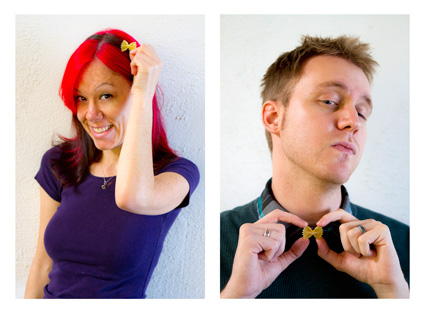
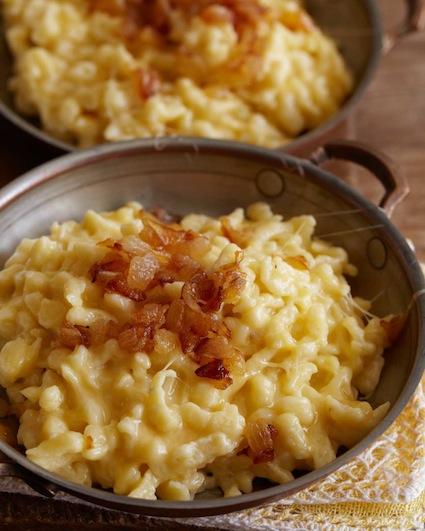 In the theme of the general cheesiness of "It's Not You, It's Brie" and the blog's series of interviews with people in the Cheese Biz who are writing and educating about, making, selling, and cooking with cheese, I'd like to introduce you to my friends, Stephanie Stiavetti and Garrett McCord. They're authors of very popular blogs, writers who have been published in NPR's Kitchen Window and beyond, and next Tuesday, they are publishing a cookbook.
Melt: the Art of Macaroni and Cheese is about... Mmm hmm. Mac n' cheese. But not just any mac n' cheese. Artisan mac n' cheese. The book is a wealth of recipes that combine artisan cheese with hi and lo ingredients that make them sing in the often cooked and bubbly, browned-top form. Not to leave the classic world behind, Stephanie and Garrett include traditional recipes like a creamy stovetop classic, but they mix it up and introduce inventive dishes like Humboldt Fog with Grilled Peaches and Orzo. My roommate, who commandeered my copy, is still lamenting the end of stonefruit season because of this recipe that combined sweet peaches with the bloomy-rinded goat cheeses and mint. In full disclosure, I also consulted for the book. We talked cheese styles and I helped with the food and wine pairing recs that follow recipes. It was very fun. Following is the interview.
Thank you S & G for making the time. Have fun on your book tour!
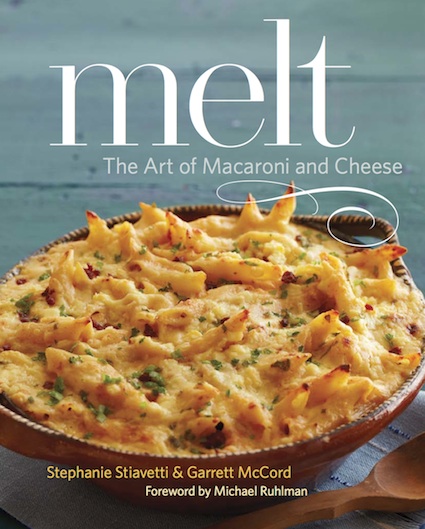
This is your first cookbook. What surprised you the most about writing a cookbook, and what was exactly how you expected it to be? Did you realize you'd have month's worth supplies of mac n cheese in your freezer after testing recipes, for example?
Garrett: I think two things I didn't expect were the stresses of testing and the sheer amount of food. We had about 85 testers working with us who were going through the recipes. It was like herding 85 cats with food allergies. Still, it was a wonderful experience because I got that chance to know a lot of bloggers, moms, students, chefs, and other people passionate about food. They were testing our recipes and taking them to funerals, baby showers, and office potlucks and telling us stories from their lives. It was enriching and enthralling.
As for the sheer amount of food? I had a rule: Tuesdays, Thursdays, and Saturdays there is food at my house. Come by.
Steph: I think that I was most surprised by how many moving parts there were. Working with Garrett made the process a lot easier, as we could share the load. I'm eternally grateful to him for wrangling the testing process - it was one of those things that was best handled by one person, and he jumped in and took the bull by the cojones. I enjoyed the recipe testing process a lot, which I was expecting. And the writing was a lot easier than I thought, because the pressure of such a large project really pushed me to perform.

You both had been exploring artisan cheese on your own, in your writing, on your blog, for some time now. What made you want to write a cookbook on cooking with artisan cheese in particular? And why did you choose noodles as it's accomplice, rather than, say, write a book about how to do melt cheese between two slices of toasted bread?
Steph: Back in the early days of the book process, Garrett and I were on the phone tossing out ideas for our book proposal. One of us came up with the cheese angle, and then the other person said, "Wait. What about macaroni and cheese?" We looked up all the other mac & cheese books on the market - at the time there were only one or two - and they were very much downhome-type cookbooks with recipes like "Yankee Doodle Lobster Mac," and other dishes like that. Our cooking styles are a little more adventurous, so we knew we didn't necessarily want to cater to that demographic.
We both love cheese, so it made sense to expand the mac & cheese idea to include a wide variety of cheeses, but as we wrote the proposal, the topic sort of focused itself to primarily involve the artisan cheese world. It was really neat to watch it evolve, as if it had a life of its own.
You two have some very adventures recipes in your book- this isn't just an ordinary mac n cheese book. You must have learned a lot about what flavor combos work and don't. Why did you decide to go beyond the norm?
Steph: We realized early on that if we were going to cook with artisan cheese, we were really going to have to "bring it" with the recipe style. When you're working with fine cheese at a higher price point, you don't want people to feel meeeehhhhhh about your dishes. And with macaroni and cheese, there are pretty much two ways people are familiar with it: creamy or baked. We really wanted to elevate the American classic by thinking out of the [blue] box, so to speak, and that pushed us to explore many global flavors that people might not automatically associate with macaroni and cheese.
While we have lots of classic dishes in Melt, we also borrowed flavors from a vast number of cuisines: Greek, Mexican, Indian, French, and even Chinese cooking made an impression on our recipe developing process. Some of my favorite dishes blend more than one culture's cooking style. And of course there were lots of flavor combos that just didn't work and ended up on the cutting room floor. Like, thyme and soy sauce do NOT go well together. ;)
With so much adventure comes a lot of experimentation. What flavor combos didn't work? Any absolute bombs? Any heartbreaks?
Garrett: There's a great polenta recipe with Sottocenere al Tartufo that didn't make it into the book. I was bummed about that. There was also a spiced red wine bechamel sauce that, oh god, was so bad. It smelled like Cthulhu's butthole. I actually pitched it into the yard because I didn't want it to go down the drain and continue fouling my kitchen with the stench.
I also learned you have to treat chocolate pasta as a savory item. The cocoa makes it bitter, not sweet. Going down the sweet route just won't yield the delightful results a savory sauce will.

With two authors, what was your creative process in writing this book? Did you discuss base flavors together, or play around with recipe ideas and techniques separately?
Garrett: Steph and I balance each other out quite well. We both have our own strengths and weaknesses, not just in cooking, but in organizational skills, tech skills, editing, writing, everything. So when one of us needed help or felt weak in a certain area, the other would leap right in. This isn't to say we didn't clash or have a few debates (with only one major fight, but perhaps too much bechamel will do that), but each resulted in the book being better than it was before and us understanding each other better.
We worked off of Google Docs so we could see and review each other's work constantly. A master recipe list was written up by us both and we would add or edit to it often, usually leaving comments for the other and having the phone call when it was needed. We also made sure to connect in person at least once a month.
Steph: In the beginning, we spent a fair amount of time on the phone or in person, dreaming up and testing flavor combinations. When we first wrote the proposal we had to come up with a nearly complete list of recipes, which changed a ton over the course writing the book. I'd say we tossed at least half the recipe from that original list, or morphed them into something else.
A lot of the recipes in Melt are true collaborations, meaning one of us would call the other and say, "Hey, what do you think of…" And then we would each weigh in, adding and extracting ingredients and methods during the conversation. Sometimes recipes would get handed off from one of us to the other, after realizing that it played upon the strengths of the other person. There's even one recipe in the book that someone didn't want to make, but then after much, um, discussion, they ended up making it anyways. And they loved it despite their vocal hatred for the dish in the beginning. Ha.
There are actually some parts of the book where we can't figure out who wrote what, because our writing and editing styles blend so well. That's definitely a trip - to read a passage and not be able to remember who originally wrote it. How did Garrett's pastry background play into the book?
Garrett: When I worked in pastry, caramel was the albatross around my neck. I burned it. A lot. In fact, at one kitchen the cooks and chefs would call out that anytime something burned, "Garrett's making caramel!" My pastry instructor, Elaine Baker, made me make caramel every. Single. DAY. Now I can do it in my sleep - both wet and dry caramels, by the way. So of course I was hellbent on adding it in to Melt. I made sure that the instructions for these things that used to intimidate me were easy and approachable. There's nothing to be scared of with baking techniques when you've read through the directions. It'll go as directed and, poof, it's done!
The book has a lot of favorite ingredients, like rhubarb and cacao nibs. I also got to deep-fry, which I used to never do at home and now have started doing too much.
As an author who is still on Level 1 of social media, I'm amazed and inspired by the ways you two are going about promoting this book on social media and beyond. I heard the other day that your book even got picked up by Walmart and Target. Wow. Congratulations! What would you advise writers with books who would like to get placement as great as yours, and, can you talk about some of the ways that you're promoting your book that you're especially excited about?
Steph: To be truthful, I have no idea how the book got picked up by Walmart. ;) I chalk that up to the awesome sales people at our publisher, Little, Brown & Co. What we did have a hand in, however, is the social media energy that is starting to stir. But we can't really take the credit for that, because it's due to our amazing circle of writing and blogging friends spreading the word.
My advice to writers is to ensconce yourself in a broad circle of media-savvy colleagues, making friends and doing all you can for the people in that group. Be friendly, generous, and genuine, reaching out whenever someone else needs help with promotion or anything to do with their own projects. That good will always comes back in spades. So go find your tribe and love them with all you've got. The organic excitement of your friends is more infectious than any viral campaign cooked up by a publicist! Lastly, if any readers want to catch you around the country, where can they look to see if you'll be in their area?
Garrett: We'll be doing the West Coast tour circuit, and hopefully diving into New York, South Carolina, Missouri, and a few other spots. We're still working out the details, so stay tuned to the Melt website. =)
Cheese Lit: Books for the Cheese-Obsessed
It’s an exciting cheese world out there, dairy girls and boys, and there are a plethora of books that explore its magnitude. So put down that slice of Alpine-style, pasture-fed raw milk cheese that’s only made from April to October for long enough to pick up one of these reads. Reconsider that slice with one of these books in hand, and you’ll feel closer to that fermented milk than you ever imagined you would.
 I'm off to the American Cheese Society Conference in North Carolina after teaching a California Cheese & Wine Class at the Cheese School of San Francisco this week. While I'm exhausting my capabilities to exist in weather warmer than 90 degrees or with any sort of humidity whatsoever (Bay Area weather pansy, right here) and enjoying the culinary wealth of the south, I wanted to give you a little cheese for thought. Before I do though, I want to congratulate my good friend Chef Fromager Tia Keenan on opening Murray's Cheese Bar last week! I couldn't imagine a better or more creative and skilled person to design and run this amazing program. Quick, to New York! But until then....
Introducing some of my favorite Cheese Lit.
It’s an exciting cheese world out there, dairy girls and boys, and there are a plethora of books that explore its magnitude. So put down that slice of Alpine-style, pasture-fed raw milk cheese that’s only made from April to October for long enough to pick up one of these reads. Reconsider that slice with one of these books in hand, and you’ll feel closer to that fermented milk than you ever imagined you would.
The following are a few of my favorite Cheese Lit books. When I say “lit,” I mean, well,… non-fiction or memoir styles. I’ve skipped the guidebooks and tutorials this time in favor of books focusing on odes to cheese, history, politics, and homages. These guys may be consulted for some general advice, but they’re overall better for cuddling up with for a good read (cat or dog at feet optional). Cheese guides to come!

The Cheese Room, Patricia Michelson
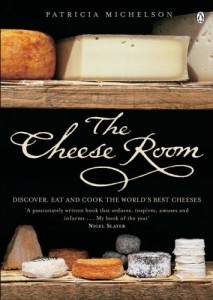
“The first taste of autumn for me comes when the cheese table in my shop displays Vacherin Mont D’Or.” How can you not want a book that starts with this line? It’s the ooziest, most loving cheese on the planet, and Michelson admits it right off the bat. The writer and owner of one of the best cheese shops in London follows up with a recipe for this luscious cheese, baked. Such deliciousness repeats.
The Cheese Chronicles: A Journey Through the Making and Selling of Cheese in America, From Field to Farm to Table, Liz Thorpe
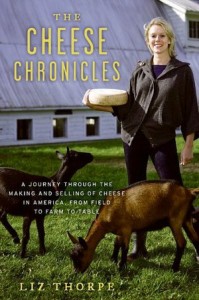 This fabulous writer and former Murray’s Cheese VP explains why she switched from a comfy desk job to standing long, long hours on her feet rubbing cheese rinds and flipping cheddars beneath the streets of Manhattan. She takes you on trips with her to train French Laundry’s staff. She tells how she fell in love with dairy. And she does it all with beautiful language and humor.
Cheesemonger: A Life on the Wedge, by Gordon Edgar
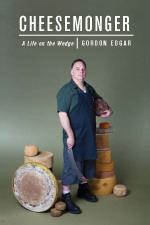
Here’s an author that doesn’t shy away from humor or politics. Edgar explores cheese culture and its reach in society by considering its often hidden role in our lives. He discusses conservative versus liberal cheesemakers, bridges the seemingly wide gap between cheese and punk culture, and looks at big farm business in the U.S. Entertaining and informing.
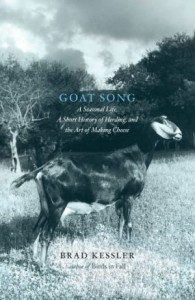
Goat Song: A Seasonal Life, A Short History of Herding, and the Art of Making Cheese, Brad Kessler
(see photo on top of post)
You may not know it yet, but you do want to know about goat’s mating life, trust me. From the point when he learns he needs to bring a stud to the farm in order to get his girls lactating to his making first tome, Kessler details his introduction to farm culture and how he fell in love with the goat. Vivid and heartwarming.
Swiss Cheese, Dominik Flammer
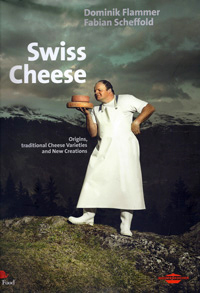
I admit, this is extremely hard to find in English. But it’s worth the hunt for the pictures alone. Gorgeous. And inspired. And I’m still looking for my copy. I’ve only been lucky enough to skim over this one at a friend’s and skim the beautiful photos with my fingertips. (The writer recently informed me it's much easier to get in Switzerland and France... so my idea... check out those country's Amazon lists from time to time too).
Cheese Lit: Books for the Cheese-Obsessed originally published on the Menuism Cheese Blog.
Updates from the conference to come, and Lastly – My book has a Facebook page! And the profile photo? A shot of my book cover! Publishes November 6th, but you can like my little ol page whenever you want!