
The Cheese Blog

French Wine & Cheese Guide Poster Giveaway: Or, What Happens When an Architecture Professor Submits to his Wine & Cheese ❤️

How did an architecture professor get so into cheese and wine maps, you ask? I did too, and the answer is below! David Gissen and I first met while I managed the wine bar at Solano Cellars and pretty quickly became friends. Not long after, he published the French wine metro map, which is as awesome as it sounds. Just recently, he released a new guide- the Cheeses of France: traditional styles with regional wine pairings with his own beautiful cheese drawings, which I think you'll like it as much as I do. It rounds up the major wheels of France and matches them to the wine that regionally adore them in a clear and beautiful way (this will shortly be going on my office wall). To celebrate the launch of the guide, I not only interviewed David below, we're hosting a giveaway!
The Giveaway:
Leave me a comment telling me your favorite French cheese and wine pairing on my Instagram page and tag a friend. That's it. Early next week I blindly pick a winner. Good luck.
Enjoy my interview with Professor David Gissen, below, and my answer to his question at the end, what are my favorite French wine and cheese pairings.
1. How the hell did an architecture professor get so into cheese and wine maps?!
I grew up in the center of a city with beautiful old buildings and which nurtured an interest in architecture, cities and history. My mother was an artist and was passionate about exploring food globally, and my aunt and uncle were very passionate about exploring European wines. My mother’s family comes from a wine-growing region in Europe and once owned a business that sold and imported wine and spirits. Though my career is primarily within architecture and education, these other things were always part of my life.
About eight years ago the publisher Steve de Long contacted me about transforming a diagram that I made, that looks a bit like a subway map, and that easily explains French wine geography, into a more formal and commercially available map. Steve is not only an acclaimed publisher of wine maps, but he also studied architecture and with many of my mentors and friends. That initial project that we completed became the Metro Wine Map of France and it had a type of ripple effect in the wine world, French landscape history, and other areas.
I can’t really explain why, but when I wanted to learn about cheese, I not only tasted many different cheeses, and took notes about them, but I began drawing them as well. I choose a more technical style of drawing as it emphasized similarities and differences, and I learned this type of drawing when an architecture student. The Cheeses of France includes most of these cheese drawings and that will enable someone to understand the complexity of French cheese.
To bring this all full-circle, last summer the curator of architecture at the Museum of Modern Art in New York acquired the Metro Wine Map of France for the Museum’s collection. He wrote to me that it would join a group of other works that entailed urbanistic interpretations of culture. That was thrilling, of course, but also made me realize that there must be some intrinsic architecture and design aspect to all of this!
2. What does terrior in cheese and wine mean to you?
I was taught to think of terroir as the taste in a wine or cheese and that is specific to its place of origin. Terroir is the taste of earth, grasses, the microbes in the air, or the dankness of a cave where cheese and wine are aged.
But every time someone explains the terroir evident in some glass of wine or piece of cheese to me we're almost always often thousands of miles from that place! So, could we more accurately think of terroir as something from somewhere that exists in a highly mobile form? It's an aspect of a site or landscape that can be dispersed globally in slices of cheese or a glass of wine. I love to think that someone in Hong Kong or Oakland, where I live, can be tasting something similar from some place that is thousands of miles away. Terroir is a sense of something from somewhere that can move.
3. You choose regional pairings for this map. What are 3 of your hands-down, cheese and wine pairings ever, regional or not?
It’s important to note that while I created the drawings and the overall design of The Cheeses of France, the numerous pairings listed under each cheese on the chart were developed in collaboration with Steve de Long. Most of the wine pairings come from the regional cheese producers themselves, but about half of them are derived from our research. Steve, in particular, was interested in the ideas regarding pairing of cheese and wine by Francis Percival and Pierre Androuet. Of those two, I prefer the latter’s more open approach, but both inspired the wines listed under each cheese on on the Chart.
But to answer your questions, my favorite cheese is an aged Valençay and I think it tastes great with either red or white Valençay. Then, I think an Ossau-Iraty with either Jurançon or Irouleguy, and finally, Salers and a Northern Rhone red wine. I think that last one is really cool.
Now, I’m curious, and I hope this makes it into your blog: what are your favorite French cheese and wine pairings?
Kirstin here! David, my favorite wine and cheese pairings are Comté with Vin Jaune or an oozy Selles-sur-Cher or Lingot de Quercy with a Sancerre. Made for each other (maybe even literally?).
Cheese and Wine Pairing with Baetje Bloomsdale, Goat's Milk Style
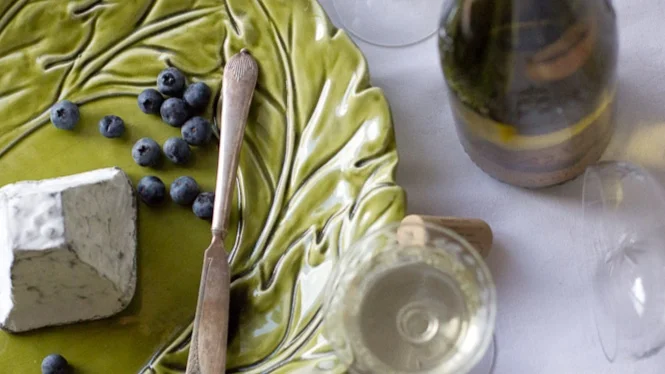
I'll be your goat cheese and wine pairing guide. And since Baetje's Bloomsdale is a classic example of a Loire Valley goat cheese, my goat cheese and wine pairing today can be applied to most Loire Valley friends.

Today,I'll be your cheese and wine pairing guide! A couple weeks ago Miss Cheesemonger and I got together to make paneer (you might remember her gorgeous pictures of the fluffy pressed cheese or the recipe link to her blog). Well, we had so much fun we decided to team up again.
Baetje's Bloomsdale: Goat Cheese and Wine Pairing
We decided that Vero would match Bloomsdale to whatever snack the cheese's heart desires and since I'm a wine girl, I would be your booze lady. Cool thing is, this pairing also pays it forward.

Baetje Bloomsdale
Since Baetje's Bloomsdale is a classic example of a Loire Valley goat cheese, today's cheese and wine pairing can also be applied to most Loire Valley friends and many soft, rinded goat cheeses, and the same goes for Miss Cheesemonger's picks.
Now for Bloomsdale.
Bloomsdale's maker, Veronica Baetje, makes cheese in a Mennonite community in Sainte Genevieve County, Missouri. As the NY Times reported when they covered the creamery after a recent World Cheese Award win, Baetje is an inspired creamery. Bible quotes grace her labels and the Baetje considers themselves devoted followers. Yet she's very modern and not afraid to stray from the course. From driving her used Porsche through Mennonite sedan-country to making time-consuming goat cheese that could topple over a Valency in a cheese competition, Veronica is not afraid of doing things her own way.

Bloomsdale getting ready for its cheese and wine pairing party
Her cheese shows this. That little number above is made in the traditional Loire Valley goat cheese style. Meaning it's a lactic-acid set cheese covered in a thin layer of vegetable ash over which a thin white layer of Penicillium Candidum mold grows.
Which brings us to goat cheese and wine pairing. There are two things to mind with this little Bloomsdale when pouring a glass of juice.
1.When pairing soft- in this case lemony and sometimes lightly grassy- flavors with wine, keep it simple. Cheesemakers work hard to preserve those lovely subtle notes in their cheese and you don't want to pick a wine that overwhelms them. Don't go too big.
2. Bloomy rinds are fussy, and their lists of annoyances are as long as Kanye West's. They dislike a lot of oak- doesn't let them stay the star of the show. They don't like tons of red fruit- gets in the way of the PC mold. And when left in a room together bloomy rinds and tannins dry the mouth and have been known to get into a slapping fight (it's embarrassing, really).
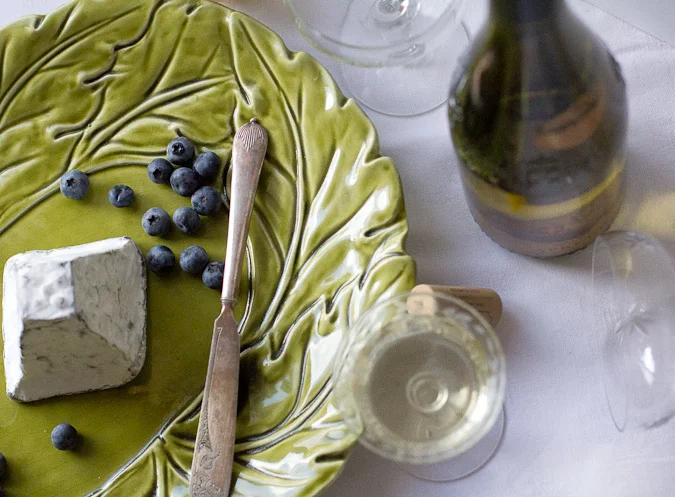
Cheese and wine pairing, on.
Goat Cheese and Wine Pairing Picks: Bloomsdale
The type of wine to focus on for a cheese like Bloomdsale is a wine like Chasselas from the Savoie region of France, pictured in the third photo above. Though un-oaked, it's lightly creamy mouthfeel mimics soft Bloomsdale. Sur lie-style Muscadets (made with the Melon de Bourgogne grape) and light sparkling cremants would have a similar effect.
Another way you can go is go citrusy and zippy. Not surprising because it's from the same region as any Loire Valley cheese, Sauvignon Blancs make a perfect goat cheese and wine pairing. You can extend this to a lean Chablis too. But stay away from uber-fruity wines. They will overwhelm.
If you need to go red for your cheese and wine pairing, try a Beaujolais or Cabernet Franc. Most are zippy and have low oak and tannins (see consideration #2).

I've left a glass on the table for you.
Head on over to Miss Cheesemonger's blog to see the second part!
Lambrusco: Cheese & Wine Pairing Fit for a Pool Party
There's an old cheese & wine geek-honored adage out there that white wine pairs better with cheese than red wine. Lambrusco begs to differ.
 There's an old cheese & wine geek-honored adage that white wine always pairs better with cheese than red wine. Lambrusco begs to differ (and it also would like to formally invite you to a summer pool party while it has your attention).
There are reasons for this adage. Because white wine often has higher acid than your standard red, it can cut through a cheese's richness as smoothly as lime does through a heavy coconut curry. And it has lower tannins, which can get into sparring matches with certain cheeses bacterias, yeasts, and rinds. White wine also can have less oak then reds, which can overshadow a cheese's nuanced flavors.
There's an old cheese & wine geek-honored adage that white wine always pairs better with cheese than red wine. Lambrusco begs to differ (and it also would like to formally invite you to a summer pool party while it has your attention).
There are reasons for this adage. Because white wine often has higher acid than your standard red, it can cut through a cheese's richness as smoothly as lime does through a heavy coconut curry. And it has lower tannins, which can get into sparring matches with certain cheeses bacterias, yeasts, and rinds. White wine also can have less oak then reds, which can overshadow a cheese's nuanced flavors.
But take a red wine, ferment it twice so it has bubbles, then serve it with cheese? That's bliss. And that's proof that adages aren't always right.

Just ask me on a summer's day, when I can be found sipping Lambrusco and downing cheese next to a pool, on a porch, or maybe even while sitting at my desk writing this post (it's not technically summer, but let's just say it's a very hot 81 here in Oakland).
Why is Lambrusco a pool cheese-party wine and why is it so good with cheese? Thus commences the third segment of Bubbles & Cheese Pairing 101.
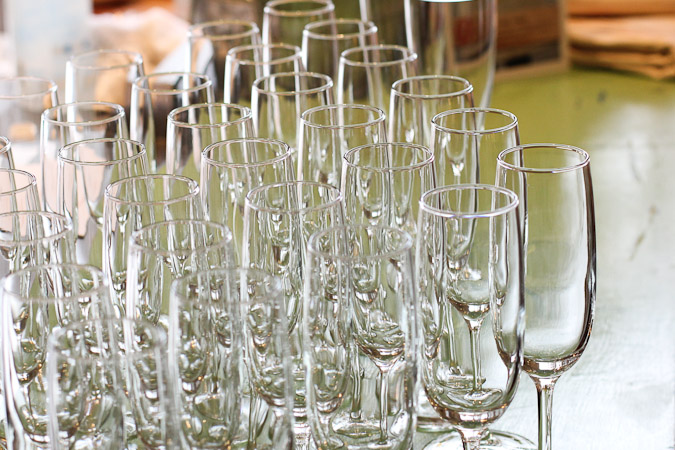
Pools and large bodies of water favor bubbles over still wines and chilled liquids over room temperature ones. It's a proven fact. Pictures of pool drinks always show a chilled liquid. The best photos picture chilled and bubbly liquid. Enter Lambrusco, a beautiful red alcoholic liquid.
Made in Emilia-Romagna or Lombardy, Italy, from the grape of the same name, Lambrusco is a red, bubbly wine that has great acidity, a dash of tannins to keep things interesting, and fresh red fruit. Lambrusco has gotten a bit of a poor reputation- not because it has been seen out late at night sneaking off to hang out with Nebbiolo or Sangiovese- but because a large amount of poor quality Lambrusco was exported to the states in the eighties and nineties that was sweet, overly fruity, and frankly, boring. The good stuff though, is a revelation.

Bing cherries, red currant, fresh herbs and pepper are flavors common in Lambrusco. Add all this to cold bubbles and you have pure refreshment.
Despite that Lambrusco's also fantastic for summer because it's bright, delicious, cold, and bubbly and looks good next to pools, the main reason that Lambrusco is the perfect summer party wine is because it's easy to pair.
Summer is meant for easy food, low amounts of cooking, light dishes, and relaxing. Since Lambrusco just happens to be one of the easiest wines to pair with cheese, this works out just right. You can pretty much set it out with any cheese and it'll charm the plate like a lightening bug charms a child. Or me. The tiny bit of tannins Lambrusco has teams up with its bright acid to cut the richness of cheese. Its often herbal and peppery notes bring out grassy, herbal lemony flavors in sheep or goat's milk cheese. And the bubbles? Well, that's like a freebie. They wrap around the rich cheese molecules and keep everything light. And because Lambruscos are low, or no oak, they don't overpower cheese.
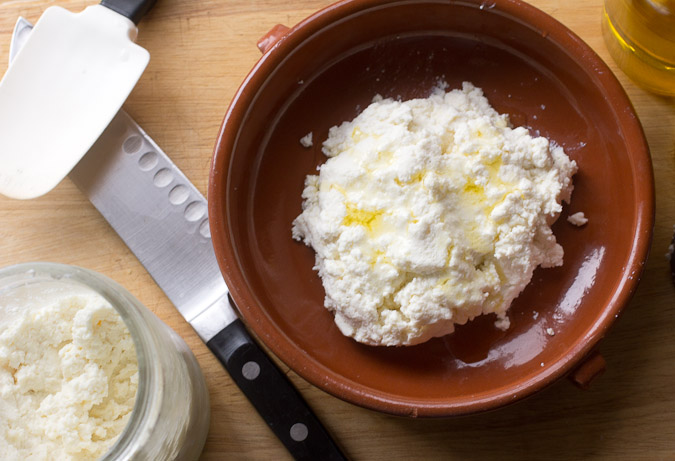
The Lambrusco's I've served in pairing classes pretty much went with everything on the plate.
But here are some guidelines.
Yes's: Goat and sheep milk cheese, and many cow's.
- Anything from sheep's milk ricotta to lightly aged wheels like Barinaga's Txiki, Bellwether's Pepato, or more aged like Pecorino Toscano. Soft and hard goat's milk cheeses are great, too. Fleur Verte- the young chevre covered in herbs? Perfect. Sleight Farm's Tymsboro or Vermont Cheese Bonne Bouche? Golden Tickets.
- Even cow's milk cheeses like Gruyere, Comté, or Cheddar can't help but say yes to the bubbly red one. You can go with bries, but generally think more aged- as a cheese gets more mature and complex, it likes a little extra in its wine, too.
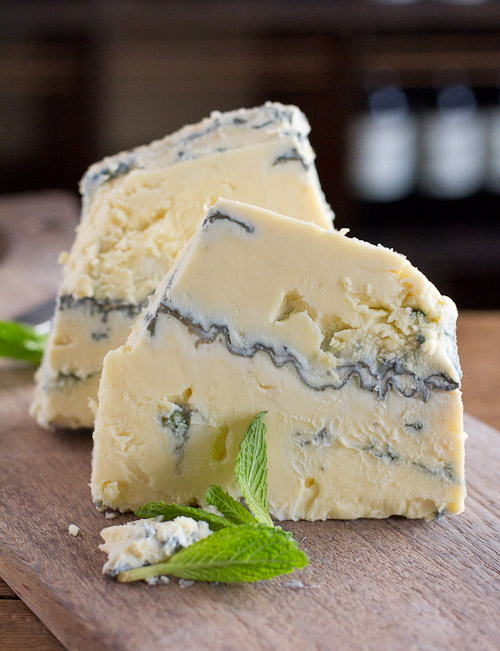
- If you're just not a sweet wine fan but like your cheeses fierce and want a wine that won't be overhwelmed, know that Lambrusco's love blues, too. Roquefort or Bayley Hazen, and even funky washed-rinds like Époisses or Tallegio too.
Only No's
- I know that Lambrusco comes from Parmesan land, which seems like a lovely and regional pairing, but stay away from the super old "grana" style like cheese with Lambrusco. If you're going Parm, think a year or under. The wine's high acidity and bubbles make the "grana" cheeses seem dry and grainy. Same goes for gouda.
What do you like with your Lambrusco?
Pét Nat- The Coolest Sparkler on the Block, and Cheese
Pét Nat - otherwise known as pétillant naturel- is the coolest sparkler on the block these days. People are throwing parties around it. Restaurants are putting on dinners in its honor, traditional vignerons versions are flying off the shelves, and experimental winemakers in the states are romancing the style every which way they can. Is it okay to be jealous of a win
 Pét Nat - otherwise known as pétillant naturel- is the coolest sparkler on the block these days. People are throwing parties around it. Restaurants are putting on dinners in its honor, traditional vignerons versions are flying off the shelves, and experimental winemakers in the states are romancing the style every which way they can. Is it okay to be jealous of a wine?
Why is Pét Nat the coolest kid on the block? Well, perhaps partially because Pét Nat doesn't care (kinda like honey badger). Unlike champagne or sparkling made via the champagne méthode that undergo two very careful fermentations- the first turns the grape juice into alcohol, and the second forms bubbles in the bottle, Pét Nat only goes through one fermentation, whenever it feels like it.
This is thrill-seeking kind of winemaking. The reason the other guys undergo two fermentations is because it's much easier to control the outcome. Once you know the juice turned to booze, you can bottle the wine then add a very controlled amount of sugar to rev up the yeast again, then keep an eye on the bubbles. Pét Nat, however, is spontaneously fermented, meaning that no sugar or yeast is added. In fact, Pét Nat is bottled and capped before the first fermentation is finished, meaning that winemakers have much less control over the final product.
It's natural winemaking, and quite simply, the bubbly can start or stop bubbling whenever it wants and flavors vary like crazy. Often there's a little residual sugar left. Scary? Kind of. Traditional? In some places. Wild? Yes. Some nights I lie awake dreaming I were as relaxed and cool as Pét Nat.

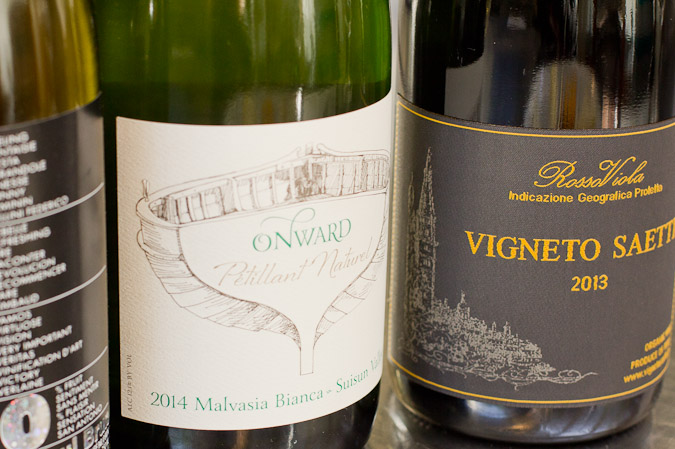
Onward and Donkey & Goat in California and Domaine La Grange Tiphaine, Texier, and Catherine Breton in France make lovely versions.
So what does a lassez-faire bubbly like Pét Nat like to eat?
Cream, and Alpines. And sometimes earthy, grassy cheddars.

Because flavors in a pétillant naturel can get a little crazy with all the spontaneous yeast action going on, pét nat can taste like, well lots of different things, but often like fresh yeast. Think the smell of fresh yeast that's being activated in a bowl of water before being added to dough rather the scent of brioche or bread baking like in champagne or crémant. Sometimes you'll get lightly tart, floral, or stonefruit notes too.
A wine with this much going on often likes being the star of the show with a creamy yet straightfoward cheese. Other times it appreciates a cheese with a little funk and yeast of its own, like a mellow Alpine whose rind has been washed with B. linens that has a light, sweet funkiness just like the cheese. I've had some fantastic pairings with Pét Nat and bandage wrapped cheddars, too. Go for a grassy one- the cheddars with earthy notes shine with the sparkling's lightly funky bubbles.

My favorite cheeses with Pét Nat
Creamy: Mt. Tam, Castica di Bufala, or Brillant Savarin
Alpine or Mountain Style: Challerhocker, Comté, Cobb Hill Ascutney Mountain, Nicasio Reserve
Cheddars: Hafod, Bleu Mont, Fiscalini
*Last notes- in case you were wondering like I was what is the difference between Pét Nat and méthod ancestrale, they are are the same method. While méthod ancestrale is a term whose use is restricted to certain AOCs- Clairette de Die, Gallac, Limoux, and Bugey, pétillant naturel may be used freely . Thank you to my sommelier friend Hristo Zisovski and his friends at Pearl & Ash who explained this me!