
The Cheese Blog

5 Questions with The Art of the Cheese Plate's Tia Keenan

The Art of the Cheese Plateauthor Tia Keenan and I first met when she was the original ChefFromager of Caselulla. It was cheese-love at first sight. I learned she hand-made the hundreds of condiments she paired to every cheese on the menu and offered to work for free for her if she would let me eat spoonfuls of the bacon ganache she made for Winnimere. But it was when she posted pics on Twitter of beaming guests holding signs saying "I was wrong, I really do like goat cheese!" that a deep and true cheese love developed. Recently Tia published a book with Rizzoli Press. Its photography and recipes for cheese condiments (matcha marshmallows, anyone?) puts it in my top 10 cheese book list. Check it out. In honor of her beautiful book, here are 5 Questions with Tia Keenan. One of which involves pairing cheese to Detective Dale Cooper of Twin Peaks. Because why stop with preserves?

5 Questions with The Art of the Cheese Plate's Tia Keenan
What cheese and condiments would you pair to the upcoming 2016 presidential inauguration?
Well, if Trump wins I will have lost my appetite. So I’ll pair his inauguration with me gasping for air. And if Hillary wins I’ll mostly be wishing I were serving a bounty of Vermont artisan cheeses in honor of President Bernie. I’ll have to go with all American cheeses, obviously. I’d love to work with First Nations and Native Americans cooks to create some condiments using native ingredients. But most likely I’ll be home alone, with a sleeping babe upstairs, too reflective and fired up to eat much of anything.
Your son is two years old. You've been in the cheese business for years, have visited international cheese regions and producers all over the country, and have a library of cheese books. But what have you learned about cheese from having a child?
Well, I lactated for 32 months, so that brought me closer to the means of production of cheese than I’ve ever been before. I think feeding my child with milk from my body for a couple of years just connected me in a much deeper way to the animals themselves, and to the gift that is milk. I now intimately understand why someone would cry over spilt milk – because I’ve done it!


You’re allowed to bring 10 things with you to a desert island that you'll be trapped on for four months (somehow your toddler will be able to come visit a lot so no worries). All of them are cheese and best pairings. What would you bring?
Ugh. What a Sophie’s Choice! Damn you, Kirstin! [Sorry, Tia. Had to be done]
Serra da Estrella with Pumpkin or Tomato Jam and really great Portuguese bread
Adelegger with Wheat Beer, preferably brewed by the cheesemaker
Romadur with Dill, Red Onions, Vinegar and Fried Toast
Franklin’s Teleme with a spoon, nothing more
Meadowood Farms Juvindale with plain potato chips http://www.bonappetit.com/test-kitchen/how-to/article/cheese-potato-chip-pairings,
Tomme de Chevre Aydius with Carrot Halwa
Kaymak from my husband’s ancestral land of FYR Macedonia (not technically cheese – more like clotted cream - but I love it)
Trader Joe’s Jalapeno Pub Cheese – don’t hate
Grevenbroecker with Roasted Grapes
Havarti with Dill, because it’ll remind me of childhood and help me feel comforted from the panic of being stuck on a desert island!
You have so many delicious pairings in your book. What about bombs? Where there any duos that you hoped would stay together forever but had no chemistry in person? Are you still glad you introduced them?
I really don’t buy into the concept of “bombs”. Are there pairings that don’t taste great? Absolutely. But I’ve never made a pairing that didn’t have one interesting or redeeming quality. I guess I’ve had some bad pairings from others – it usually happens when people try to get too creative and just pile on the flavors and add truffle oil – but I would never save room for them on my shelf of memories. There are too many good things to taste and combinations to make for me to remember the ones that weren’t memorable.
You're an expert on pairing cheese to delicious condiments like tequila-braised rhubarb, pickles, handmade matcha marshmallows. How are you on pairing cheese to people? Here's 5 whose perfect cheese pairings I'd like you to explore:
-Detective Dale Cooper on Twin Peaks: Definitely some Cougar Gold, It’s cheese in a can from Washington State University. Weird enough for Dale, weird enough for me.
-Hillary Clinton: She’s very much a pioneer. She’s the Laura Chenel of politics, right? At the time of her entry she seemed revolutionary, but now that the culture’s changed she’s just a really well made chevre. Nothing wrong with that, just not sure I’d want chevre to be my top cheese, ya dig?
- Jim Jarmusch: Jarmusch is just so NYC, so I want to pair him with a NYC cheese. We don’t make much because we’re eight million people deep in urban living, so I’m thinking Salvatore Bklyn Smoked Ricotta. It’s clean and smooth but has its very own kind of punk rock attitude. Very Jim.
- RZA: I have to respect RZA for his radical black Taoist veganism. He’s probably one of the few people I’d be willing to eat vegan ‘cheese’ with.
- Gloria Steinem: I have a lot of conflicting feelings about Steinem. I worked for her at Ms. Magazine as intern 10,000 years ago. She’s an icon. I get it. I appreciate it. I’m not sure if I’m left behind or she’s left behind. I guess I’d want to feed her Kraft singles, to show her how so many poor and working class Americans eat. I mean, she understands working class cheese on an intellectual level, but she’s not been in the muck of it for a very long time.
Thank you, Tia! All book photos by Noah Feck
Cheesemaking with the SF Milk Maid: Gosling goat cheese
We’d make the Gosling in one day, she’d leave me with the newly formed pyramid, and then I’d baby and flip it in my fridge for two to three weeks until it passed through cheese adolescence into adulthood.
 If you've ever taken a class with the SF Milk Maid or flipped through Louella Hill's new cheesemaking book, Kitchen Creamery, you've probably had a moment much like the ten or eleven of those I've had recently where you find yourself shaking your head in amazement, asking, how does one person know so much?

Louella's book is packed with more cheese types than you though any one human would be able to make, her hand-drawn illustrations accompany the wheels so one can see what rogue bacteria may be to blame if there are too many divets in your brie, and when Louella's not writing a book, she can be found teaching classes around the Bay Area. She kinda does a lot.
One of the original employees of Narragansett Creamery and the owner of SF Milk Maid, a cheesemaking business that teaches people how to properly stretch curds, Louella's got a breadth of cheese knowledge under her belt that far surpasses even the amount of cheese that the average French person keeps in their fridge during a year. And she's nice, and, a big believer in the glory of butter. In short, she's lovely.

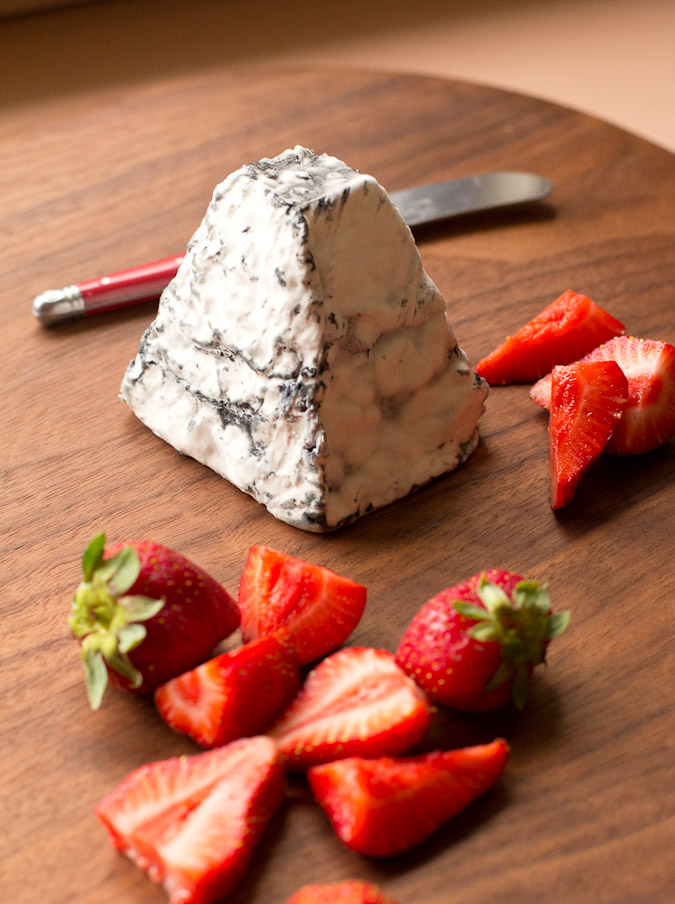
So when the Louella asked me if I wanted to make Gosling with her at home, I said hell yes. My quick yes could have also been me wanting to make a cheese called Gosling, but mostly I said yes because I wanted to play with this lovely woman in the kitchen. Our cheese of choice? A Loire Valley-style, ashed goat cheese pyramid that looks like Valencay. It was the first time I worked with goat's milk since returning from Sleight Farms in Somerset, England, and I was beaming.
We'd make the Gosling in one day, she'd leave me with the newly formed pyramid, and then I'd baby and flip it in my fridge for two to three weeks until it passed through cheese adolescence into adulthood.
Louella's publishers were nice enough to share the recipe for the beauty below, but I'd also highly recommend Louella's book. It's beautiful, down-to-earth, and clear.
Thank you Louella, for cutting curds with me!

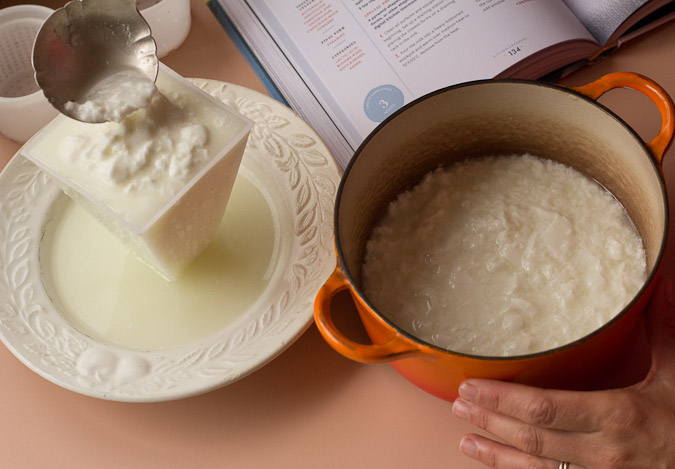



Gosling, Valency Style Cheese- adapted from Kitchen Creamery, Chronicle Books, 2015
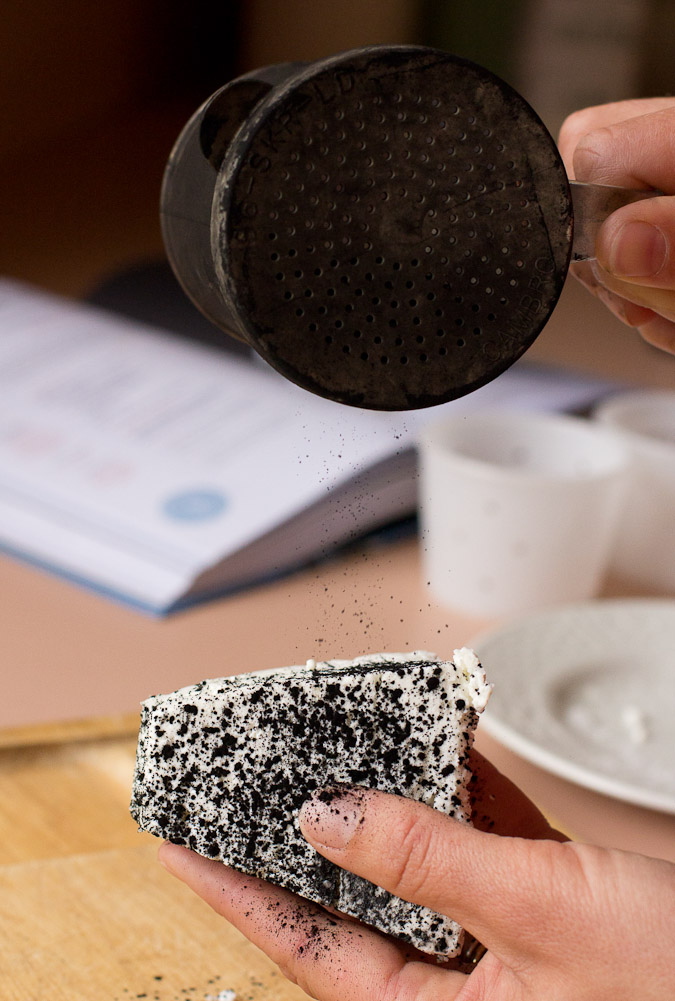
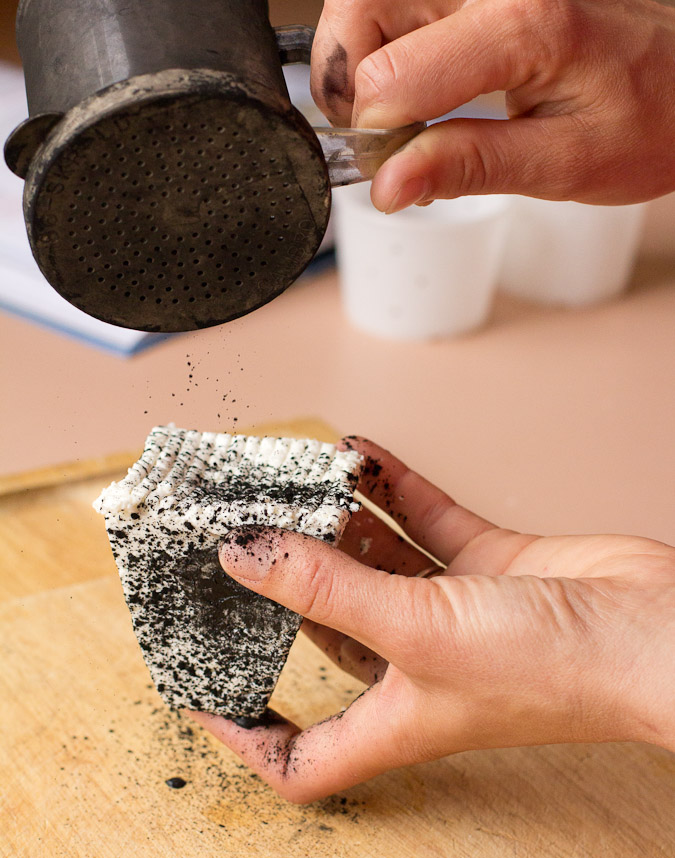
These pyramid-shaped cheeses are pure entertainment. At first, they’re firm, geometric and black with ash: brand new. A week later, they’re fuzzy and gray: adolescent. With time, they become white with softened edges: middle-aged. Finally, they slump as the insides become soft: mature. This recipe can be made with cow milk if goat milk is not available and, traditionally, Valencay is an unpasteurized cheese. This recipe is very similar to the Chevre on page XX.
2 gal goat milk 2 tbsp buttermilk 4 drops rennet, undiluted pinch of Penicillium candidum mold powder tinier pinch of Geotrichum mold powder 2-3 tsp salt
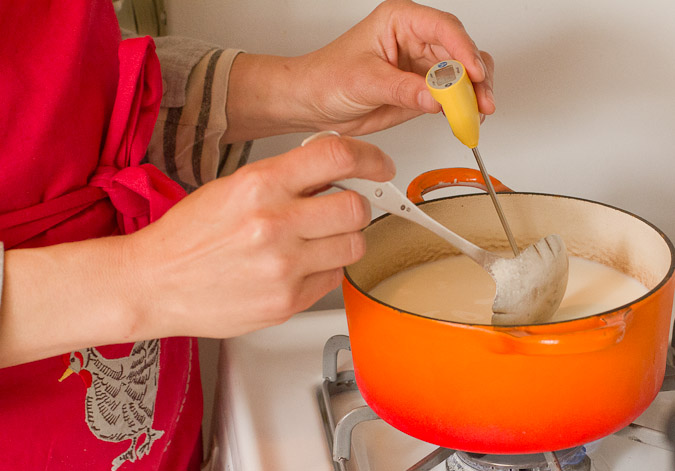
Materials: 4 pyramid-shaped cheese forms, 2 tsp food-grade vegetable ash Yield: three to four pyramids, ~8 oz/237 ml each 1. Pour milk in a pot and warm to 72˚F/22˚C. Turn off the heat.
3. Add buttermilk plus mold powders then stir in gently.
4. Now add the 4 drops of rennet. Stir the rennet in then cover the pot and leave in a warm, undisturbed location (free of cold drafts or vibrations) for 15 to 17 hours. If needed, incubate the pot to keep the temperature from fluctuating too much. When curd has firmed up, you will notice a small amount of yellow whey collected on the top and sides of the curd block.
5. Using a ladle or large spoon, scoop curds into clean pyramid forms. It may seem there is too much curd for too few forms. Wait 10 to 15 minutes for the level of the curds to drop, and then fill them to the top again. Continue doing this until all the curd has been used. If clear that the curd amount is disproportionate, add another pyramid form. Set filled pyramids inside a tall, clean plastic aging bin, with an aging mat inside on the bottom. Place lid on tub and allow pyramids to drain for 4 hours. You will need to periodically remove whey from the tub so that the cheese is not sitting in liquid.
7. After 4 hours, invert the pyramids on the aging mat (when cheese has firmed enough to allow you to do so). Pour off any whey as it accumulates in the bottom of the bin.
8. After another half day at room temperature, remove cheese from their forms. Drain and dry the plastic tub, then return cheeses to tub (without forms). Set them them on top of the aging mats.
9. Sprinkle each pyramid with ½ -3/4 tsp of salt over all surfaces as evenly as possible. Allow salt to soak in the salt while continuing to draining in covered bin at room temperature (removing built up whey from the bottom of the container as needed). Drain for 12 more hours.
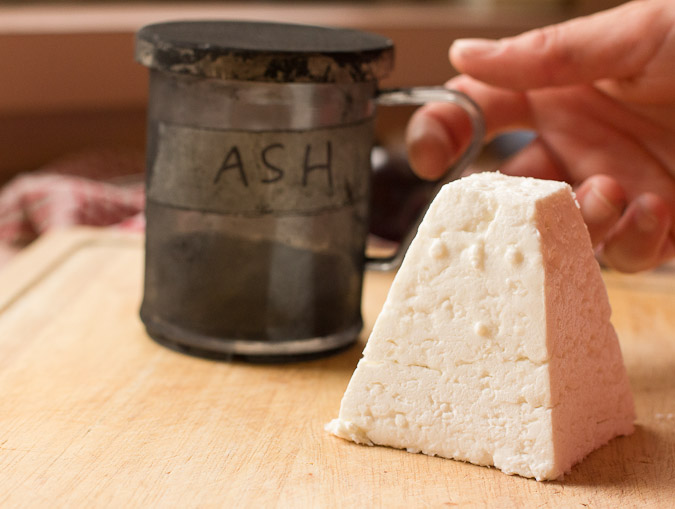
11. Once cheeses have stopped releasing whey, cover them with vegetable ash; In a draft-free area, use a saltshaker filled with ash to sprinkle all surfaces of each pyramid.
12. Finally, move the salted, ashed cheeses to a dry bin. Set on top of dry, clean mats. Cover with lid and place in the refrigerator for 3 – 4 weeks. Twice a week, rotate the cheeses and remove accumulated moisture. When the cheeses are covered in a downy grey / white mold, they are done. Wrap in breathable cheese paper and store in the refrigerator for up to 3 more weeks.

Pacific Northwest Cheese: A History
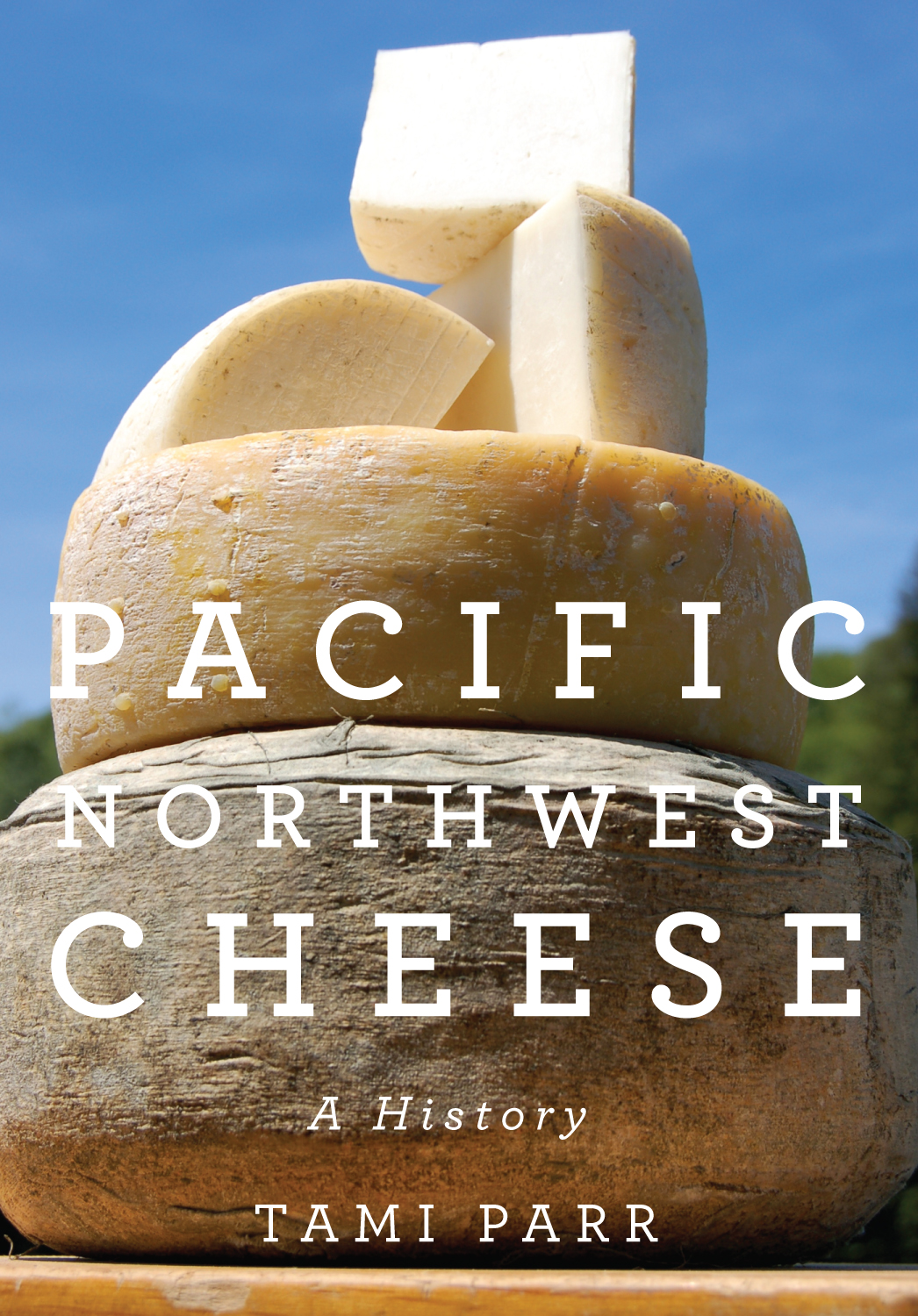
Tami Parr's new book, Pacific Northwest Cheese: A History, is a read fit for history buffs, cheese geeks, and anyone who appreciates research that connects things as seemingly distant as the onset of tuberculosis to the rise of dairy goats in Oregon. It's the type of book that would compel those who loved Cheese and Culture: A History of Cheese and its Place in Western Civilization, or a reader that would seek out a 1970's copy of The World Atlas of Cheese (yup, that's me). Put it on the list for your cheesemonger friends.
Parr sets the scene with a chapter tracing pioneers's treks to the Pacific Northwest, connecting the journeys to the Lewis and Clark Expedition and government pushes to populate the resource-rich region. The first milkings begin, in fact, along the trek, when Parr notes that the rocking motion of the pioneer wagons meant hands-free churned butter. Dairy for early Pacific Northwesterners meant survival. Milk was quickly turned into butter or fermented into cheese so the milk wouldn't spoil. It wasn't until later that it became an industry.
One of my favorite parts of the book was Parr's exploration of goats. I've always found Oregon and Washington's goat cheeses to have a je ne sais quoi, a certain vivaciousness and depth to them that suggests they've been doing it for a year or hundred years longer than the rest of the country. According to Parr, this is true. The region always welcomed dairy goats, especially during the bovine tuberculosis scare, the milk flourished here during world war rationing, and the animal stayed on and thrived. Those mountains are great climbing fun for our chèvre friends, too.
Parr covers Cougar Gold (quite possibly the only tasty canned cheese in the world), the invention of rindless cheese, Oregon and Washington's attachment to blue mold, and the start of the artisan cheese back-t0-the-land movement in the area.
Though it might seem a bit dry at times for readers attached to lots of metaphors and colorful similes, Paar is a very good writer and skillfully sums up a wealth of research in a way that would make many academics jealous. And as with the butter churning bit above, she's not opposed to sprinkling her findings with the fun facts of early cheese life, such as those detailing the duties of an early cheese cooperative inspector.
"One of Christensen's first tasks," says Paar, "was reportedly weeding out the heavy drinkers among the cheesemakers and substituting sober ones- a move that no doubt had an immediate positive effect on the quality of the region's cheese."
I also like that Paar notes emerging styles and non-Euro focused cheese makers like the Ochoa Family in Oregon and doesn't shy away from talking about the colonization of the area, even as it relates to dairying.
All in all, I would highly recommend this book for those ready to dive into the deep subject of cheese or Pacific Northwest history. It, and a wedge from a modern artisan producer she discusses in her book, like Briar Rose, Juniper Grove, or Tumalo Farms, would make a caseophile very happy.
Cheese Super Heroes! The Swiss Cheese Book
 I used to say (okay, I still say) that the next time I go to CheeseCon -a.k.a an American Cheese Society Conference-, I'd bring a cape, maybe some tights, something bright and spandex-y, and a lasso. That CheeseCon has nothing to do with capes or super heroes in the traditional sense doesn't really have anything to do with it. Anytime you can attach Con to the end of a gathering of hundreds of people, as is done with ComicCon, you have, in my opinion, ample reason to attach a large piece of fabric to your neck wear green tights. And the lasso? Obvious. Cows. Cattle. By the way, have you seen how much work cheesemakers do in one day? A Super amount. ComicCon ain't got nothing on us cheese folk. Except... maybe the easy comic association.
Anyhow, I got a package the other day. My roommate is a grad student, so he gets about three to fifty-three packages a week filled with books, but, me? I rarely ever get a package. So I was already excited before I opened it. And then I opened it. And I was even more excited (one might say super excited).

The package? Well,"Swiss Cheese: Origins, Traditional Cheese Varieties and New Creations," by Dominik Flammer and Fabian Scheffold is the newest cheese book in my collection. One of the coolest things about the book, oh, you know, beyond its detailed description of the history and culture of the artisan Swiss cheese industry, and lively profiles of modern and traditional cheesemakers of the Alps and beyond, is its photos.
The cheesemakers in the photos look like super heroes (sans capes). Photographed standing on top of some of the highest mountains in Switzerland, lifting wheels of cheese while balancing on logs teetering over rushing streams, or rolling their wheels up grassy hills, cheesemakers are pictured in their element- holding something they created with love, in the region that matters most to them.
If you'd like to oogle cheeses in distant lands, in landscapes just as pretty as the animals that give their milk to make these wheels, check out this book. In can be found in English here. Available in French and German elsewhere.
Just wanted to share one of favorite cheese finds with you, first shared with me by Mz Tia Keenan of Murray's Cheese Bar.