

The Cheese Blog

Melt, Stretch & Sizzle is the most stylish, sexy, hot cheese book ever

If cheese was photographed for an art or fashion magazine, this is what it would look like. A fashion magazine's articles might be titled something like, "Fondue: On the Art of Seduction," or, "This Season, Cheese Conquers its Fears and Melts our Hearts," or "Cheese Heats up and SIZZLES." (worth reading over celebrity advice any day!)
In Melted, Stretch, & Sizzle, Tia Keenan and photographer Noah Feck team up again for a stylish, ode to hot cheese that is as gorgeous to look at as it is packed with delicious recipes. Classic fondue. Not-so-classic burrata mac & cheese. Poutine with Lazy Gravy. And Goat Cheese Queso Fundido. I wouldn't expect anything less contemporary or beautiful from the chef-fromager who opened both Caselulla and Murray's Cheese Bar, wrote The Art of the Cheese Plate, authors cheese columns for WSJ and Bon Appetit.
Tia is always on the forefront of things. In honor of the latest book by one of the most creative and funny people I know, below is an interview about what it took to make a book devoted to hot cheese, with one of my favorite cheese ladies ever, Tia Keenan.
I hope you enjoy it, and check out her book!


1. Your book is awesome. How did you pick what hot cheese dishes do put in?
I wanted to include some of the hot cheese "greatest hits", things like Mornay sauce, Mac & Cheese, a grilled cheese, so that I could talk to the reader about some fundamentals of cooking with cheese, but at the same time I wanted to introduce readers to an international mix of hot cheese dishes that are perhaps less familiar to do them. To me a good cookbook deepens our understanding of foods and recipes that may already be familiar, while also exploring new flavors, techniques, and contexts.
2. Was there one that you really wanted to fit in but couldn't?
I had plenty of dishes I was interested in and developed a few that didn't make it into the book. I would've loved to have gotten a fried cheese donut in there, but couldn't find the right place for it.
[blog author's note, here: mmmmmmm.....]
3. What does hot cheese mean to you?
It's the excitement and deliciousness that happens when cheese and heat energy meet.
4. So much food photography out there features what look like the same people- mainly young, and white- holding platters, or feasting at the same parties. Your book includes hands with age spots holding popovers, gorgeous black hands holding gougère or lips admiring melting fondue. They're beautiful, and it's wonderful to see not just one community reflected in a contemporary book. What inspired you to mix up your photo scene, and how do you think your photos do (or don't) reflect the greater food and cheese movement?
The problem always with shooting cheese is that most of it looks the same, is the same color. Aesthetically, I knew that using a darker-skinned black model would be a nice contrast to the white/yellow tones of melted cheese. I also am just tired of seeing white people all over food photography, so when I could push back against that in photos, I did. Black is beautiful! And for the older hands, well, I asked my 80-something neighbor Renee to model, because I knew she'd be fun on set and as her friend I've admired her hands. Having fun on set, bringing people you adore into the sacred space of making images - this is one of the ingredients to making photos that people want to look at. I love, respect, rely on, and admire older women, and in their hands lies the history of cooking and delicious food. My question is: why aren't black and brown women, and older women, the central figures of food imagery? All the best food comes from them.


5. You've long been in the forefront of the cheese scene and pretty much were the first one in the restaurant world matching crazy flavors, textures, and unconventional foods with cheese. One might say you have a forward-thinking cheese-vision. Can you please look in your crystal ball and tell us what you see in our cheese future, and how it relates to your recent books, The Art of the Cheese Plate, and Melt, Stretch, & Sizzle?
To be honest, this was a hard book to make, for a myriad of reasons. And I essentially wrote three cheese books in three years (ACP, Short Stack Chevre, and MSS). I need a bit of a break. I think I'd like to write a memoir actually, or at least a book about some parts of my life. I need some time to get back to another cheese book. Percolation is really important to my creative process - I need time to think and dream and ask questions.
6. What is Sterio's favorite hot cheese dish? [her son]
Mac & Cheese, by a mile.
7. What is the one thing that you wish people kept in mind or knew about cooking with cheese when left in the wild?
Never cook with cold cheese.


Melt: the Art of Macaroni and Cheese, An Interview
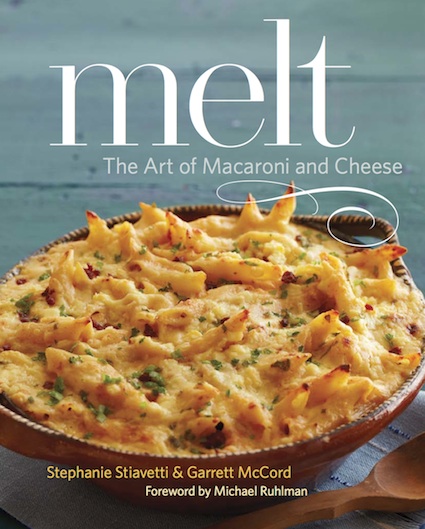
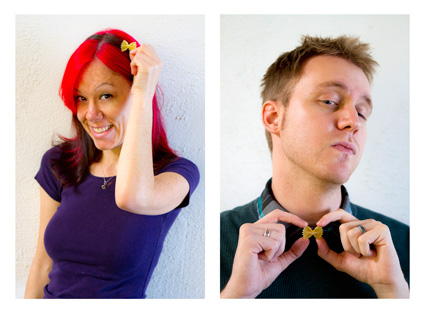
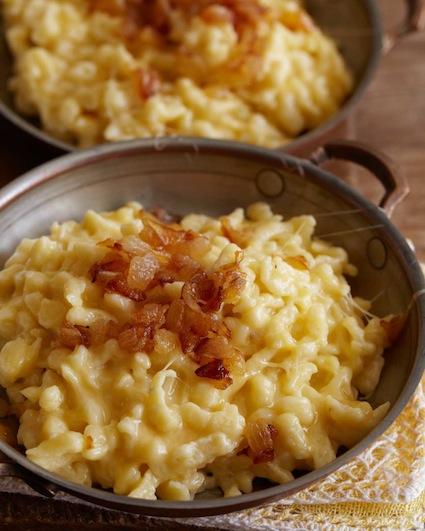 In the theme of the general cheesiness of "It's Not You, It's Brie" and the blog's series of interviews with people in the Cheese Biz who are writing and educating about, making, selling, and cooking with cheese, I'd like to introduce you to my friends, Stephanie Stiavetti and Garrett McCord. They're authors of very popular blogs, writers who have been published in NPR's Kitchen Window and beyond, and next Tuesday, they are publishing a cookbook.
Melt: the Art of Macaroni and Cheese is about... Mmm hmm. Mac n' cheese. But not just any mac n' cheese. Artisan mac n' cheese. The book is a wealth of recipes that combine artisan cheese with hi and lo ingredients that make them sing in the often cooked and bubbly, browned-top form. Not to leave the classic world behind, Stephanie and Garrett include traditional recipes like a creamy stovetop classic, but they mix it up and introduce inventive dishes like Humboldt Fog with Grilled Peaches and Orzo. My roommate, who commandeered my copy, is still lamenting the end of stonefruit season because of this recipe that combined sweet peaches with the bloomy-rinded goat cheeses and mint. In full disclosure, I also consulted for the book. We talked cheese styles and I helped with the food and wine pairing recs that follow recipes. It was very fun. Following is the interview.
Thank you S & G for making the time. Have fun on your book tour!
This is your first cookbook. What surprised you the most about writing a cookbook, and what was exactly how you expected it to be? Did you realize you'd have month's worth supplies of mac n cheese in your freezer after testing recipes, for example?
Garrett: I think two things I didn't expect were the stresses of testing and the sheer amount of food. We had about 85 testers working with us who were going through the recipes. It was like herding 85 cats with food allergies. Still, it was a wonderful experience because I got that chance to know a lot of bloggers, moms, students, chefs, and other people passionate about food. They were testing our recipes and taking them to funerals, baby showers, and office potlucks and telling us stories from their lives. It was enriching and enthralling.
As for the sheer amount of food? I had a rule: Tuesdays, Thursdays, and Saturdays there is food at my house. Come by.
Steph: I think that I was most surprised by how many moving parts there were. Working with Garrett made the process a lot easier, as we could share the load. I'm eternally grateful to him for wrangling the testing process - it was one of those things that was best handled by one person, and he jumped in and took the bull by the cojones. I enjoyed the recipe testing process a lot, which I was expecting. And the writing was a lot easier than I thought, because the pressure of such a large project really pushed me to perform.

You both had been exploring artisan cheese on your own, in your writing, on your blog, for some time now. What made you want to write a cookbook on cooking with artisan cheese in particular? And why did you choose noodles as it's accomplice, rather than, say, write a book about how to do melt cheese between two slices of toasted bread?
Steph: Back in the early days of the book process, Garrett and I were on the phone tossing out ideas for our book proposal. One of us came up with the cheese angle, and then the other person said, "Wait. What about macaroni and cheese?" We looked up all the other mac & cheese books on the market - at the time there were only one or two - and they were very much downhome-type cookbooks with recipes like "Yankee Doodle Lobster Mac," and other dishes like that. Our cooking styles are a little more adventurous, so we knew we didn't necessarily want to cater to that demographic.
We both love cheese, so it made sense to expand the mac & cheese idea to include a wide variety of cheeses, but as we wrote the proposal, the topic sort of focused itself to primarily involve the artisan cheese world. It was really neat to watch it evolve, as if it had a life of its own.
You two have some very adventures recipes in your book- this isn't just an ordinary mac n cheese book. You must have learned a lot about what flavor combos work and don't. Why did you decide to go beyond the norm?
Steph: We realized early on that if we were going to cook with artisan cheese, we were really going to have to "bring it" with the recipe style. When you're working with fine cheese at a higher price point, you don't want people to feel meeeehhhhhh about your dishes. And with macaroni and cheese, there are pretty much two ways people are familiar with it: creamy or baked. We really wanted to elevate the American classic by thinking out of the [blue] box, so to speak, and that pushed us to explore many global flavors that people might not automatically associate with macaroni and cheese.
While we have lots of classic dishes in Melt, we also borrowed flavors from a vast number of cuisines: Greek, Mexican, Indian, French, and even Chinese cooking made an impression on our recipe developing process. Some of my favorite dishes blend more than one culture's cooking style. And of course there were lots of flavor combos that just didn't work and ended up on the cutting room floor. Like, thyme and soy sauce do NOT go well together. ;)
With so much adventure comes a lot of experimentation. What flavor combos didn't work? Any absolute bombs? Any heartbreaks?
Garrett: There's a great polenta recipe with Sottocenere al Tartufo that didn't make it into the book. I was bummed about that. There was also a spiced red wine bechamel sauce that, oh god, was so bad. It smelled like Cthulhu's butthole. I actually pitched it into the yard because I didn't want it to go down the drain and continue fouling my kitchen with the stench.
I also learned you have to treat chocolate pasta as a savory item. The cocoa makes it bitter, not sweet. Going down the sweet route just won't yield the delightful results a savory sauce will.

With two authors, what was your creative process in writing this book? Did you discuss base flavors together, or play around with recipe ideas and techniques separately?
Garrett: Steph and I balance each other out quite well. We both have our own strengths and weaknesses, not just in cooking, but in organizational skills, tech skills, editing, writing, everything. So when one of us needed help or felt weak in a certain area, the other would leap right in. This isn't to say we didn't clash or have a few debates (with only one major fight, but perhaps too much bechamel will do that), but each resulted in the book being better than it was before and us understanding each other better.
We worked off of Google Docs so we could see and review each other's work constantly. A master recipe list was written up by us both and we would add or edit to it often, usually leaving comments for the other and having the phone call when it was needed. We also made sure to connect in person at least once a month.
Steph: In the beginning, we spent a fair amount of time on the phone or in person, dreaming up and testing flavor combinations. When we first wrote the proposal we had to come up with a nearly complete list of recipes, which changed a ton over the course writing the book. I'd say we tossed at least half the recipe from that original list, or morphed them into something else.
A lot of the recipes in Melt are true collaborations, meaning one of us would call the other and say, "Hey, what do you think of…" And then we would each weigh in, adding and extracting ingredients and methods during the conversation. Sometimes recipes would get handed off from one of us to the other, after realizing that it played upon the strengths of the other person. There's even one recipe in the book that someone didn't want to make, but then after much, um, discussion, they ended up making it anyways. And they loved it despite their vocal hatred for the dish in the beginning. Ha.
There are actually some parts of the book where we can't figure out who wrote what, because our writing and editing styles blend so well. That's definitely a trip - to read a passage and not be able to remember who originally wrote it. How did Garrett's pastry background play into the book?
Garrett: When I worked in pastry, caramel was the albatross around my neck. I burned it. A lot. In fact, at one kitchen the cooks and chefs would call out that anytime something burned, "Garrett's making caramel!" My pastry instructor, Elaine Baker, made me make caramel every. Single. DAY. Now I can do it in my sleep - both wet and dry caramels, by the way. So of course I was hellbent on adding it in to Melt. I made sure that the instructions for these things that used to intimidate me were easy and approachable. There's nothing to be scared of with baking techniques when you've read through the directions. It'll go as directed and, poof, it's done!
The book has a lot of favorite ingredients, like rhubarb and cacao nibs. I also got to deep-fry, which I used to never do at home and now have started doing too much.
As an author who is still on Level 1 of social media, I'm amazed and inspired by the ways you two are going about promoting this book on social media and beyond. I heard the other day that your book even got picked up by Walmart and Target. Wow. Congratulations! What would you advise writers with books who would like to get placement as great as yours, and, can you talk about some of the ways that you're promoting your book that you're especially excited about?
Steph: To be truthful, I have no idea how the book got picked up by Walmart. ;) I chalk that up to the awesome sales people at our publisher, Little, Brown & Co. What we did have a hand in, however, is the social media energy that is starting to stir. But we can't really take the credit for that, because it's due to our amazing circle of writing and blogging friends spreading the word.
My advice to writers is to ensconce yourself in a broad circle of media-savvy colleagues, making friends and doing all you can for the people in that group. Be friendly, generous, and genuine, reaching out whenever someone else needs help with promotion or anything to do with their own projects. That good will always comes back in spades. So go find your tribe and love them with all you've got. The organic excitement of your friends is more infectious than any viral campaign cooked up by a publicist! Lastly, if any readers want to catch you around the country, where can they look to see if you'll be in their area?
Garrett: We'll be doing the West Coast tour circuit, and hopefully diving into New York, South Carolina, Missouri, and a few other spots. We're still working out the details, so stay tuned to the Melt website. =)