
The Cheese Blog

Chèvre, Coconut & Guava Sandwich Cookies from Shortstack Chevre

If you've ever searched for a killer goat cheese recipe online- say you've already made that chèvre and arugula salad and are aching to put the extra six ounces of the log to tasty use, you'll likely have noticed most chèvre recipes are savory. That is to say, not sweet. Beet and goat cheese salad. Chèvre and quinoa bowls, you get the picutre. Which might lead one to believe that that's all chèvre is good for.
Not true.
While I would never turn down a goat cheese tart, my hands-down favorite way to enjoy chèvre (fresh goat's cheese/goat's milk fromage blanc) is sugared up.

When sweetened with sugar, dark chocolate, fruit, or honey, chèvre transforms whatever dish into which its incorporated into a bright, luscious, sunny dish. Its lemony notes help lift sweet and rich creamy desserts to lighter places, bring out layered notes in chocolate, and add a subtle creme fraiche or buttermilk flavor to baked goods.
So I'm very happy to share with you Tia Keenan's Chèvre, Coconut & Guava Paste Sandwich Cookies from her latest cheese book- Chevre- a slim yet dense Shortstack book.
Now my friend Tia is skilled (she opened Caselulla and Murray's Cheese Bar in NYC), so it's not the only recipe I'm batting my eyelashes at, but it was the first one to scream "make me now," or to put it more accurately, "eat me first." When Tia describes the recipe in the intro and says the chèvre gives the cookies a buttermilk biscuit flavor rather than a chèvre flavor, she's spot on. I might even try them with an extra thin layer of chevre spread over the guava if I was serving them to a fierce goat cheese crowd, but they're charmers as is. I served them at a Memorial Day party, and they off the cookie plate fast. And I brought my friend and her husband two for a treat and my friend ate them both. I did not tell her husband.
Thanks for sharing these Tia! The recipe follows. Buy the book here for more chèvre love.
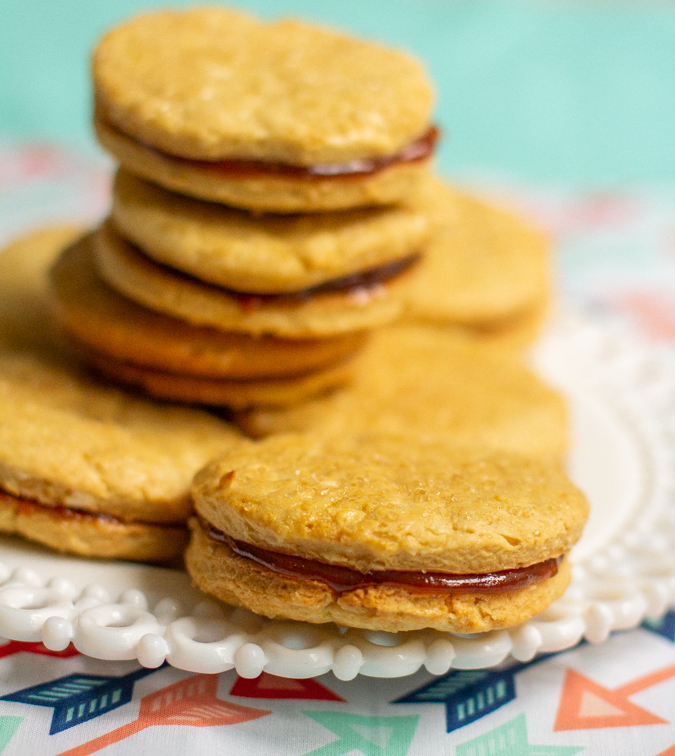
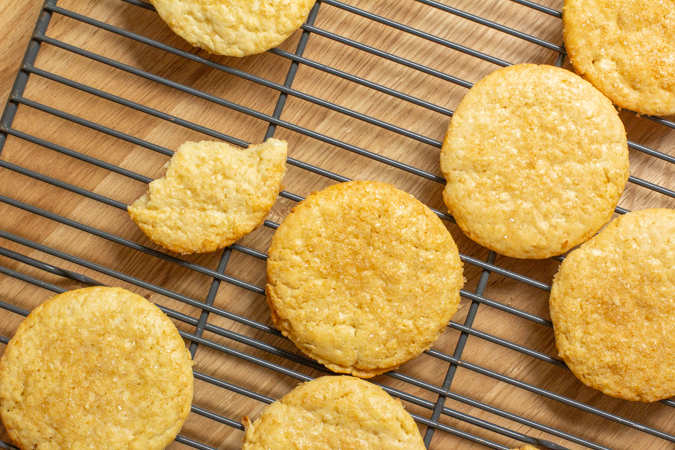
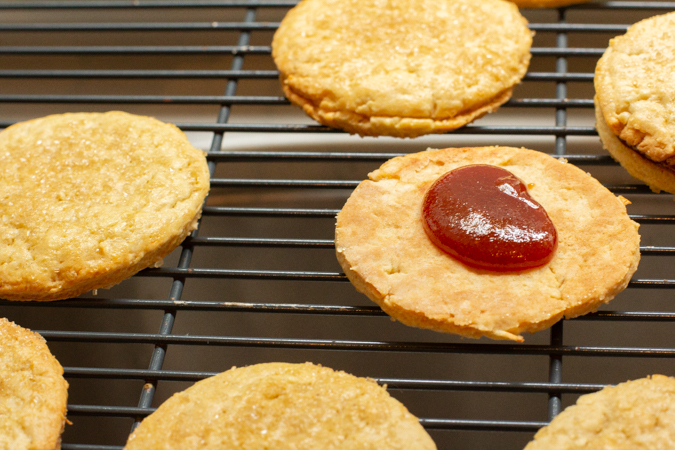
Chèvre, Coconut & Guava Paste Sandwich Cookie Recipe
These hearty, biscuity sandwich cookies are best with a big ol’ mug of milky tea or coffee. The chèvre lends a buttermilk biscuit twang to the cookie, which is a nice contrast to the sweet filling made from guava paste. Guava paste is the working-class cousin of cheese-plate-stalwart quince paste—and a more affordable and readily available fruit paste for pairing with cheese.
3 1⁄2 cups cake flour, plus more for rolling out the dough 1⁄2 cup granulated sugar 1⁄2 cup packed light brown sugar 2 tablespoons baking powder 1 teaspoon baking soda 11⁄2 teaspoons kosher salt 4 ounces (1 stick) cold unsalted butter, cut into cubes 6 ounces chèvre, crumbled 1 cup unsweetened coconut flakes 1 egg 1⁄2 cup heavy cream 2 teaspoons demerara sugar 16 ounces guava paste (such as Goya brand; available at super- markets), cut into 2-inch cubes
Preheat the oven to 425° and place racks in the upper and lower thirds of the oven. Line two baking sheets with parchment paper. In a food processor, combine the flour, granulated and brown sugars, baking powder, baking soda and salt and pulse to combine. Add the butter, chèvre and coconut and pulse until the mixture resembles coarse meal. In a small bowl, whisk together the egg and cream; set 3 table- spoons aside in another bowl. Add the remaining egg mixture to the flour mixture and pulse until the dough begins to pull away from the sides of the bowl.
Turn the dough out onto a lightly floured surface and knead gently to bring it together. Roll the dough flat to a 1⁄4 inch thickness and cut out rounds with a 21⁄2-inch cookie cutter or rim of a drinking glass. Place the cookies 1⁄2 an inch apart on the baking sheets, 16 cookies per sheet (you’ll have less than that for the last sheet and will need to bake in 2 rounds for 4 sheets total).
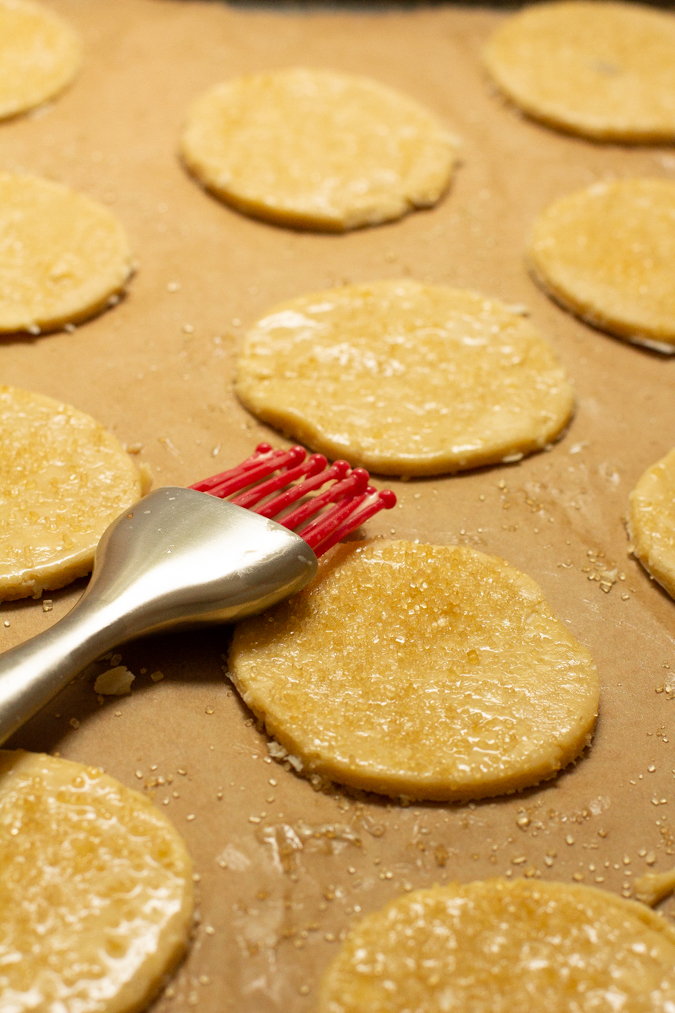
Brush the cookies with the reserved egg mixture and sprinkle with the demerara sugar. Bake for 10 minutes, rotating the sheets between the upper and lower racks halfway through baking, until the cookies show just a bit of color. Let the cookies cool on the baking sheets for a few minutes, then, using a spatula, transfer them to a cooling rack.
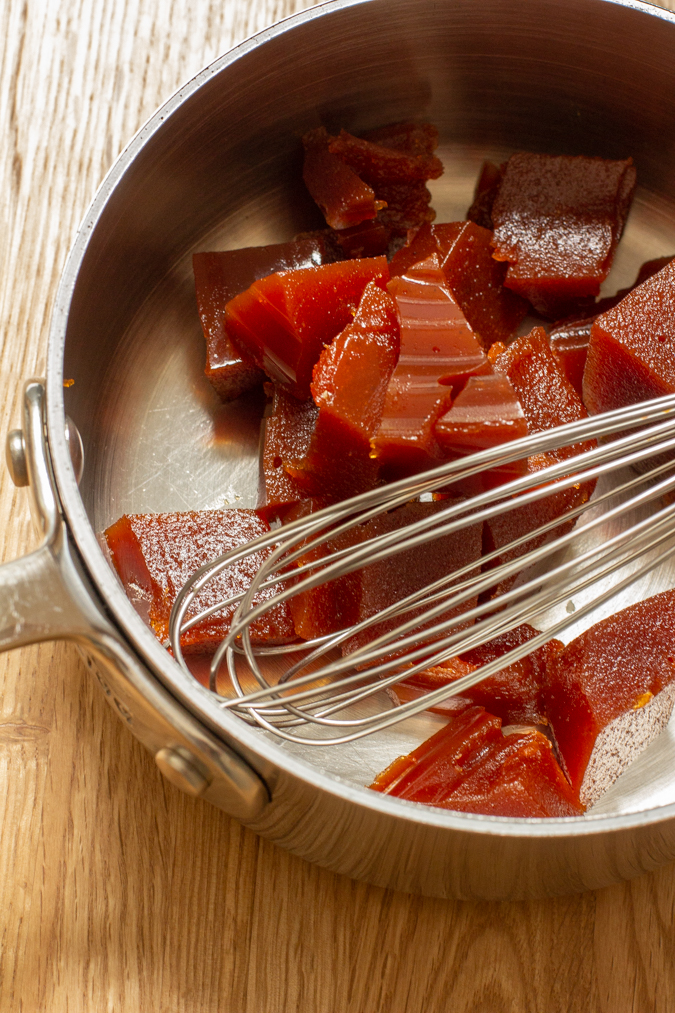
Place the guava paste and 1⁄4 cup of water in a small saucepan. Melt the paste over medium heat, stirring occasionally at first, then more frequently as the paste melts, 15 minutes. You will need to stir vigor- ously, forcing out any lumps in the last minutes of cooking.
Drop a 1⁄2 teaspoon of the hot filling onto the bottom half of a cookie, then place another cookie on top of the filling to make a sandwich (if the filling cools and gets stiff before you finish assembling the cookies, reheat the filling to make it easier to work with). The cookies will keep in an airtight container for up to 5 days.

Reprinted with permission from Short Stack Editions Vol. 33: Chevre, by Tia Keenan (shortstackeditions.com).

Making a Mother's Day Cheese Plate? Turn it up to 11.

If your mom is anything like my mine, she'd appreciate a Mother's Day cheese plate that rocks the dairy boat.
She'd like a Mother's Day cheese plate that was so unusual she'd have to ask twice if the cookies really were supposed to go with the cheese (yessss, Mom). One that featured fermented vegetables and preserved fruit. One that let her enjoy the many layers of her favorite cheeses in ways she never had before.
For Mother's Day, turn your mother's cheese plate up to 11.
Of course you can build a simple plate packed with cheese, and maybe a little honey or dried fruit. But a more contemporary option is pairing cheeses that you know your mother (or the mother-figure in your life) adores to exciting sides and condiments that she'd never cozy up to her favorite wedges on her own. Do the daring leg work for her.

My mom (isn’t she cute?)
Should you be afraid to go bold in your pairings? If you reach out of bounds, will flavors get too extreme or clash?
No, and maybe. In case you're wondering, I can now speak from with confidence that dried mango with chili powder does not play nicely with cheese. Play around after Mother's Day- here are some pairings that are good-to-go now
Tried and tested, these are my picks!
My Mother's Day cheese plate features the lovely Comté: Stepladder Creamery's Cabrillo, Tomales Farmstead Teleeka, preserved lemon, Oreo's or Newman's O's, and Cultured's gingery sauerkraut.
Full disclosure, the Comté Association sponsored my post and asked me to pick 2 more cheeses to feature on the plate. More disclosure, Comté was already one of my top 10 cheeses (so, yay!).
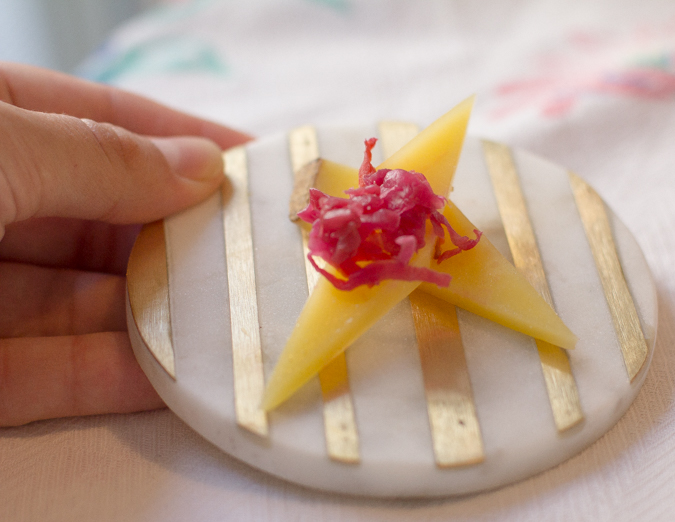


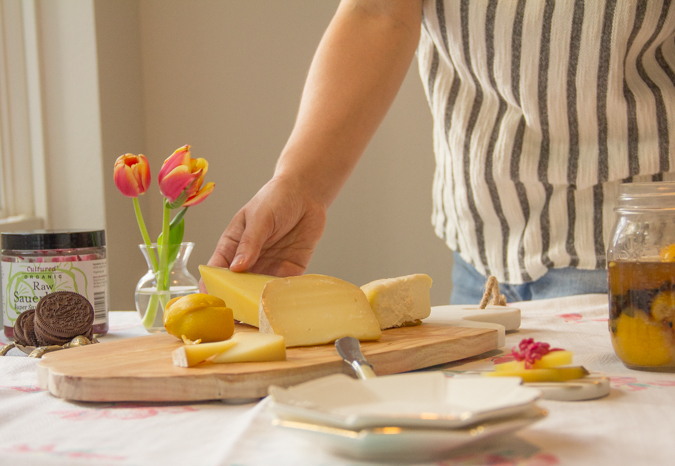

Comté with Cultured's "Super Sauerkraut Salad:" I've recently discovered the joy of pairing krauts and fermented cabbage with this Alpine-style cheese. This one is one of my favorite duos. The kraut's gingery and tangy flavor slices through Comté's richness like a bright acidity wine does a triple-creme, while allowing the cheese's brown buttery and hazelnut nuances shine through. Pair a gingery and bright beet-hued kraut with golden Comté, or go a little bolder and pair with Kimchee (really- it's not to spicy-start with a tiny piece and go as bold as you like it). Even more pairing, you ask? Throw an off-dry Riesling in the mix. But the next way I'm trying this combo is in a grilled Comté and kraut grilled cheese sandwich with buttered country bread.
You can read more about Comté's culture and history here.
Steppladder Creamery's Cabrillo: A goat and cow's milk hybrid, Cabrillo already shows light notes of lemon from its goat's milk so matching it to a preserved, salty lemon felt natural. It made it even more sunny and bright. I also tried it with goji berries, and... well, let's pretend I didn't. Together the preserved lemon and the Cabrillo offer a liveliness fit for a cheese plate, or light appetizers. Another cheese option? Garrotxa, Panteleo, or Pennyroyal Boot Corner.
Tomales Farmstead Teleeka & Chocolate Cream Sandwich Cookies: Goat, sheep, and cow's milk- are you sensing a California theme here? Yup, when goat and sheep's milk cheesemakers don't have enough milk from the tiny producers (goat and sheep provide less milk during certain seasons), they often buy cow's milk from dairy farmer neighbors. This cheese is like a robiola, and the grassy hints of the goat's milk shine through while the sheep and cow's milk provide a thick, creamy texture. I've always loved fresh chevre with chocolate so I decided to test these cookies out here. Delicious. Bright and sweet and earthy. At one point I scraped out the cream filling from the cookie sandwich, replaced it with Teleeka, and liked the cookie even better. Another cheese option? La Tur, Tomales Farmstead Kenne, or Vermont Creamy's Crémont.

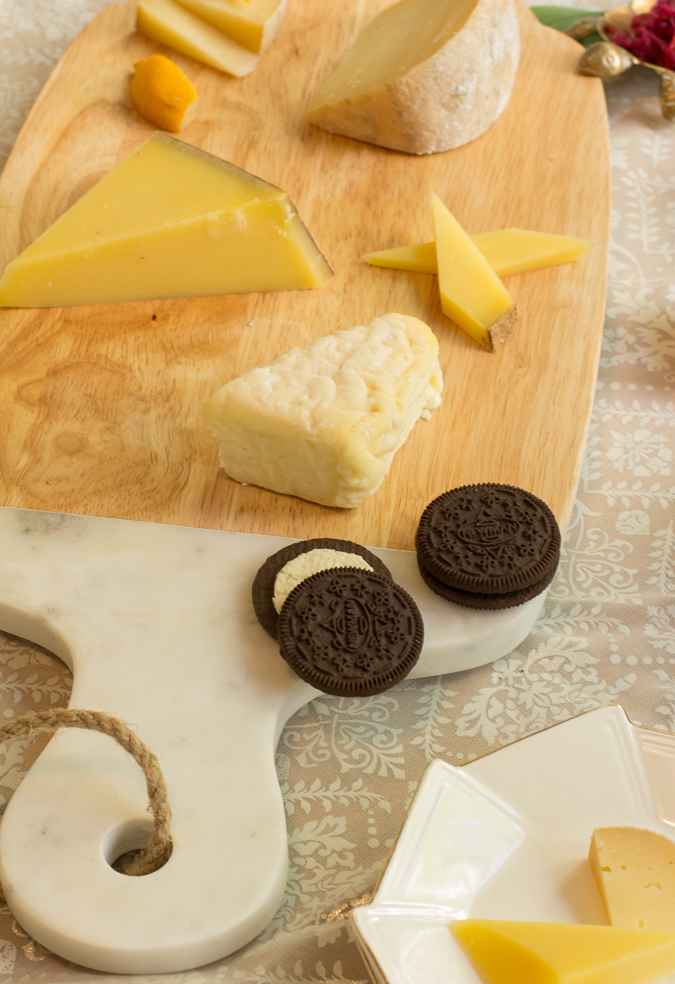
Enjoy your Mother's Day with an amazing woman in your life.

Oh, Hello Goat Cheese: I'm Back, Oozing Wheels & ❤️ Shapes

Oh, hello there! It's been a while, cheese lovers. Goat cheese lovers, this post is for you.
I'm sorry I've been away from this blog for so long (hopefully you've had your dairy needs met in other ways), but I promise I've been away for an amazing reason.
My cheese class business has been as busy as a hummingbird in spring.
As always, I've been teaching public classes at places like 18 Reasons and Preserved (<-- a new one for me, love it), but in the past few months, my private class business has ramped up to 11. It's been wonderful and I'm very lucky! So while I've talked about cheese, paired it, and made it, because I've been doing it so much front of other people, and working on my next book, I haven't had time to blog my heart out here.

Luckily, I just hired a couple wonderful people for inspiration and to help me with the nuts and bolts of the business (oh, hello invoicing and newsletter links). Meaning I'm back!. I'm excited to tell you about what I've been doing while away, too.
I'm been making those oozing goat cheeses! And the little heart shaped one? Yup, made that too. I ❤ making ❤ cheeses (the next time you can learn how to make something like this with me is at 18 Reasons later this month, or in a private class).
I hadn't played around with goat's milk much since I taught a queso fresco fundraising class at Tomales Farmstead (I got to use their own milk, yay!) so I've been having a blast. Using what I learned from making cheese with Sleight Farms, and reading books and testing recipes from some of my favecheesemakingbooks, I developed these little guys here. Of course there was a lot of research and tasting.
Did I mention they ooze? They do. I maaaaay have forgotten one in my cheese cave (otherwise known as wine fridge) for a week too long. Oops.
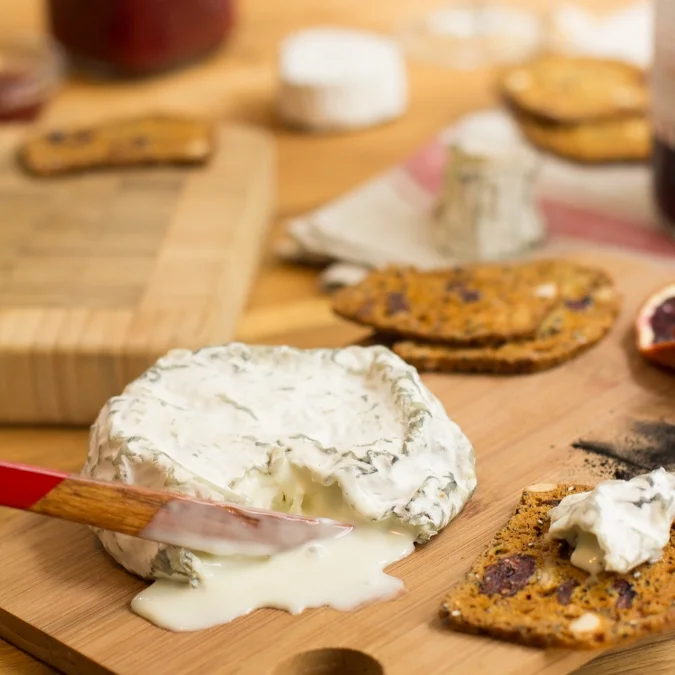
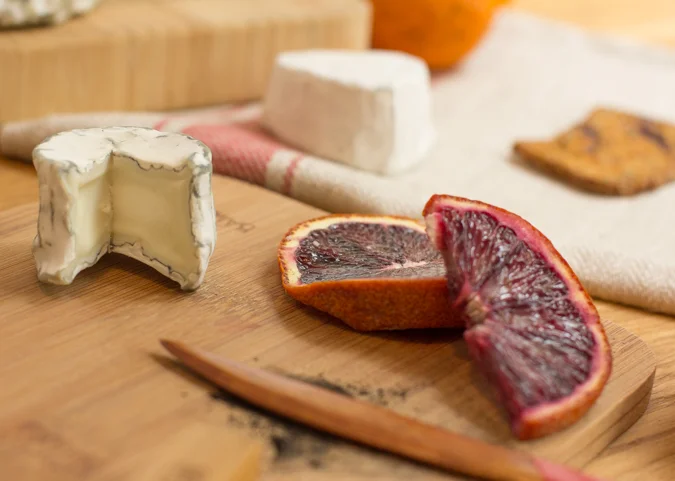

I was also excited to make these cheeses because it's an amazing time to use goat's milk. Those green hills around California from all the rain = tons of delicious grasses and herbs for the ladies to snack on.
This also means it's a great time to buy goat cheese because many goats around the country are likewise getting their nibbles on. My northeastern friends, we've got your back until your goats can prance outside. Stay warm please.
A goat cheese or two I'd give 5 starts to are those made by Stepladder, Capriole's Sofia or Wabash Cannonball, Bonne Bouche, Prodigal Farms beauties, and Ruggle Hill's gems. Just to start. There's a lot of exploring to do, my friends.
Pair with Sauvignon Blanc, unoaked whites and sparklings, Gamay, or Cabernet Franc, and enjoy in front of a fire or Burning Log watching it rain or snow.
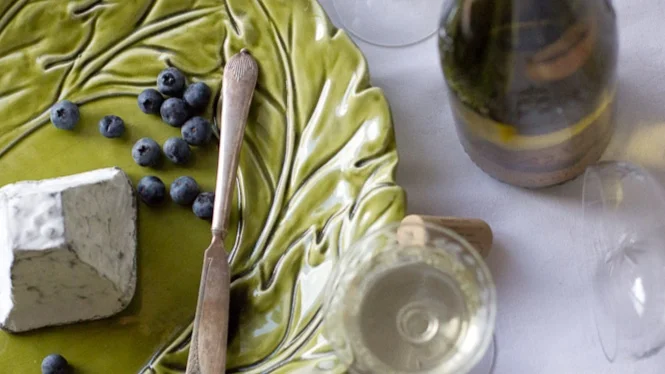
Cheese and Wine Pairing with Baetje Bloomsdale, Goat's Milk Style
I'll be your goat cheese and wine pairing guide. And since Baetje's Bloomsdale is a classic example of a Loire Valley goat cheese, my goat cheese and wine pairing today can be applied to most Loire Valley friends.

Today,I'll be your cheese and wine pairing guide! A couple weeks ago Miss Cheesemonger and I got together to make paneer (you might remember her gorgeous pictures of the fluffy pressed cheese or the recipe link to her blog). Well, we had so much fun we decided to team up again.
Baetje's Bloomsdale: Goat Cheese and Wine Pairing
We decided that Vero would match Bloomsdale to whatever snack the cheese's heart desires and since I'm a wine girl, I would be your booze lady. Cool thing is, this pairing also pays it forward.

Baetje Bloomsdale
Since Baetje's Bloomsdale is a classic example of a Loire Valley goat cheese, today's cheese and wine pairing can also be applied to most Loire Valley friends and many soft, rinded goat cheeses, and the same goes for Miss Cheesemonger's picks.
Now for Bloomsdale.
Bloomsdale's maker, Veronica Baetje, makes cheese in a Mennonite community in Sainte Genevieve County, Missouri. As the NY Times reported when they covered the creamery after a recent World Cheese Award win, Baetje is an inspired creamery. Bible quotes grace her labels and the Baetje considers themselves devoted followers. Yet she's very modern and not afraid to stray from the course. From driving her used Porsche through Mennonite sedan-country to making time-consuming goat cheese that could topple over a Valency in a cheese competition, Veronica is not afraid of doing things her own way.

Bloomsdale getting ready for its cheese and wine pairing party
Her cheese shows this. That little number above is made in the traditional Loire Valley goat cheese style. Meaning it's a lactic-acid set cheese covered in a thin layer of vegetable ash over which a thin white layer of Penicillium Candidum mold grows.
Which brings us to goat cheese and wine pairing. There are two things to mind with this little Bloomsdale when pouring a glass of juice.
1.When pairing soft- in this case lemony and sometimes lightly grassy- flavors with wine, keep it simple. Cheesemakers work hard to preserve those lovely subtle notes in their cheese and you don't want to pick a wine that overwhelms them. Don't go too big.
2. Bloomy rinds are fussy, and their lists of annoyances are as long as Kanye West's. They dislike a lot of oak- doesn't let them stay the star of the show. They don't like tons of red fruit- gets in the way of the PC mold. And when left in a room together bloomy rinds and tannins dry the mouth and have been known to get into a slapping fight (it's embarrassing, really).
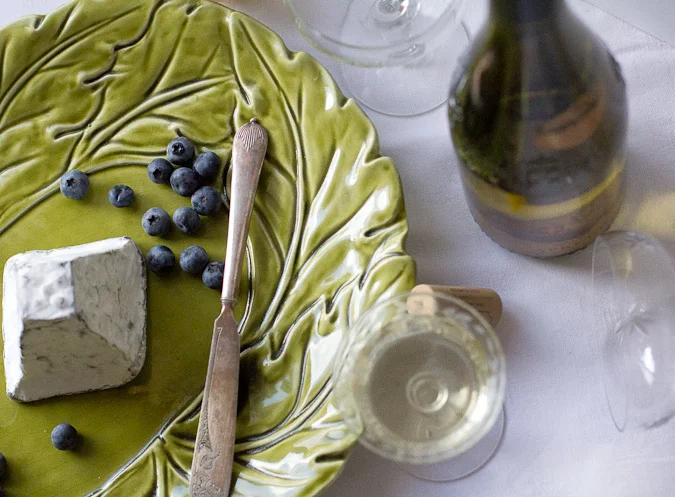
Cheese and wine pairing, on.
Goat Cheese and Wine Pairing Picks: Bloomsdale
The type of wine to focus on for a cheese like Bloomdsale is a wine like Chasselas from the Savoie region of France, pictured in the third photo above. Though un-oaked, it's lightly creamy mouthfeel mimics soft Bloomsdale. Sur lie-style Muscadets (made with the Melon de Bourgogne grape) and light sparkling cremants would have a similar effect.
Another way you can go is go citrusy and zippy. Not surprising because it's from the same region as any Loire Valley cheese, Sauvignon Blancs make a perfect goat cheese and wine pairing. You can extend this to a lean Chablis too. But stay away from uber-fruity wines. They will overwhelm.
If you need to go red for your cheese and wine pairing, try a Beaujolais or Cabernet Franc. Most are zippy and have low oak and tannins (see consideration #2).

I've left a glass on the table for you.
Head on over to Miss Cheesemonger's blog to see the second part!
LaClare's Katie On Cheese Love & Flipping Curds at Nine Months
She said, “It hit me like a ton of bricks.” Katie, who wanted to involved in the farm life but didn’t want to have to milk the family’s goats twice a day or clean out their pins, thought cheese was the perfect answer.
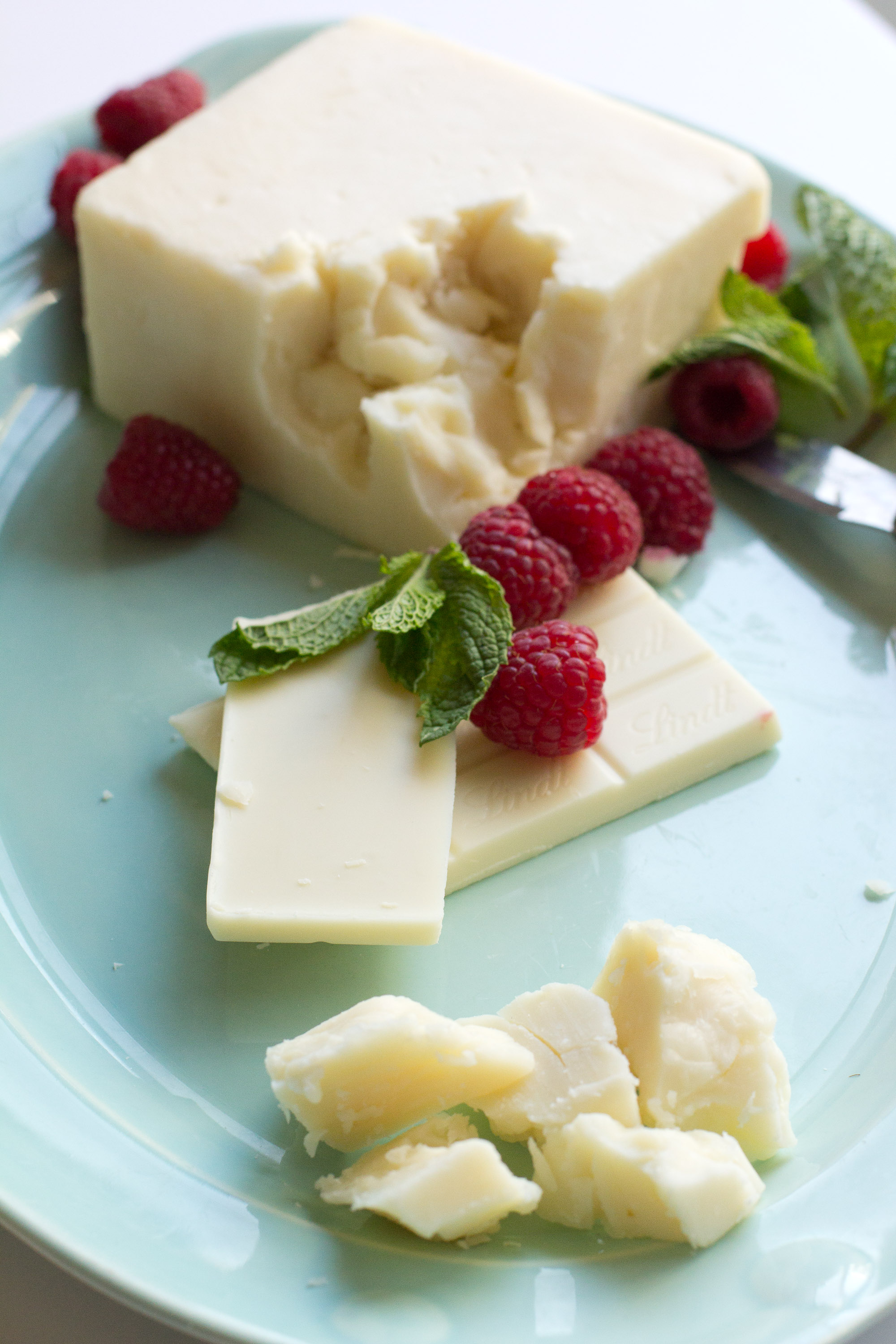 After sharing a drink or two with my friends at the Wisconsin Milk Marketing Board at the last American Cheese Society Conference, we decided to collaborate on a project (this is how most things get done at ACS). I’d get to pitch a topic. My pick? The female cheesemakers of Wisconsin. I’d tell the stories of my choice of four of my favorite women cheesemakers in a series of blog posts. I loved interviewing these ladies, what they’re doing, and thank them for their time. This is the third of the series, focusing on Katie Fuhrmann of LaClare.
Katie Fuhrmann of LaClare Cheese and I first met at the Sonoma Cheese Conference about three years ago. We were sitting across from each other at an outdoor patio after the sessions had wrapped up, beer in hands, and we both looked up and met each other’s eyes. I was super impressed after just trying Katie's Evalon for the first time at a sample panel, knew she was just opening her new and first creamery at the age of twenty-eight, and really wanted to meet her. Having the intention of befriending the brunette Wisconsin curd magician and being so very smooth as I am, I turned to her and said...
“I, ah, I like your cheese.”
I think she was very impressed (could have been her Midwestern politeness). We became quick cheese friends.
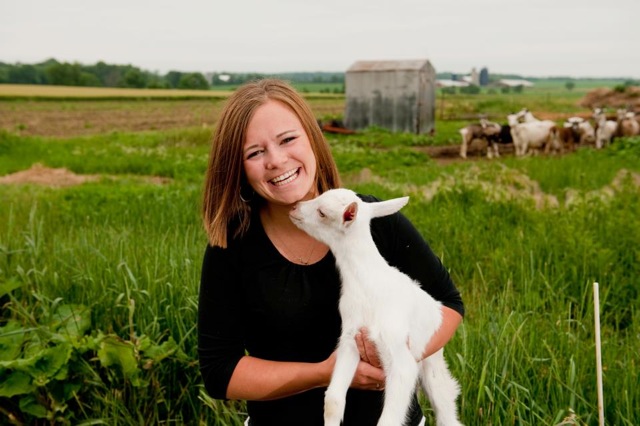
When LaClare's clothbound Standard Market Chandoka won runner-up Best in Show at the American Cheese Society Awards I, like many in the cheese world who continuously root for the talented and sweet cheesemaker, were very happy. The cheesemaker, however, was very surprised (and the very modest company has not yet even updated their website to reflect the victory).
Today’s LaClare's most widely available cheeses are Chandoka, Evalon, and Martone. Chandoka, featured above, is a goat and cow’s milk hybrid made in the style of a New Zealand cheddar with sweet lemony notes and fluffy consistency (note to cheese geeks New Zealand Cheddar makers simply stack the cheddar slabs on one another rather than flipping them over as is done with English Cheddar). Her Evalon is a subtle, lightly caramel-like goat’s milk gouda. Her Maratone, below, is a fresh and light goat and cow’s milk hybrid shaped into a tiny, cheese-plate friendly mound covered with ash.
How does one that is twenty-eight go on to start winning Best in Show awards two years after launching her own creamery?
Skills and gumption it seems. Katie was always ambitious when it came to the LaClare family farm. Knowing that she wanted to contribute to the family, she started making her own soap on it at sixteen. Then, in 2008 when the family started shipping off their goat’s milk to a creamery to be made into cheese, Katie took note.

She said, “It hit me like a ton of bricks.”
Katie, who wanted to involved in the farm life but didn’t want to have to milk the family’s goats twice a day or clean out their pins, thought cheese was the perfect answer.
She started learning how to make cheese under Nathan Deahny at Saxon Creamery, who at that time was making cheese with LaClare’s milk. The mentorship relationship was ideal and within years Katie was applying for her license, moved her cheesemaking to Cedar Grove (another Bob Wills inspired maker) and then to Willow Creek. Other cheesemakers she’s cut curds next to during her learning process have been Bruce Workman of Edelweiss, Chris Roelli of Roelli Cheeese, Bob Wills, and Jon & Dave Metzig. Cheesemaking in Wisconsin is apparently supportive.
“There’s a sense of community and respect, no competition. Just, 'Hey nice job at that cheese you made',” says Katie. “We all want to represent Wisconsin and that it was built being a dairy state.”
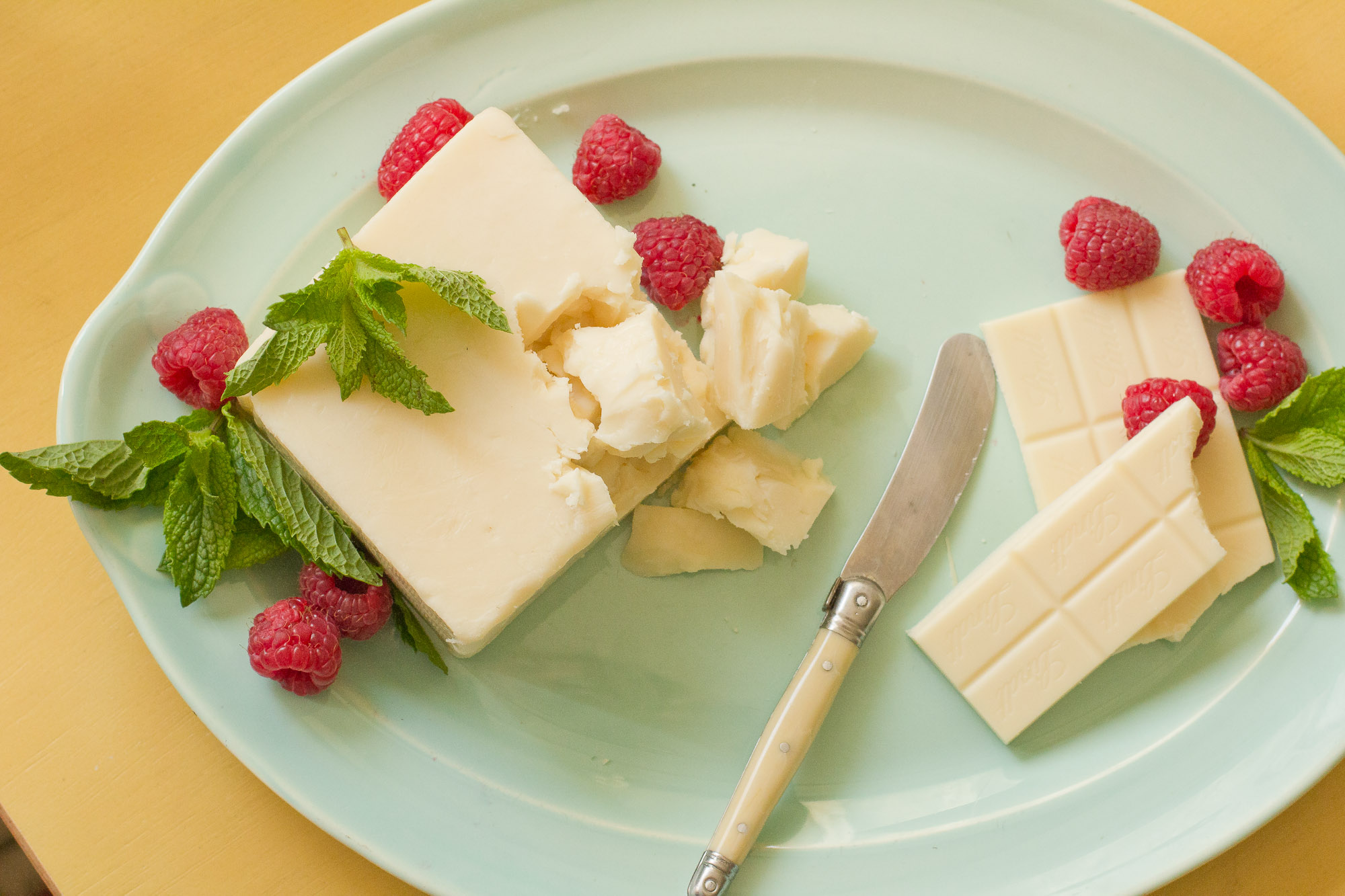
Besides the makers she worked next to, Katie also sites the last “Women in Wisconsin Cheese” focus, Marieke, among her biggest influences. Sure, for her talent and prowess (both make some of the country’s most respected gouda styles), but thoughts of Marieke in particular crossed her mind when she was recently making cheese and over nine months pregnant. Marieke made cheese almost all the way through when she was pregnant with her own five children, and so did Katie. As it became harder to shuffle curds around the vat, Katie told herself, “If Marieke can do it, I can do it.”
“I used a stool to reach into the big vat because my pregnant belly didn’t fit over it anymore,” says Katie, laughing, “you just twist and turn and make it work.”
Katie worked up until the day she gave birth, saying she had plans to start the day's cheese, then go into the hospital. As it was, Katie went straight in.
But her brother still teased her about missing the day.
"He told me since Charlie was born at 8:30 am, I could be back in time for the audit!," which was scheduled at 9am.
Word is, she took the entire day off.
The posts were sponsored, and edited only by me.
Cheesemaking with the SF Milk Maid: Gosling goat cheese
We’d make the Gosling in one day, she’d leave me with the newly formed pyramid, and then I’d baby and flip it in my fridge for two to three weeks until it passed through cheese adolescence into adulthood.
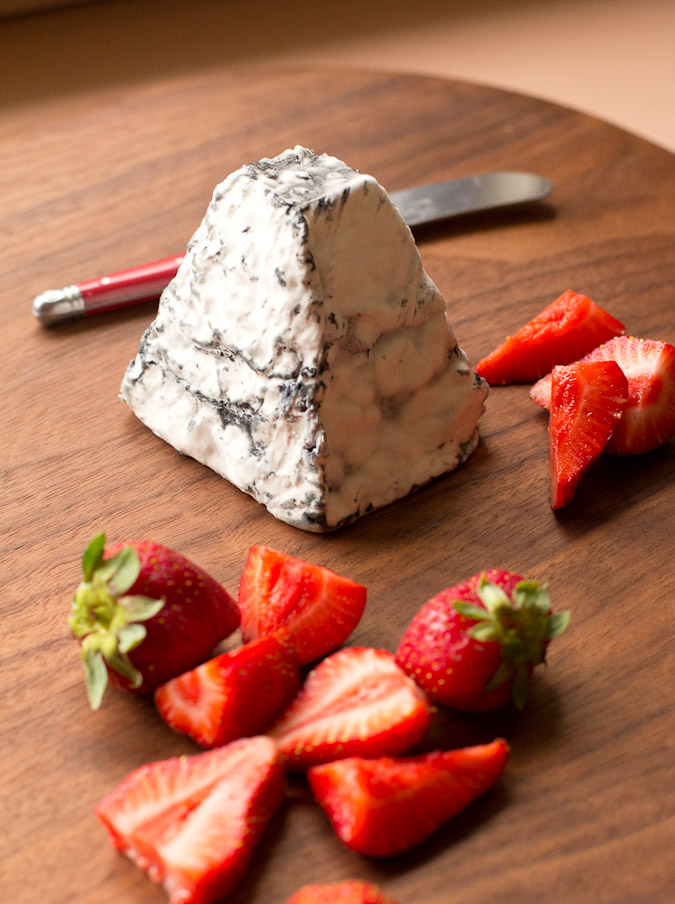 If you've ever taken a class with the SF Milk Maid or flipped through Louella Hill's new cheesemaking book, Kitchen Creamery, you've probably had a moment much like the ten or eleven of those I've had recently where you find yourself shaking your head in amazement, asking, how does one person know so much?

Louella's book is packed with more cheese types than you though any one human would be able to make, her hand-drawn illustrations accompany the wheels so one can see what rogue bacteria may be to blame if there are too many divets in your brie, and when Louella's not writing a book, she can be found teaching classes around the Bay Area. She kinda does a lot.
One of the original employees of Narragansett Creamery and the owner of SF Milk Maid, a cheesemaking business that teaches people how to properly stretch curds, Louella's got a breadth of cheese knowledge under her belt that far surpasses even the amount of cheese that the average French person keeps in their fridge during a year. And she's nice, and, a big believer in the glory of butter. In short, she's lovely.

So when the Louella asked me if I wanted to make Gosling with her at home, I said hell yes. My quick yes could have also been me wanting to make a cheese called Gosling, but mostly I said yes because I wanted to play with this lovely woman in the kitchen. Our cheese of choice? A Loire Valley-style, ashed goat cheese pyramid that looks like Valencay. It was the first time I worked with goat's milk since returning from Sleight Farms in Somerset, England, and I was beaming.
We'd make the Gosling in one day, she'd leave me with the newly formed pyramid, and then I'd baby and flip it in my fridge for two to three weeks until it passed through cheese adolescence into adulthood.
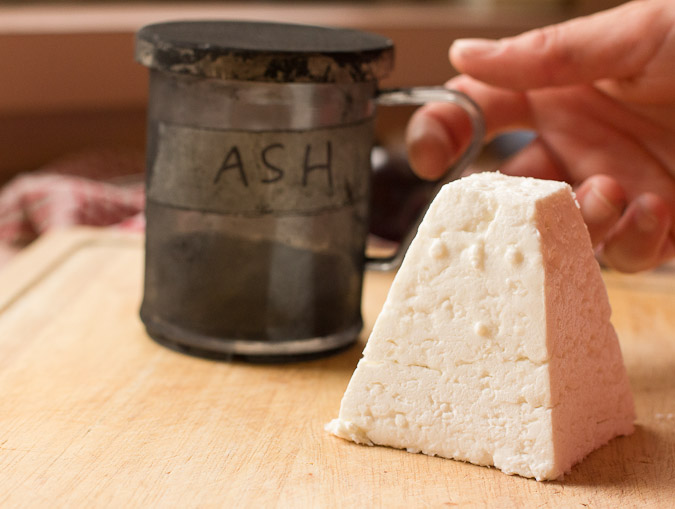
Louella's publishers were nice enough to share the recipe for the beauty below, but I'd also highly recommend Louella's book. It's beautiful, down-to-earth, and clear.
Thank you Louella, for cutting curds with me!

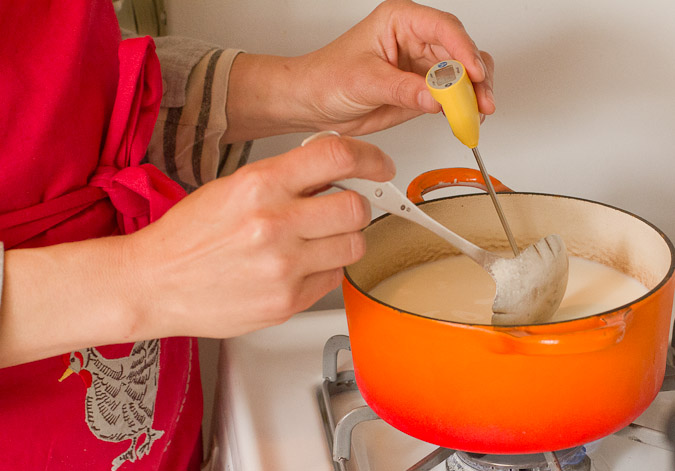
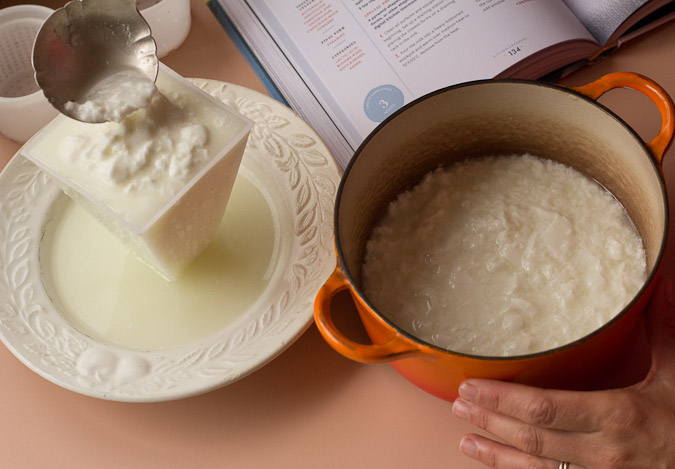



Gosling, Valency Style Cheese- adapted from Kitchen Creamery, Chronicle Books, 2015
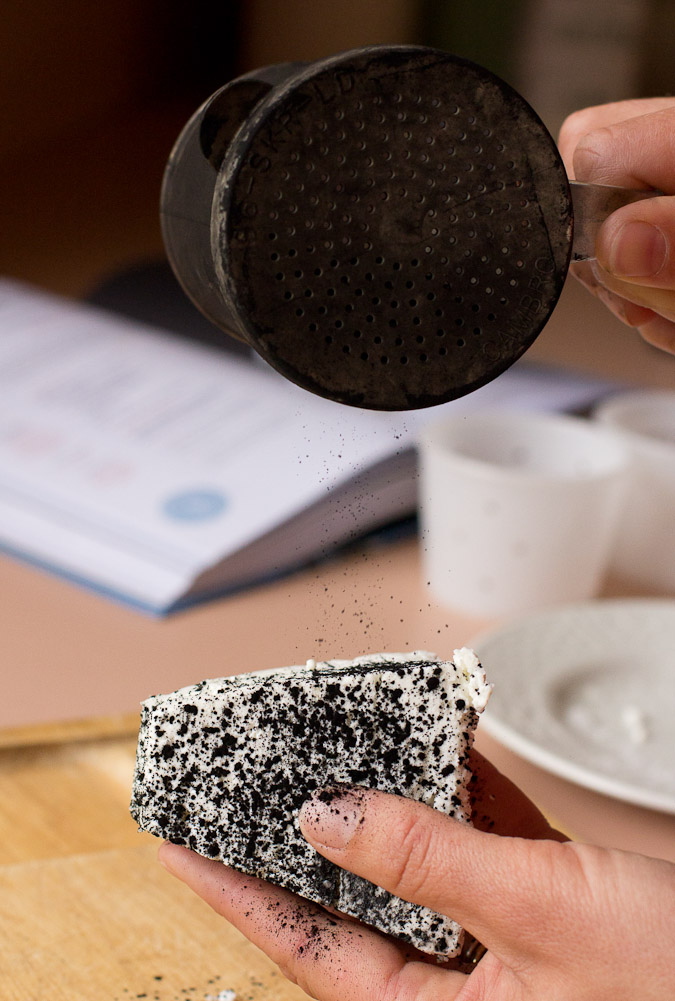
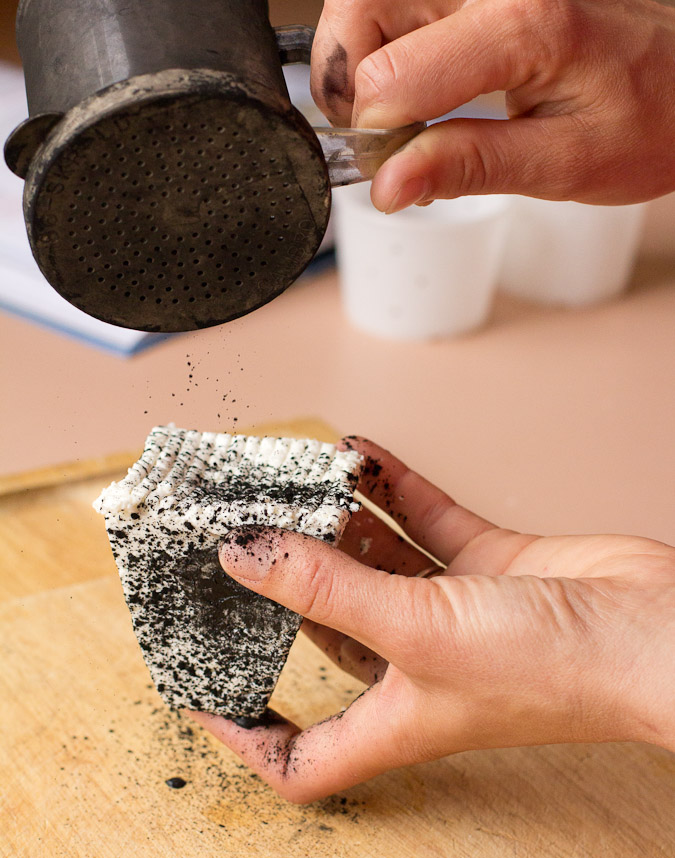
These pyramid-shaped cheeses are pure entertainment. At first, they’re firm, geometric and black with ash: brand new. A week later, they’re fuzzy and gray: adolescent. With time, they become white with softened edges: middle-aged. Finally, they slump as the insides become soft: mature. This recipe can be made with cow milk if goat milk is not available and, traditionally, Valencay is an unpasteurized cheese. This recipe is very similar to the Chevre on page XX.
2 gal goat milk 2 tbsp buttermilk 4 drops rennet, undiluted pinch of Penicillium candidum mold powder tinier pinch of Geotrichum mold powder 2-3 tsp salt
Materials: 4 pyramid-shaped cheese forms, 2 tsp food-grade vegetable ash Yield: three to four pyramids, ~8 oz/237 ml each 1. Pour milk in a pot and warm to 72˚F/22˚C. Turn off the heat.
3. Add buttermilk plus mold powders then stir in gently.
4. Now add the 4 drops of rennet. Stir the rennet in then cover the pot and leave in a warm, undisturbed location (free of cold drafts or vibrations) for 15 to 17 hours. If needed, incubate the pot to keep the temperature from fluctuating too much. When curd has firmed up, you will notice a small amount of yellow whey collected on the top and sides of the curd block.
5. Using a ladle or large spoon, scoop curds into clean pyramid forms. It may seem there is too much curd for too few forms. Wait 10 to 15 minutes for the level of the curds to drop, and then fill them to the top again. Continue doing this until all the curd has been used. If clear that the curd amount is disproportionate, add another pyramid form. Set filled pyramids inside a tall, clean plastic aging bin, with an aging mat inside on the bottom. Place lid on tub and allow pyramids to drain for 4 hours. You will need to periodically remove whey from the tub so that the cheese is not sitting in liquid.
7. After 4 hours, invert the pyramids on the aging mat (when cheese has firmed enough to allow you to do so). Pour off any whey as it accumulates in the bottom of the bin.
8. After another half day at room temperature, remove cheese from their forms. Drain and dry the plastic tub, then return cheeses to tub (without forms). Set them them on top of the aging mats.
9. Sprinkle each pyramid with ½ -3/4 tsp of salt over all surfaces as evenly as possible. Allow salt to soak in the salt while continuing to draining in covered bin at room temperature (removing built up whey from the bottom of the container as needed). Drain for 12 more hours.
11. Once cheeses have stopped releasing whey, cover them with vegetable ash; In a draft-free area, use a saltshaker filled with ash to sprinkle all surfaces of each pyramid.
12. Finally, move the salted, ashed cheeses to a dry bin. Set on top of dry, clean mats. Cover with lid and place in the refrigerator for 3 – 4 weeks. Twice a week, rotate the cheeses and remove accumulated moisture. When the cheeses are covered in a downy grey / white mold, they are done. Wrap in breathable cheese paper and store in the refrigerator for up to 3 more weeks.

Strawberry Rhubarb Balsamic Compote (Looooves Goat Cheese)
In the theme of spring, baby goats jumping about fields, goat cheese, and the most amazing sweet strawberries I've tasted in years (are they candy, are they strawberries, are they candy-strawberries?), I wanted to share again with you one of my favorite recipes for cheese
 In the theme of spring, baby goats jumping about fields, goat cheese, and the most amazing sweet strawberries I've tasted in years (are they candy, are they strawberries, are they candy-strawberries?), I wanted to share again with you one of my favorite recipes for cheese. I developed this recipe after talking to my relatives in Minnesota last year about our local farmer's markets. Mine seemed almost completely red they were so flooded with strawberries, I told them. Walking through their's, they said, felt like they were wading in rhubarb.
Now, I love the combo of strawberries and rhubarb. And I love pie. And I see where someone else might have gone with this. But since I also love goat cheese, and strawberries and rhubarb taste awesome with goat cheese, and and I am worse at making pie dough then I am at holding to new year's resolutions of being able to do a pull-up by the end of May, I decided to focus on a strawberry-rhubarb balsamic compote instead that pairs excellently with cheese. Win-win?

It's sweet, but it's also tart. It's dessert-like, but it's also has enough freshness to it that you could spoon it over your oatmeal in the morning and feel like you were getting a serving of fruit (in a completely gratuitous way).

The cheese I created the recipe for is Pug’s Leap Pavé, above. Pug’s Leap is a much-loved Petaluma creamery that went out of commission for a while while transitioning to different ownership. Well, as of about two years ago, it’s back, and producing lovely bloomy-rinded, French styles that are lively, thick and flaky, and slice-ready for being put on a crostini with strawberry-rhubarb balsamic compote. And not only do they make their own cheese, they supply milk for the lovely Gypsy Rose family too. And did I mention that they have a flying pug on the label?
Try this compote next time you have brunch, serve a heavy meal and want to keep your dessert light, or, over ice cream or yogurt. Then keep your leftovers for toast or oatmeal the next morning.
Strawberry Rhubarb Balsamic Compote

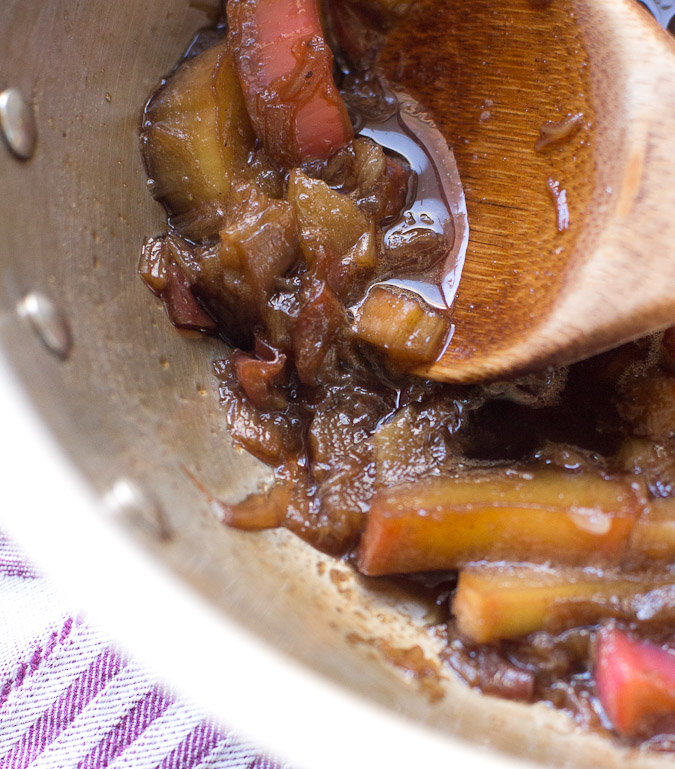
Strawberry Rhubarb Compote
1/2 pound rhubarb- sliced half an inch thick
1/4 cup plus 1 tablespoon granulated white sugar
1 tablespoon honey
1/8 tablespoon freshly ground pepper
3 tablespoons balsamic vinegar
2 cups sliced strawberries- sliced a quarter inch thick.
In a medium saucepan, combine the rhubarb, sugar, pepper, honey, and balsamic and stir with a wooden spoon. On high heat, warm until the balsamic starts bubbling. Once bubbly, reduce heat to medium-low. Cover the pot with a lid, leaving it slightly ajar so steam can escape. Cook for seven minutes, lifting lid to stir occasionally. Take off the lid and cook for two more minutes, or until half of the rhubarb in the pan is soft and dissolving, like in the fifth photo above. Add the strawberries to the pot and stir. Continue cooking on medium-high heat for ten to fifteen more minutes, until the strawberries start to soften, but still keep their shape. Cool, then serve with your favorite goat cheese!