

The Cheese Blog

A Visit to Tomales Farmstead: When a Guild Class Means Baby Goats
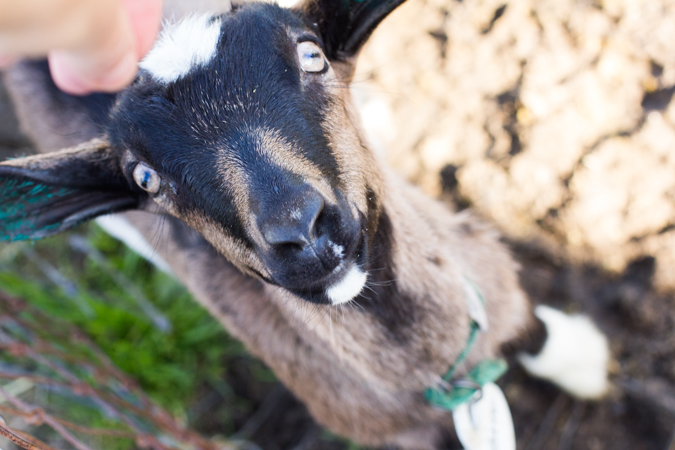
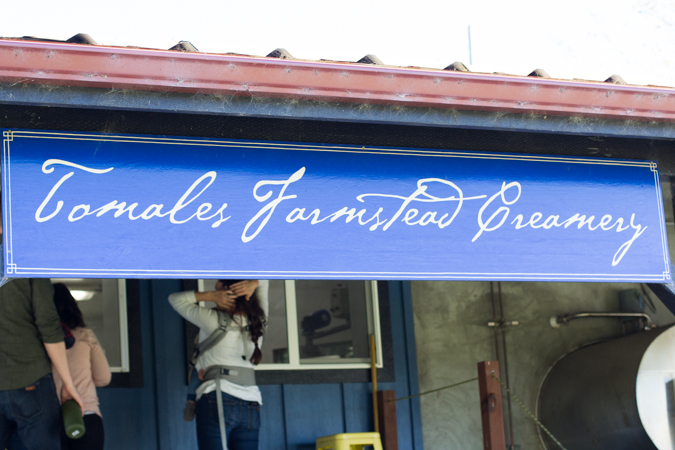


Early December I had the lucky opportunity to visit this dear kid above. Just as snuggly as she looks, Sweet Pea (whose given name I may have forgotten) pranced up to the fence to demand head scratches and nibble on my fingers. Only a year or two from now, Sweet Pea will not only give snuggles, she will be a valuable milk supplier to Tomales Farmstead Creamery.
Classes at Tomales Farmstead mean baby goats.
This post is a photo dairy of my recent visit to Tomales Farmstead, where I taught a class to some amazing cheese lovers who bid on a class with me at the creamery to raise money for the California Cheese Guild. Bless you, cheese lovers.
After a farm tour and tasting (which anyone can arrange) I taught the class how to make cheese: whole-milk ricotta from the farm's goat milk and Straus cow's milk, traditional ricotta from leftover whey, and queso fresco with milk from the creamery's goat herd. Raw milk, ya'll. This was one of my favorite classes to teach.
Not only did I get to team up with Hadley, one of the Tomales Farmstead cheesemakers (below) and ask her geeky cheese questions, I got to cuddle with her baby between culturing and pressing the queso fresco. Classes at Tomales Farmstead can mean human babies, too.


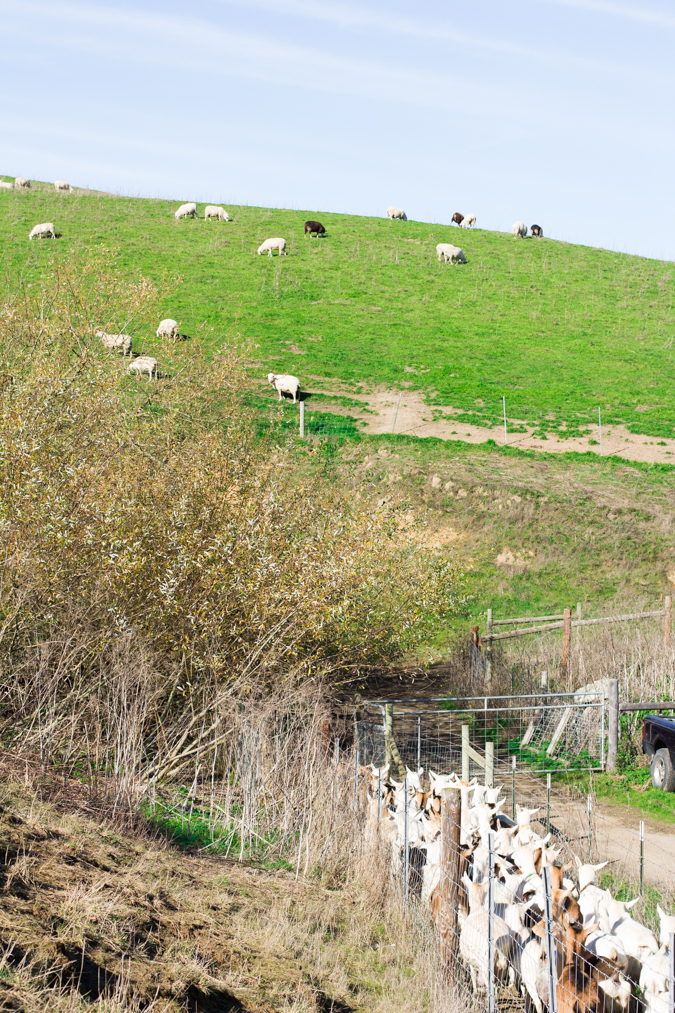
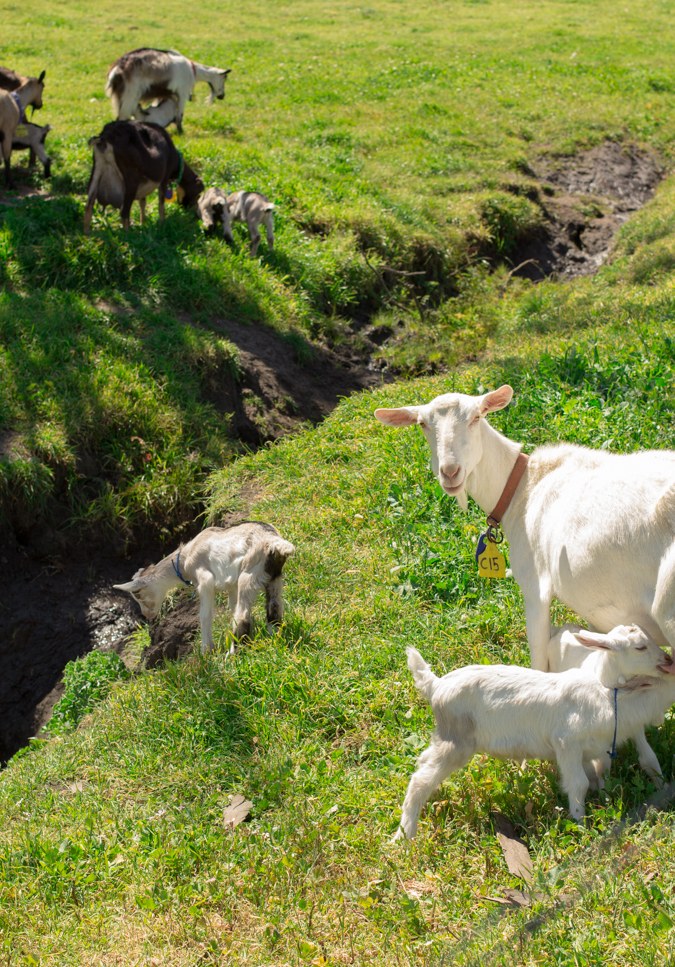
We visited the growing babes, attempted to herd some goats to the pastures after being milked, peeked in the creamery, and made and likely each ate more cheese in three hours than one should in a week. That's all to say that we left very happy.
Thanks for the opportunity, Tomales Farmstead! I look forward to joining you again soon.

Baby Tomales Farmstead Atika

As a heads up, if you, like me love the combo tour and class events, I'll be teaching a Cheesemaking 101 class nearby at Point Reyes Creamery's The Fork on Saturday, January 13th. We'll tour the farm, visit the creamery, taste Point Reyes's lineup, have lunch, then make cheese with the same milk and cream used for beauties like Bay Blue. Queso fresco, creme fraiche, cultured butter, and ricotta. Tickets up.
Kitchen Curds: Farmers Cheese
Let's start off with a warning. If I hear about any of you stealing cheese from a farmer, you will be expelled from all Kitchen Curd activity. Unless, that is, the farmer has a daughter who appreciates that sort of thing. Then you have my blessings. With this in mind, the next Kitchen Curd assignment is ..... Farmer's Cheese.
 Let's start off with a warning. If I hear about any of you stealing cheese from a farmer, you will be expelled from all KItchen Curd activity. Unless, that is, the farmer has a daughter who appreciates that sort of thing. Then you have my blessings.
With this in mind, the next Kitchen Curd assignment is ..... Farmer's Cheese.
Like Mozzarella, this is a fresh, unripened cheese, made in vast quantities on farms (and, according to the internet, by many sweet Polish grandmothers). Why is it called Farmer's Cheese? Because this fresh cheese requires little attention, is easy to make and is something farmers often make at home when wanting to put their fresh goat, cow or sheep's milk to good use without having to worry about aging or storing the cheesy results for long periods of time. They can just eat it.
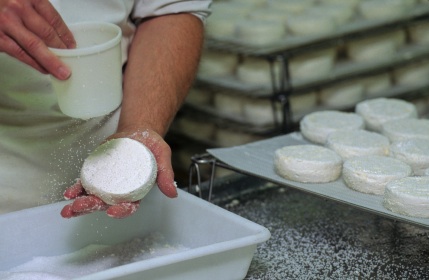
Although the type of Famer's Cheese whose recipe many of us will be following in the Home Creamery book is simply listed as "Farmer's Cheese," both chevre (like the Poitou Chevre pictured above) and Neufchatel fit into this genre too.
Like in most Kitchen Curd events, I’m using recipes from the Home Creamery book by Kathy Farrell-Kingsley, but you can use any recipes you’d like. The Farmer's Cheese recipe can be found on page 66.
Kitchen Curds Guidelines:
- If you’re interested in making the pre-selected dairy good (always open to suggestion) at home, and can do so by the selected due date, then….
- Make the choosen dairy product at home (your home). Warning: Check your recipe at least 2-3 weeks prior to beginning your cheese. Few (like Farmer's Cheese) require products, such as rennet, that generally need to be special ordered.
- If you have a blog, send me the link to the post where you talk about your Kitchen Curd experience - good, interesting, funny, delicious or just plain bad. I’ll post your link on the assigned “Its Not You, it’s Brie” cheesemaking post. If you don’t have a blog, share your experiences in the comment section of the the post where I list the links to the Curd blogging adventures (this post won’t emerge until about a wk. after the links due date).
- Send me your links by the last day in September.
- Have fun!
Kitchen Curds: I've Got your 180 Degrees Right Here
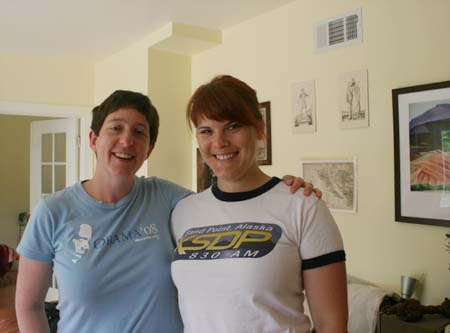 Three girls (Penny, Molly and Kirstin), two non-reactive pots, a book with misprinted temperature instructions, and a whole lotta curd love = a Kitchen Curd Party!
We met at noon, on a dark and stormy day. The eagle had landed, and she brought whole milk, citric acid, rennet, butter muslim, a thermometer, strainers, and snacks for sustenance until the cheese was ready. After nourishing ourselves with sparkling water spiked with peaches and lime and Blue Bottle coffee, we decided we were ready to start the Curding Process. It was time to heat up the milk.
Using the recipe from Kathy Farrell-Kingsley's Home Creamery book (pgs.84-86), we brought the milk to 88 degrees and added the citric acid. After the milk reached the prime temperature, we dissolved rennet in cool water and added the mix into the pot. 15 minutes later, we returned.
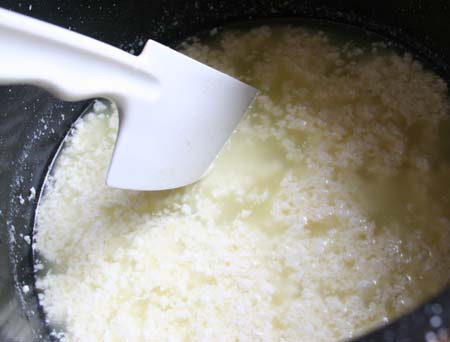
Back at the pot, curds were ready to greet us. Not the type that one could slice into one-inch sqaures like the Home Creamery book suggests, but curds just the same. No one was discriminating. They were little, they were real and we made them.
Next step - heating the curds to 108 degrees for 15 minutes, and stirring frequently. As the mixture rose in temperature, the whey slowly expelled, the curds became tighter and firmer, and Penny and I brought eight cups of salted water to 108 degrees in a separate pot while Molly cooked us fresh scallops (not in book, but highly recommended).
Penny and I took bringing those eight cups of water to 108 degrees very seriously . Between scallop bites, we took the water's temperature. A lot. Both of us. I think I even heard Penny assuring the water to come to the proper temperature only when it felt the moment was right, that we would wait just as long as it needed.
While the water was warming, we spooned the curds into a butter muslin-lined strainer. They were beautiful. After letting them sufficiently drain and cutting them, we placed them in a bowl, over which we prepared to pour the 108 degree water.
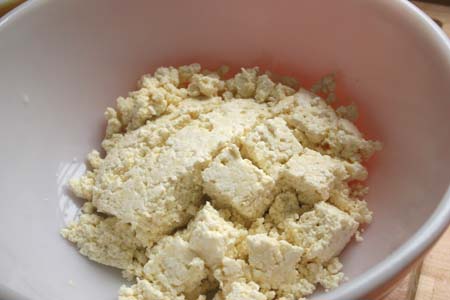
Then we added the water to the bowl to melt the curds.
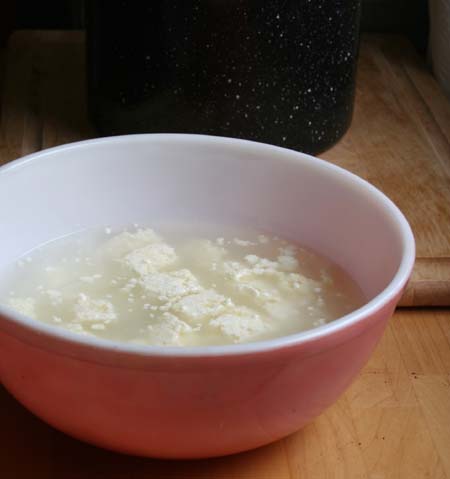
The girls told me I should be the first one to stretch the melted curds. Having heard before that only people with Italian blood running through their veins were allowed to stretch mozzarella, it was with wide eyes and a happy heart that I washed my hands, did a few lunges and neck rolls, and slipped my fingers in the bowl.
Instead of becoming a lovely lump, however, ready to be stretched into taffy-like submission, the curds separated. They fell apart in my fingers.
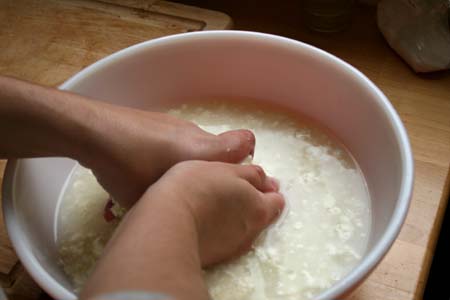
While Penny worked to convince me that it wasn't my Norwegian-American touch that caused the curds harm, Molly scanned the internet for what went wrong. We soon learned that, just like the twins in the Parent Trap, the "8" and the"0" had switched places. Unfortunately, this was in the part of the text that read "heat to 108 degrees." But there was still hope.
Next post: How to Fix Broken Curds: A Life Lesson.
Check out these other awesome Kitchen Curders who made mozzarella. Successfully. Anyone else who would like their link added to this post, please email it to me at itsnotyouitsbrie@gmail.com, or slip it in to the comment section below. Thank you for participating!
Girlichef made hers in the microwave in 30 minutes, and she stretched her curds magnificently.
Simona, at Bricole, made mozzarella two or three months before everyone else. That's skill.
* many pictures taken by Molly, the official "It's Not You, it's Brie" group and goat photographer.