

The Cheese Blog
Tomme Brulée: Blowtorches in the Cheese Cave
If you walk into a cheese shop and ask for Basque cheese, chances are you'll be led to Petit Agour or Petit Basque. Some wheels, made in small production batches, will be amazing. Others, made by larger companies in factories, are little more than pale interpretations of the real thing- like fat free cake with sugar free frosting, or roller blades instead of the four wheelers. But there's another sheep's milk that's escaped the Pryenées that shouldn't be missed.
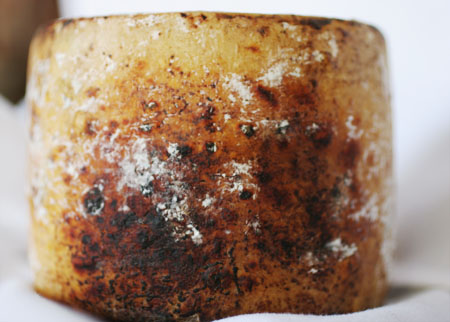 If you walk into a cheese shop and ask for Basque cheese, chances are you'll be led to Petit Agour or Petit Basque. Some wheels, made in small production batches, will be amazing. Others, made by larger companies in factories, are little more than pale interpretations of the real thing- like fat free cake with sugar free frosting, or roller blades instead of the four wheelers. But there's another sheep's milk that's escaped the Pyrenees that shouldn't be missed.
Tomme Brulée is Petit Basque burnt to another level.
Aged by Affineur Pascal Beillevaire, Tomme Brulée is a pint-sized sheep's milk cheese with a bruléed rind. But before it goes crispy, it starts out like many small Basque style cheeses.
First, the milk for Tomme Brulée (translates to burnt wheel) is cooked slowly so that the sugars caramelize a touch. Sheep's milk has its own characteristic sweetness, and cooking the milk at low temperatures brings out even more of the sugar inherit in it. Then, the curds are separated from the whey, the wheels are shaped, and drained. Next, the cheese is heavily pressed to create a rich, hole-free paste and left to age.
Then at some point in its aging process, it's burnt. I'm not exactly sure when it's bruléed, so if anyone knows, help a girl out. But at one point or another (I'm assuming a couple months after its left to mature) someone takes a blow torch to the rind and flambées it.
Now I don't know if you've ever have the opportunity to burn a brulée crust or handle a blow torch in a kitchen, but its pretty much one of the coolest thing one can do with a food product besides this. I mean, you have a blow torch. And you are turning sugars into a hard crust that someone will joyously break with a spoon or, a blistering a rind that transforms a shepherds cheese into a cheese oddity. Sometimes the blow torch is huge too and you feel amazing holding it. You probably look great too (wink wink).
And the flavor? Well, honestly, it's really similar to a Petit Agour or Petit Basque. But it has an extra little smokey, caramel kick. Like the cookies of my my ex-in-laws made with a cigarette between her lips at Christmas time (but, you know, a lot better).
I like this cheese with a Viognier or a creamier white with a touch of oak. It fares well on a cheeseboard, but its smooth paste is also great for melting.
Have you tried this burnt beauty before? What did you think?
Roccolo Cheese: The Holy Lombardic Trinity
Roccolo is a dream cheese. It is a holy trinity cheese. It is soft and firm and crumbly all in one. It tastes crazily varied from rind to center. It smells a little different in spots.
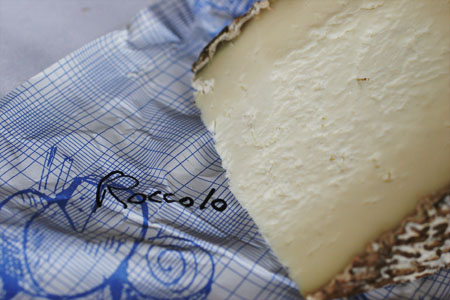 Roccolo is a holy trinity cheese. It is soft and firm and crumbly all in one. It tastes crazily varied from rind to center. It smells a little different in spots. In other words, its three distinct layers offer a cheese lover three cheeses for, well, .... more than a fraction of the price of a block of colby, but you get more than just orange and yellow cheese that tastes nearly the same no matter the hue.
Roccolo comes from Lombardy, Italy. Made by cheesemaking enterprise Arrigoni Valtaleggio, a large family company that helped to spearhead Tallegio imports, Roccolo is a a natural rind cow's milk cheese whose name translates to "bird snare." The cheese's rind echos the hue of the local bird hunter's stone hut they used to set camp in in earlier times.
After being brined in a salt water bath, Roccolo is set to age on pine boards and flipped and rubbed daily with a little extra salt water brine to bring out earthy, B.linen bacteria like those found in other washed rinds.
Yet pick up a slice of Roccolo and give it a good sniff, and you'll only find the scent somewhat similiar to other semi-soft washed rinds. Rather than having a strong, sweetly blaring scent, Roccolo has an earthier scent like a mushroom that's been foraged after a weeks of rain, and maybe dropped in a little dirt before being put in the straw mushroom basket.
Its taste is quite distinct too. It ranges from buttermilk to butter to mushrooms, to oysters to salty beef fat. The center is a little fresher tasting, and the further you get towards the brown, moldy rind, the funkier it gets.
The most interior part of the paste is crumbly and off-white. The layer beyond is smooth and the hue of that manilla folder a teacher holds in elementary school when presenting test scores to parents on Parent-Teacher night. The outside is brown with white and grey mold and an occasional yellow streak. I eat the rind, mold and all. I know that people are washing it and flipping it everyday and this might scare a folk or two who are concerned with others fondling their cheese, but the rind adds so much pizzaz to the tasting experience. If you like less funk, skip the rind.
I like this cheese with a dry Riesling or a balanced, oaked Chardonnay, Viognier or Roussane-Grenache Blanc blend. Or a Champagne. Mmmm......
If Roccolo isn't available near you, also try Salva Cremesco or Tomme Crayeuse, both cow's milk cheeses with an earthy taste and varied texture (although a little creamier than Roccolo).
Any super-layered cheese favorites?
American Cheese for Independence Day

Happy Grass-Fed Cows & Cheese Underground

I'm honored to have "It's Not You, it's Brie" second guest post writer to be none other than the Wisconsin Cheese Maven and one of my favorite cheese writers, Jeanne Carpenter of Cheese Underground. If you haven't checked out her blog, do so. And if you're on the Wisconsin Tourist Board, you should be paying this woman. Her writing makes even born and raised California-ites, such as this girl, want to take an exceptionally long road trip to your fine cheese state (even though I've heard it snows everyday, and I'm certain people wear sweaters year-round).
And here she is, sharing the glories of Wisconsin, grass-based cheese. Thank you Jeanne.
'Tis the Season for Grass-Based Cheese
Spring has sprung in Wisconsin and that means hundreds of thousands of lucky cows are bolting to lush, sweet pastures and preparing to churn out some of the best milk produced in the world. And what is 90 percent of that Wisconsin milk made into? Cheese, of course. In fact, more and more Wisconsin cheese is being crafted and marketed as "grass-based." So what does that mean exactly? How does grass turn into cheese and why is Wisconsin grass-based cheese special?
It all starts beneath the surface. The state's naturally sweet soils and limestone-filtered water produce some of the best grass and milk in the Midwest. Sweet grass = exceptional milk = award-winning cheese. It's true - you really can taste the difference in a grass-based cheese. The flavor is often more complex, with earthy, grassy notes. You'll also notice a difference in the color of the cheese -- usually grass-based cheeses give off a more golden hue, reflecting the diet of the cows that produced the milk.
Some of my favorite Wisconsin grass-based cheeses include:
Pleasant Ridge Reserve -- Arguably the most famous cheese to come from Wisconsin in the last eight years (it won Best of Show at the American Cheese Society in 2001 and 2005, and was named the U.S. Champion Cheese in 2003), this grass-based beauty is made at Uplands Cheese near Dodgeville, Wis. The herd is rotationally grazed on pasture grasses, herbs and wildflowers, and cheese is made only during the lush grass season, which in Wisconsin runs from early May thru mid July, and then again in Sept thru mid-October. Beautfort in style, the washed-rind, complexly flavored, raw-milk cheese is aged in a cave environment. More info: http://www.uplandscheese.com/
Edelweiss Graziers -- Edelweiss Creamery near Monticello, Wis., partners with a handful of local farm families to bring a pure and complex flavor profile to a line of small batch, seasonal cheeses made from the milk of pastured, grass-fed cows. Grass-based Cheddar, Gouda and Emmentaler are all available. More info: http://edelweissgraziers.com/
Otter Creek Organic Cheddar -- Milk from this farm's rotationally-grazed Holstein herd is used exclusively to craft Raw Milk Seasonal Cheddars at Cedar Grove Cheese in Plain. The flavor of each cheese changes with the seasons. In the spring, pastures are full of clover, rye and young grasses. In the summer, orchard grass, young corn and sorghum take over, while fall brings mature rye, alfalfa and clover. In winter, the herd eats silage and baleage, made of fermented alfalfa and grasses cut from the farm's pastures. More info: http://www.ottercreekorganicfarm.com/cheeses.php
Taste any of these cheeses and you'll find it hard to argue with the quality of Wisconsin grass-based cheeses.
Jeanne Carpenter
(photo taken by Carpenter at Sassy Cow Creamery, near Columbus Wisconsin)