
The Cheese Blog

A Farm Visit to Milleens Cheese: Feeding Calves & Free Range Kids

October felt like a loooooong month- busy, car problems, job stuff, little time to write. Felt a little heavy. Then, this week hit, and suddenly last month felt as light and breezy as skipping through a field of poppies alongside a liter of puppies. When browsing through photos from my summer trip to Ireland this week, a few batches made me smile. One of them was from my trip to Milleens. For a little history about the creamery's impact on on Irish cheese, read more here.
Milleen's original cheesemaker Veronica Steele is as important to Irish cheese as Laura Chenel or Alison Hooper of Vermont Creamery is to the U.S. cheese movement. It's on her kitchen stove that she and other Cork cheesemakers learned how to make the washed-rind cheese for which the region is celebrated. Milleens is on my list of top ten washed-rind cheeses world-wide.
With a soft and wonderfully stinky rind and sweet center that oozes with age, Millens is saucer size and persimmon orange. Let's keep crossing our fingers it makes it to the states.


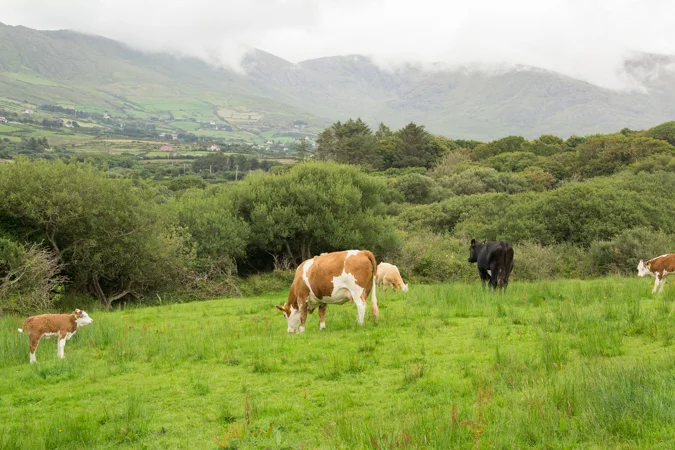
The creamery is in Eyries- a town alongside the rocky Cork coast whose three-to-four block town center is lined with bright blue, yellow, and fuchsia houses. Here I had the chance to join the Steele family (children of current head cheesemaker and Veronica's son, Quinlan Steele) in roaming the farm and feeding the baby calf who needed a little extra love until her mother grew used to nursing. I had wandered around the creamery and tasted different ages of the cheese on a previous visit a couple years before and walking around the farm this time was a perfect finale.
Revisiting the photos of the animals on the green Irish grass and and watching Quinlan's children eat blackberries from the hedges as they climbed the stone fences reminded me of how happy and welcomed I felt when visiting. In the middle of everything, it made me feel lighter.
Light enough to remember that even in a time of uncertainty and doubt, it's good to have hope. There are wonderful people out there and free range kids who make forts out of berry bushes. And after remembering my conversation with Quinlan (a sustainability advocate who is just a touch less passionate about his local community than he his about his children), inspired to be more active and vocal about what matters to me and treasured members of my community going forward.
Here is to hope, community, welcoming strangers, and free-range kids with blackberries on their faces. And amazing funky-sweet Irish cheese.
Thank you for the visit, Milleens!


Great Dessert Cheeses & Their Buddies
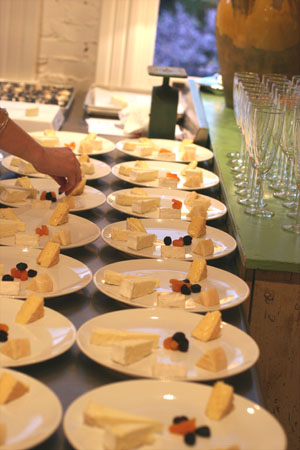
No offense to my other great dessert loves, carrot cake with orange-cream cheese frosting, or peanut butter and chocolate ice cream, but I’ve never been of the mindset that one needs to end the night with a sugary bang. Maybe just a light ka-boom. For me, cheese supplies enough of that ka-boom. A little sweet, a little salty, and creamy and loving to everyone that it meets, cheese is its own dessert. Plus, it requires less time than carrot cake, souffles, cupcakes, tarts, and even fruit salad (if you count that as a dessert) to put together.
 So I have a new regular writing gig, dear readers. Every 4-5 weeks I will be writing for Menuism as their new expert cheese blogger. This is good for three reasons. 1. I get to meet new cheese lovers. 2. I get to be on the list of awesome menusim writers like chocolataire and rock and roll cake-designer extraordinaire, Kate Steffens 3. They come up with ideas that they'd like me to write about. This means that you also get new topics that I might not have thought up myself. Which is very good- by the way, I'm ALWAYS open to writing suggestions.
Below is my latest post for Menuism, Great Dessert Cheeses originally published on the Menuism Cheese Blog. And here is my interview with them.
Sparkling Wine & Cheese Pairing: A Class Guide
Last night I taught one of my favorite classes ever at the Cheese School of San Francisco- Cremes & Bubblies, and in its honor, I’m creating a guide to pairing sparkling and creamy cheese today. Why is it my favorite? Two reasons. One, I love cremes and bubbles. Separate, together, at a dinner table, at a party, on the side of the road, however, wherever. Two, I loved this class because the students were into it.
 Last night I taught one of my favorite classes ever at the Cheese School of San Francisco- Cremes & Bubblies, and in its honor, I'm creating a guide to pairing sparkling and creamy cheese. Why was it one my favorite classes? Two reasons. One, I love cremes and bubbles. Separate, together, at a dinner table, at a party, on the side of the road, however, wherever. Two, I loved this class because the students were into it.

The first sign of whether students are going to be down with the class is if they laugh at the name of my blog. These guys did- hearty chuckles. If they don't, I know it's going to be a loooooong night, and it's very likely my jokes will fall flat. But these guys didn't just assuage my fragile ego by making me feel funny, they asked questions, they commented on flavors rather than starring at me questioningly when asked "what do you taste?," they contributed fun information to the class, and they ate and drank like pros. As a side note, I also attribute the class's success to listening to Def Leopard while crossing the Bay Bridge to teach- I was inspired, and the students felt it. Do you want to get rocked? Why yes, yes I do (get those cheese class engines revving!).

In short, it's hard to get a bad pairing with bubbles and cremes. Cremes are creamy, soft cheeses that are high in moisture and taste especially rich. If you nibble on them with a sparkling, you've got a win-win situation- the bubbles (like the carbonation in beer) and the acidity in wines like Champagne help cut the fat in the cheese and uplift the pairing experience. I always imagine the bubbles wrapping themselves around the creamy cheese molecules and taking them to a happy place, like cheese heaven. Truth be told, it's hard to fall flat when matching bubbles to creamy cheeses, almost everything tastes at least good. But some pairings are much better then others. Below I divulge the pairings in the class that were the favorites, and why they worked to create a light and easy pairing guide for sparklings.
 A 4-Step Guide to Sparkling and Cheese Pairings
1. Light, lively cheeses like light, lively bubbles.
La Tur (cow, sheep and goat) from Piedmont Italy, and Crémont (goat and cow) with Prosecco. When you have goat cheese, think light, low-oak, and unoaked sparklings. Proseccos. Cavas. If you don't know if they're low oak or un-oaked, ask your wine salesperson. You can go fruity, but don't go bold and heavy with your wine. Your spunky little goat cheese or milk blends like to shine without heavy oak getting in the way.

2. Richer cremes like richer wines.
Nettle Meadow Kunik (triple creme cow, sheep and goat) and Brillat-Savarin (triple cow) with cremants or Champagnes. Cremants are sparklings made in the Champagne Method that are not from the Champagne region. They age in barrels, accumulate a light creamy, yeasty flavor. Champagnes generally (but not always) achieve a greater creamy, yeasty flavor and have more acidity than cremants. When I'm pairing creamy triples with sparkling, I either go cremant or Champange. Cremants are less expensive, so I often go there. When triple cremes are still clean-flavored and buttery like Kunik and Cremont, you don't need the richness and earthiness of Champagne.
3. Sultry cheeses like sultry, full-bodied, earthy Champagnes.
Old Chatham Nancy's Camembert (sheep and cow) and Bent River Camembert with Champagne. A full-bodied champagne is yeasty, toasty, creamy, earthy, sometimes mushroomy. They replicate what's going on with these cheeses. Sheep's milk cheese? Earthy, buttery, toasty. Camembert? Earthy, yeasty, mushroomy. These are easy pairing matches made in heaven. It's also possible to get an earthy cremant if you don't feeling like dishing out the dough for a Champagne- ask your winemonger, they should be able to direct your choice.

4. Washed rind creamies with rosés.
Rush Creek Reserve (cow) and Pont L'Eveque (cow) with sparkling rosés. This is a pairing inspired by the regional Époisses and Burgundy pairing. The stinky washed rind Époisses is traditionally matched with a Pinot Noir, so when I think of other creamy washed rinds, I let this guide me. A rosés light red fruit goes with the washed rind funk. Most sparking rosés are going to be heavy on the Pinot, but a rosé need not be Pinot Noir to pair well. But it helps.

Lastly, I'm teaching a class at the Cheese School that I'm super excited about. Southern Cheese & Spirits in March. I'm very excited about it. Think artisan cheese, paired to southern beer and .... moonshine. If you're in the SF area, please come! Geek out and feel the moonshine burn with me.
Limburger Cheese: Just as Stinky as You Like it.
Below I share with you photos from my tour at the Chalet Cheese Co-op- the only remaining Limburger producer in the country. If you see Limburger in the U.S. that is made in the country, it's Chalet. It may have a proprietary label, but it is always Chalet pumping the sweetly funky flavor out. Pick it up and note the dates on the label- they will guide you to finding a cheese age you love. And you will love one of them. More about Limburger in my forthcoming book.
 Remember Monterey Jack on the Chip and Dale Rescue Rangers (Rescue Rangers= the cartoon, not the burlesque show)? Well, Monty, as he was known to his friends, was the Australian mouse who helped chipmunks Chip and Dale fight crime. Yet even though he was darn good at helping to put the right fox, cat, or dog in prison, he was better known for his love for cheese.
There was one cheese in particular that if he got a wiff of it, he was gone. Taken. Impassioned. Spent. Could do nothing else until he found that cheese and made it his own. That cheese was Limburger. Even though Monty was a secure mouse and never cared about what others thought, it was apparent in some episodes that Chip n' Dale thought Monty was crazy for loving a cheese that could smell so strong. Well, Chip n' Dale were not always the brightest, most cultured rodents.
The fussy chipmunks just didn't have the opportunity to taste Limburger at the age that would have pleased them. Oh, but I have. I have.

When I headed to Wisconsin last week to do delicious research for my cheese book, head cheesemaker Myron Olson at Chalet Cheese Co-op tasted us on Limburger at three stages- young & mild, slightly older & soft & sweet, and older & gooey & funky and strong. Amazing. Even though they were all versions of the same washed-rind cheese, the flavors, textures, and strength of the different ages varied like crazy. Honey mustard, rye bread and strawberry jam were also on board too. Young, the Limburger tasted like a fresh, less creamy Red Hawk. Older, the cheese tasted of and had the texture of Tallegio. Oldest, it tasted strong and pungent and begged for its classic pairing of rye bread, honey mustard and onion slices.
Below I share with you photos from my tour at the Chalet Cheese Co-op- the only remaining Limburger producer in the country. If you see Limburger in the U.S. that is made in the country, it's Chalet. It may have a proprietary label, but it is always Chalet pumping the sweetly funky flavor out. Pick it up and note the dates on the label- they will guide you to finding a cheese age you love. And you will love one of them. More about Limburger in my forthcoming book.


Places to find Chalet Cheese (please add to the list in the comments section!):
Bi-Rite, San Francisco
Maple Leaf Cheese Sales, WI (will ship, but not recommended in summer) 608-934-1237
Hefty Creek Specialities, WI (owned by one of Chalet Cheese's award-winning cheesemaker and yodeler), hefticreek@hughes.net, 608/325-6311
Have you had a chance to try Limburger at its different stages? What did you think? Which is your favorite?