
The Cheese Blog
Larkmead's Dan Petroski: Loire Cheese & Wine

Larkmead Vineyard's Assistant Winemaker Dan Petroski and I first got to know each other through Snooth connections and formed a further blogging bond when we realized that we both have a fondness for making cheese at home and Jay McInerney's wine writing. That gave me the right, when I heard that he was taking a trip to France, to let him politely know that he had a a homework assignment- to write about a cheese memory on the trip. As I'm very fond of his writitng (and Larkmead's "Firebelle"), I was very happy when he accepted and didn't later claim that a French dog ate his laptop.
What follows is Petroski's guest post for "It's Not You, it's Brie" detailing an experience that he had with Loire Valley goat cheeses and Pinot Noir. This is the first of many posts to come featuring some of my favorite guest writers with cheese stories & memories or recipes, with the next one being Jeanne Carpenter of Cheese Underground.
Thank you Dan!
Cheese & Wine in the Loire
When Kirstin asked me to offer up a cheese story as a result of a recent trip to France, I was a bit hesitant to comply, for various reasons. One was that I love cheese in all its forms – from pre-packaged, pasteurized and preservative-rich blocks of neon orange to cheese made from the raw milk of animals grazing in the small pastures of a village following a strict cheese producing season and expression of ripeness. I am not a cheese snob, nor expert.
But as evidenced by a French friend sharing a meal with me in Sancerre who joked by circling a finger over his head that it appeared that I go to bed at night dreaming of Crottin and Comte, I am fascinated with the aromas, the flavors, the textures and the finishes on the palate – the similar components that excite me about wine. So I complied.
My first two meals of significance (a lunch followed by dinner) in France consisted of five-course affairs that brought my heart to a crescendo and then dropped it into my stomach while I held the table edge tight and tried to catch my breath in amazement. The locals, of course, were picking their teeth and yawning a tune to a commonplace tone. The fourth course of both monumental meals, of course, was cheese.
When sufficient time had passed after the main meal, when you thought you could lift a fork no more, the sound and smell of the wooden cheese cart wafting its way atop creaky old floor planks to your table reminded you of unfinished business.
The cheese cart consumed every sense. Under foot, the wood settled after the trembling movement of its rolling wheels. The sight of cow, goat, and sheep milk categorized in front of you, with soft cheese seeping, demanded full attention. The pungent aromas and delicate dairy smells overwhelm the nose. You wanted to taste them all. But not being the glutton, I knew it was proper to accept three, maybe four, pieces of your choice. Since my first leg of the trip was in Sancerre where they are famous for Crottin de Chevre, I had to taste through a selection of goat cheeses. (Rule number 1 of eating anything; eat local).
Last July, I e-mailed Kirstin about pairing foodstuffs for a Pinot Noir tasting; she listed a couple of cheeses including a Chevre. I thought that was a little rule breaking because goat’s cheese can have an acidic/tart bend that I suspected wouldn’t play well with Pinot; so when I looked around at the empty bottles of wine on the table in France and the only grape juice remaining was a Vacheron Pinot Noir (the 2005 Belle Dame) from the Loire, I had my chance to take the recommendation to task.
Goat’s milk, pungent, “goaty” aromas, said to be an aphrodisiac amongst the herd, produces a very chalky character. The goat cheese of record in the Loire is the Crottin de Chavignol, a cheese that is as equally important a component to the cheese board as it is heated and crumbled on your salad.
Having consumed highly concentrated dishes swimming in butter based sauces reduced to caramelized consistency throughout the meals, the drying character of this cheese reminded me of that welcomed feeling when tannins take over your mouth after you guzzle down a glass of fruit-forward wine. Sometimes, when you are lucky and the wine is right, the tannic finish will carry a bit residual sweetness derived of alcohol to round them out; or it will contain a refreshing, salivating acid that leaves you wanting another sip. The Crottin left me wanting a sip of wine.
In the Vacheron wine, I found an explosive, creamy, bright, spicy cherry character that filled the middle of my palate and painted away the chalky cheese that framed it. The Pinot left behind a singe of acid that kept me wanting more, like dropping to the bottom of an arc on a roller coaster, when it was finished, it wasn’t so bad, it was actually exciting and you wanted to try it all over again.
And, I did.
Chevre Asparagus Barley Salad

Have you ever seen an asparagus field?
Call me naive, but I always thought asparagus grew in cute little bunches like one buys from the store. Not with the rubber-band, mind you, but I thought that they liked to at least kick it in groups. Represent the family, keeping it tight.
Turns out, asparagus grows in singular stalks, each protruding from the earth like green pencils stuck in play-dough or the flowers we drew with crayons as children. Laugh all you want, but seeing an asparagus field for the first time was a revelation, and I cried some inside knowing how disconnected I had been to my favorite vegetable to dip in aioli.
Since spring is here, a time when goat cheese is especially lively, and magical asparagus grows in bunches, I wanted to make a salad that celebrated both seasonal beauties.
Spring and early summer is when a goat's mothers milk has the most protein and fat since it's used to nourish her new babies. More protein and fat = a happier, more lush and flavorful cheese. Plus, when there is more fat, the flavor of the natural herbs, thistle, and grasses that the animals eat is more noticeable in the cheese. Win-Win.
Back to the salad. After searching my pantry, I found some barley. A head of radicchio showed up in my fridge. The vinaigrette is one that I often use to add an bright, light herb flavor to a delicate green salad or a little punch to a grain dish, such as this.
What do you do with your fresh chevre?
Notes
Barley takes from 45 to an hour to cook. If you precook the grain the night before, the salad is a quick fix for dinner.
I roasted the asparagus for this recipe; steaming or grilling also works well.
I sipped this salad with a Tocai Fruliano from Italy.
Asparagus, Chevre & Barley Salad
Preheat oven 400 degrees
1 cup uncooked pearl barley, rinsed
1 bay leaf
1 lb. asparagus
small head radicchio (about 8 oz pre-trimmed)
8-10 oz fresh goat cheese
4-5 Tbsp vinaigrette (recipe below)
salt and pepper to taste
1. Add barley, bay leaf, and 1/2 Tbsp salt to 4 cups boiling water in a medium-sized sauce pan. After water returns to a boil, reduce heat to simmer and cook grains for around 45 minutes. Once cooked, drain and set aside to cool.
2. Cut asparagus into 1 inch long pieces, discarding the very tough stems. Roast for seven to ten minutes. Asparagus should still be lightly crisp and bright green.
3. Placing the core on the cutting board and using it to mark the center of the veg, cut the radicchio into quarters. Cut out and discard the white core, then quarter radicchio again.
4. Put all ingredients in a large mixing bowl and add 4 Tbsp of vinaigrette. Add salt and pepper to taste and more dressing if you like. I used 5 Tbsp.
Vinaigrette
2 Tbsp. lemon juice (around 1 lemon)
1 medium clove garlic, minced
6 Tbsp. extra virgin olive oil
1/3 bunch chopped tarragon and/or chervil
salt and pepper to taste
Put lemon juice in a small bowl and add garlic. Whisk in one Tbsp oil until blended. Add remaining oil and whisk until emulsified. Finish by stirring in herbs.
Brie: Creamy, Unpasteurized, Illegal

Although easily the most talked-about cheese in the United States, real Brie, unpasteurized, creamy, and oozing, does not exist in the land of the Puritans. This raw cow's milk beauty only gets as far as a contraband suitcase passing through American customs can carry it.
In 2004, the United States government passed a law stating that any cheese aged under 60 days imported to or sold in this country must be made with pasteurized milk. More about this law another day. Suffice it to say that Brie, who in its natural state is unpasteurized and aged under five weeks, rarely makes it into our borders and is never sold in our cheese markets unless it has been passed under the counter in a loving, black-market gesture.
So what is that soft stuff bearing the Brie label? For the most part, an impostor, often delicious, but an impostor nonetheless.
According to the AOC regional appellation laws of France, Brie also has to come from the region formally named Brie, now called Seine-et-Marne. Anything not from this region is not technically Brie. It is rather a cheese, made in a bloomy-rind, soft-ripened style, like the big "B." But it will never be Brie, no matter how often the package claims the title.
Furthermore, claim cheese purists while shrugging their shoulders in a nonchalant French fashion, even the cheeses that the French government allow to exit France with a "B" stamp are not real Brie. Their milk has been pasteurized and the complexity, the texture, the specialness, well, it's all gone. It's just something that the citizens of France make, ship, sell than have nothing else to do with themselves. They prefer the raw, oozing variety.
So what can we do to taste real Brie?
1. Illegal, naughty cheese importing things
2. Eat in France
3. Wait until it is no longer illegal. Like thirty years to never.
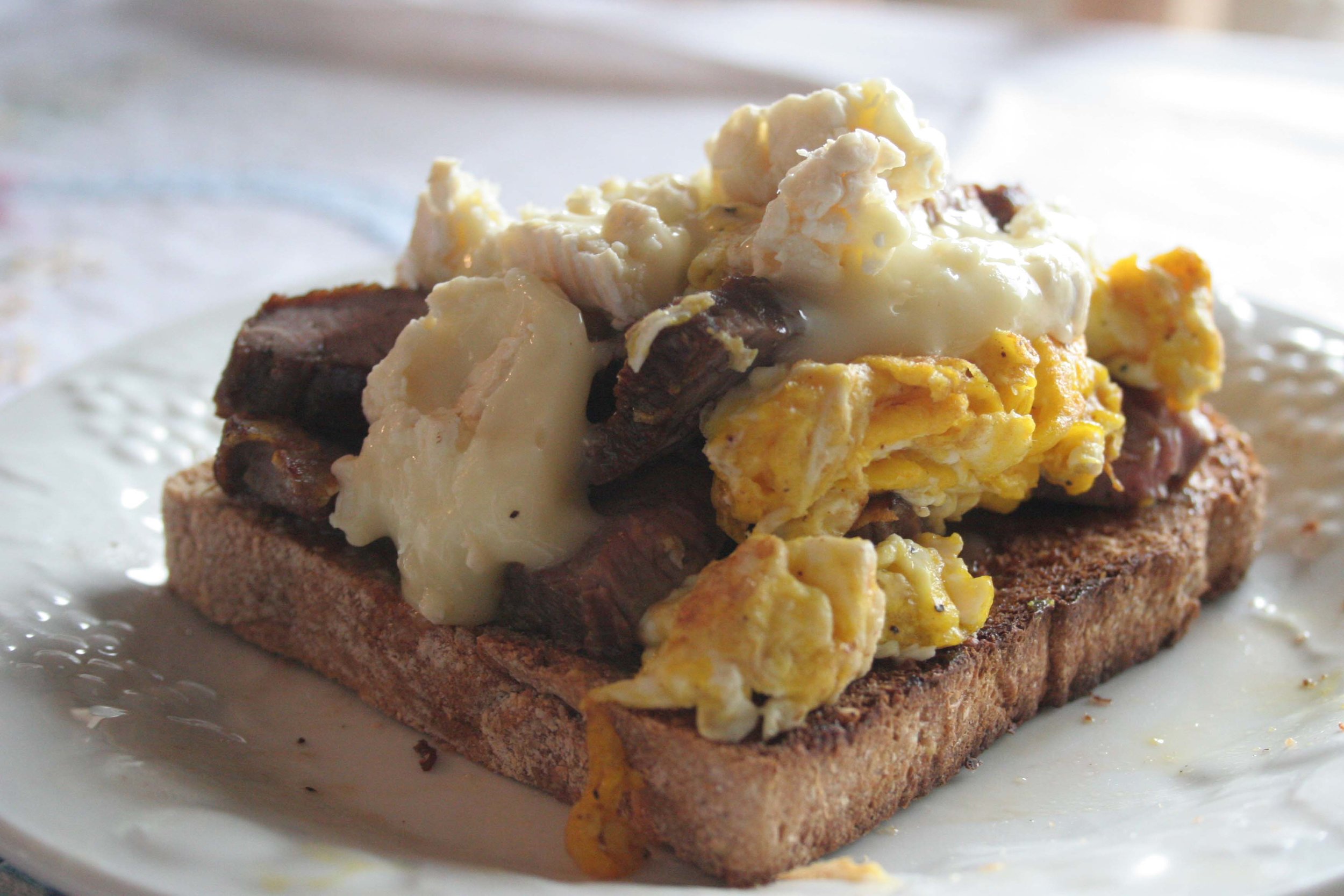
In the meantime, I've found myself charmed by the mushroomy Brie de Meaux imported from France- the one that spreads on one's plate even though it's not the real deal. It, and more local versions of the bloomy-rind made by American cheese makers taste almost as good melted over toast topped with scrambled eggs and flank steak as the big "B" itself.
Next post: La Tur, the wonder 3-milk cheese
What do you do with your brie?
It's not you, it's brie..... a cheese blog
