
The Cheese Blog
Lincoln Log: Like Bucheron but Better
Zingerman's Lincoln Log is made in the grand tradition of European goat cheese classics Bucheron and Cana de Cabra, but because Lincoln Log is made in the states, you're going to love it even more.
 Zingerman's Lincoln Log is made in the grand tradition of European goat cheese classics Bucheron and Caña de Cabra, but because Lincoln Log is made in the states, you're going to love it even more.
Lincoln Log, Bucheron and Caña de Cabra are foot-long cylindrical cheeses with bloomy-rinds and soft centers. They age from the outside in and have three striking layers: the outer, plush white rind; the soft, velvet ribbon below the bloom, and the soft, crumbly center. Taste each separately, than enjoy together.
Bucheron is a French cheese that makes its way on more seasonal chevre chaud salads than bacon does burgers (or food blogs). Caña de Cabra is pretty much dead on like Bucheron, except that it's made in Spain, so it obviously hangs out way later at night and rocked a mullet before hipsters remembered what they were.
But Lincoln Log tastes better. Why? It's not that little "Made in the U.S.A" tag that's on it (or not on it, whatever), it's because its made close by, spends less time in transportation, so there is a much better chance you'll get it fresher.
And this is a cheese you want especially fresh, when it's lively flavors jump out to say hello and the rind hasn't yet developed a strong ammonia-esque flavor.
Bucheron and Cana de Cabra are great, but Lincoln Log shines at a creamery near you. Try with an un-oaked California Sauvignon blanc or Italian varietal white.
That Cheddar Tang: Fiscalini Farms
It wasn't until I visited Fiscalini Farms one swelteringly hot, fine Modesto spring day that I truly understood the cheddar tang. There at Fiscalini, I witnessed the act that gives cheddar its sharpness, its spicy character, its oomph.
 It wasn't until I visited Fiscalini Farms one swelteringly hot, fine Modesto spring day that I truly understood the cheddar tang. There at Fiscalini, I witnessed the act that gives cheddar its sharpness, its spicy character, its oomph.
People often ask what makes cheddar sharp. Although we're used to sheep and goat's milk cheeses like Mahon or Panteleo getting spicy and more tangy with age, many popular cow's milk cheeses like Comté, Fontina, or Joe Mato's St. George, develop a sweeter, deeper buttery character when ripening.
So why is Cheddar, also a cow's milk cheese, so punchy?
Let me tell you a little story about Cheddar.
After driving to two incorrect Fiscalini addresses - first, the family home where the smiling owner pointed a blushing Kirstin in the correct direction, second, to the Fiscalini dairy where a man holding a large baby bottle to feed new calves also pointed me in the right direction (always forward, never straight)- my visiting grandmother Oma and I arrived at Fiscalini cheese, late. Lucky for us, cheesemaker Mariano Gonzalez took pity on an excited cheese geek with worse directional skills than a toddler driving a Big Wheel, and her grandmother who had only ever purchased cheapie cheddars at the supermarket. Although we missed the initial cheese curdling, we were in time to watch the "Cheddaring" process.
Making Cheddar- Lactic Acid Magic
After adding rennet and separating the curds from the whey, the cheesemaker cuts the curds into flat, long sheets and stacks them one on top of each other. Then, he leaves them to sit. As the sheets sit, the lactose (milk sugar) converts to lactic acid.
Throughout the cheesemaking process and ripening, lactose turns to lactic acid. It helps provoke curd and whey separation, and the sugar conversion makes it easier for lactose-intolerant folk to digest aged cheeses - less sugar is left to bother tummies.
In the case of cheddar, lactic conversion is swiftly encouraged within the first hours of cheesemaking. When stacked and left to sit in a room temperature room prior to salting, the sweet sugars in the milk turn sharp sooner. That tanginess in your cheddar? That's lactic acid, inspired.
After the stacked curds have hung out, kicked back, relaxed, acidified sufficiently, the cheesemakers cut the sheets once more into "fingers" (what Wisconsin calls cheese curds). They stir the fingers around and salt them. A lot. Then they take the curds and press them into molds.
Pressing huge wheels of cheddar is a lot of work, and if your grandmother is with you, she will tell the cheesemakers over and over again how strong they are. Note: after a little exposure to making cheddar, this cheese fiend has decided artisan cheddar is romantic not because of its connection to years of beautiful tradition, but because of the passion it requires from someone about to lift a hundred or so pounds of cheese curds one to three times a day for the rest of their life.
Next, the wheels are left to age, and are flipped every day as they mature.
Fiscalini Farms doesn't often give tours, but if the rare chanse arises to see Mariano Gonzalez in action, take it. Cheddaring, and Gonzalez at work are cool things to see. Bonus? If you bring your grandmother, she'll leave understanding why artisan cheese is worth more than the bright orange, rubbery cheddar at the supermarket and may have some waiting for you next time you visit. It's possible. Unfortunately, she will also leave slightly dissapointed because she forgot to ask if the cheesemaker's assistant was single. For you, she says. Sigh. So, seek out Fiscalini bandage-wrapped Cheddar at a cheese shop near you. They take immaculate care of their animals, and their cheddar is one of the best in the country.
What are your favorite domestic cheddars?
Bellwether Farms: Sheep's Milk Heaven
With visions of fluffy lambs jumping over wheels of golden cheese stacked on Sonoma's emerald hills, a friend and I drove with happy hearts to visit Bellwether Farms. Cheesemaker Liam Callahan doesn't normally give tours- his facilities aren't currently set up for handling visitors- so this was a very special ocassion.
 With visions of fluffy lambs jumping over wheels of golden cheese stacked on Sonoma's emerald hills, a friend and I drove with happy hearts to visit Bellwether Farms. Cheesemaker Liam Callahan doesn't normally give tours- his facilities aren't currently set up for handling visitors- so this was a very special ocassion. Plus, it was birthing season for the sheep and we were hoping to catch sight of the babies.
For whatever reason- my alarm clock not going off, highway 101 construction on the way to Petaluma, or us kind of getting "lost," we were late. The result? We missed the frolicking baby sheep but experienced one of the best cheese tours of our lives.
Thanks to Callahan, who took time out of his busy Friday to answer my 1,001 questions during cheese production, we were able to see (and understand) how they make their small batches of San Andreas and their coveted sheep's milk basket ricotta. Thank you so much for the tour Liam, and I hope "It's Not You it's Brie" readers enjoy the following photo tour of this traditional, family run creamery. Behind the scenes photos are taken by my cheesemaker tour photographer, Molly, who also captured the cuteness on the "Redwood Hill Kids, Come Home with Me" excursion.


What's the best cheese tour you've been on? Any favorite cheese places you like to visit in your area?
Cheese Busy & Links du Fromage

Been busy, but still thinking of you!
Here's a little update on the cheese haps, and then, Links du Fromage:
In the past two weeks. I've visited Bellwether and Fiscalini cheesemakers, both of which are generally closed to tours, so I'll post some inside info and photos soon. I learned a tremendous amount from visiting both farms, and I think you'll like hearing the low-down too.
I'm teaching a rosé and cheese pairing class at the San Francisco Cheese School this Wednesday and have a Wine and Cheese Pairing basics course there coming up in August. Next week, I'll head to my favorite beer bar for an excursion in cheese and beer pairing and will write about my findings. I've also been working, typing, editing, re-editing, pitching, interviewing and querying for possible cheese articles (which is quite the humbling experience). I've learned a lot these past couple of weeks and am looking forward to sharing it with you in the future. I just need an hour or two to sit down to do so!
In the meantime, I've been reading some great articles and blog posts lately. I hope you enjoy them too.
Lastly, "It's Not You, it's Brie" got mentioned in the latest Culture magazine. Thank you!
Notes from a Diary Anti-trust Meeting in Upstate New York, Green State Fair.
New Uplands Cheese, Cheese Underground.
Washington State Cheese (ohhh.... oozy buttery goodness), Gordonzola.
Cheese and the Art of Waiting, Know Whey.
Smokin Sheep's Ricotta: Marcelli Formaggi
Great ricotta used to only be available in Italy. In fact, tasting fresh ricotta's when in Sienna or Tuscany could be a __ because you knew that what you could get at home would only pale in comparison. Those vibrant flavors and textures were only available to you as long as you stood on foreign soil and held Euros in your pocket.
 Great ricotta used to only be available in Italy. In fact, tasting fresh ricottas when in Sienna or Tuscany was bittersweet, because you knew that what you could get at home would only pale in comparison. Those vibrant flavors and textures were only available as long as you stood on foreign soil.
Now, fresh, delicious ricotta runs abundantly and freely through the blood of American cheese shops and recipes for homemade ricotta are easy to find and make.
But there is still one ricotta that is particular to Italy. Unlike the best fresh sorts that are also made domestically, Marcelli Formaggi ricotta is specific to the rolling hills of Abruzzo.
The Marcelli family makes many different types of ricotta, the bounties of which are covered in the new issue of Culture cheese magazine, but my favorite is their Ricotta al fumo Ginepro. It is made from the milk of Sopravvissana sheep who graze the Abruzzo hills surrounding a village of 300 people. The ricotta is a firmer style that, because it is aged just beyond 60 days, makes it across North American borders in a raw-milk state.
Like most professional cheesemakers, the Marcellis make their traditional ricotta with the whey remaining after they make their pecorinos. Then -here's the kicker- before they leave the ricotta to mature for two to three months, they smoke it.
Now, before you wrinkle your nose remembering the smoked "goudas" of your yesteryear and write off this dear cheese, consider that smoking cheese is an ancient practice that extends its life and one that is deeply rooted in tradition. Unlike some supermarket goudas that have been doused with artificial smoke flavoring, this cheese has been cold-smoked over juniper wood. The gentle smoking lends the ricotta delicate woodsy flavors that mingle expertly with its sheepy, nutty flavors and slicable texture.
"It's Not You, it's Brie" cheese club members will be blessed with some of this ricotta in their May club, but if you're not in the San Francisco Bay Area and are unable to drop by to pick your club up (must sign up 2 weeks to a month ahead of time), you can pick some up on the Marcelli website.
For cheese plate consumption, serve with a side of toasted walnuts, walnut-wheat bread and small-batch honey. On its own, drizzle with a high-end olive oil and freshly cracked pepper. In a salad, this cheese couldn't be happier than it is paired with the earthy sweetness of roasted beets, although in summer time, I could imagine it rocking a salad of grilled corn cut from the cob and heirloom tomatoes.
Lastly- just a sneak mention, here are some of my favorite fresh, domestic ricottas (but try all you can, the more local it is, the fresher it is, and fresh ricotta is best consumed young): Bellwether sheep, Bellwether Jersey cow's milk and Salvatore Brklyn.
"It's Not You, it's Brie" readers, do you buy ricotta, or do you make your own? Any local ricottas whose names you'd like to share?
France: Cheese by Wine by Cheese in Photos
France treats a food and wine lover right. Of course occasionally there is a hang-up, like when a train that was taking you to a Chinon winery you were aching to visit is cancelled due to country-wide strikes. I like to think of this side of the country as a much-needed practice in letting things go. After all, there will always be an almond croissant, fantastic bottle of Chenin Blanc, or thick wedge of raw-milk cheese waiting to offer you comfort around the corner.

- Comté aging at Marcel Petite


- Raw-milk Époisses


- Croissants for breakfast in Montrachet, Burgundy


- Cherry custard tart, Domaine Quenard, Savoie
Cheese Class Fever
After a gastronomically enlightening and waist-band expanding cheese and wine trip to France, I'm back and living in cheese class fever! Join me for French Wine & Cheese: Le Duo Dynamique, Mooooving Beyond the Cow: Artisanal Goat and Sheep's Cheese, and two more to-be-announced classes.
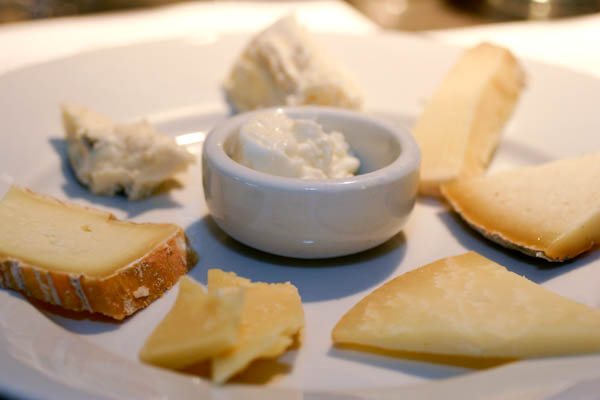 After a gastronomically enlightening and waist-band expanding cheese and wine trip to France, about which I will write about on future blog posts, I am back and in prime cheese (and wine) class teaching form. Or at least, I am refreshed and my schedule is packed with classes that I am super excited about. And in case any of you were wondering, I DID make it through the volcanic ash that halted European air travel in time to teach a class at the San Francisco Cheese School scheduled just 2 days after planes were relased from Paris! Merci, Diex du fromage!
UPCOMING CLASSES:
French Wine & Cheese: Le Duo Dynamique
May 8, 2:00 pm (Saturday), Solano Cellars, Alabany, CA
Feeling revived and fromagical after returning from a wine and cheese-themed trip to France, Solano Cellars wine bar manager, "It's Not You, it's Brie" blog author, and San Francisco Cheese School instructor Kirstin Jackson will teach a class covering the regional specialties of the nation that makes more cheese (in spirit) than America serves Big Macs. After sitting through an hour long slide-slow detailing Kirstin's trip to the Eiffel tower, students will be guided through a tasting of eight cheeses that demonstrate France's cheese excellence and dairy range. The cheeses will be paired to regional wines that love them. Eight cheeses, five wines, and a slide show? Sign up soon! The class is limited to 22 students and will fill up fast.
1580 Solano Ave, Berkeley, CA 94707, call 510.525.9463 for reservations
Mooooving Beyond the Cow: Artisanal Goat and Sheep's Cheese
May 18, 7:00 pm – 8pm (Tuesday) 18 Reasons, San Francisco, CA
In a land where more people grow up snacking on more Velveeta than chevre, spicy and lively goat and sheep's milk cheeses don't get the love they deserve. This class will explain the many differences between milks, introduce eight favorites with accoutrements to match, and help you to make room in your cheese cave for our cloven-hoof friends. Note: No wine or other flavored beverages will be served so that your palate can focus on the cheeses to the fullest extent. A dynamic world beyond cow's milk cheeses awaits your cheese plate!
Wine 101 Spring Session: 3-Part Series (Wine Focus Only)
Three Wednesday nights, May at 6:30pm, Solano Cellars
Be transformed from wine-weak to wine-geek and never drink mindlessly again! Solano Cellars instructors Jason Lefler and Kirstin Jackson create a fun atmosphere, focusing on the fundamentals of wine appreciation while debunking snobbish misconceptions and marketing myths to bring the adventure of wine to normal people. An excellent introduction to the diverse and rewarding world of small-production wine.
Class 1: WTF is Wine, Anyway? Weds, May 5th
The Tasting Ritual/The Mechanics of Appreciation –) – Scents and Flavors, - Acid, Tannin, Oak, Etc – What and Why?
Class 2: Regional Wine Styles to Know and Why- Weds, May 12th
Old to New World Wine – The Foundation of Global Wine Styles – Italy, France Spain & Beyond
Class 3: Advanced Techniques- Weds, May 19th
Blind Tasting– Food and Wine Pairing - Adventurous Drinking -– Navigating the Wine List
Also, keep an eye out for the San Francisco Cheese School's spring/summer schedule. I'll be teaching a wine and cheese basics pairing class there and another focusing on cheese and rosé (gotta love the pink). Plus, the school is packed with amazing teachers who like to talk about wonderful things like Comté and bourbon.
Lastly, what would YOU like to learn about in a cheese or cheese and wine class? I love hearing your suggestions and would love to address your interests.