
The Cheese Blog
"It's Not You, it's Brie" -A Cheese Book
I decided not to say much about it until I had something as firm as a wheel of Vella Dry Jack to share with you, but now things are very firm. I'm very excited to share that I am writing a book about cheese: "It’s Not You, It’s Brie: Behind the Wheel, A Guide to Unwrapping American Cheese & Culture."

I normally like to start off my posts with a little build up to get the reader's motor running. Most times the cheese shots at the top of the page do the trick- nothing grabs attention like a seductive, glistening wheel whispering "slice me." This time, I'm starting my post with the first wedge of cheese I shot for this blog. I'm honoring its impact on what I'm about to share.
I launched "It's Not You, it's Brie" around two years ago. I've talked about a lot of cheese since then, dear readers, but what I haven't talked about much is that I also have been working on a cheese book proposal. I started putting it together about a year before I launched this blog. The thing is, I've had to shelve it numerous times while sorting through life happenings, and I decided not to say much about it until I had something as firm as a wheel of Vella Dry Jack to share with you.
Now, dear readers, things are very firm. I'm very excited to share that I am writing a book about.... cheese!
"It’s Not You, It’s Brie: Behind the Wheel, A Guide to Unwrapping American Cheese & Culture" will guide people through the historical and cultural stories of selected American cheeses and explore how some of our most stand-up dairy gems came to be (and taste!). I'll stray far from the classic 8 styles of cheeses, keep it lively and literary, use my cultural anthropology and professional cooking background to shape cheese stories, attempt on occasion to move beyond humor only a mother could love, and include recipes and pairing suggestions.
It will publish in 2012.
I'm pretty flippin excited.
And I'm very happy to share it with you.
Phew! So, thank you for reading- interacting with you in the comments section and seeing such interest in cheese and the people who craft it has been inspiring. You've been good to me and the cheese world. And as always, thank you cheesemakers and cows and sheep and goats and buffalo and .....you know... for providing such amazing cheeses to write about.
And heads up - even though I'm cramming a lot of writing into short periods of time, I have no intention of letting the book's progress bring the blog writing to grinding halt. I'll keep dwelling on about my favorite cheeses and include more guests posts and interviews too (so please, if you have any topic or requests, let me know) and let you know when and where I'm teaching classes. I'll also include info about the book's progress, release, promo, and include photos from my "research" farm visits. I love research. I love travel. I also love chocolate and peanut butter, but that doesn't really apply here.
Thanks for reading, thanks for your support and more to come soon!
Seasonal Goat Cheese: Cevrin. Because it's Goat's Time to Shine
The season of the goat is among us. Unlike cows who can generally be milked anytime throughout the year within their 300-day lactation cycle, goats are on stricter breeding and milking cycles that are more tied to the time of year. Spring is goat season.
The season of the goat is among us. Unlike cows who can generally be milked anytime throughout the year within their 300-day lactation cycle, goats are on stricter breeding and milking cycles that are more tied to the time of year. Spring is goat season.
After the momma goats have finished birthing their cutie-pie babies towards the end of winter, they kick into high gear for milk production. In spring, the mum's bodies concentrate on making the highest fat, most nutritious milk possible for their kids. This is also around the time of the year when flowers, herbs, and delicious grasses start sprouting. In Sonoma and Napa mustard plants rear their golden heads. Depending on where one lives in snowy regions, grasses might start poking through icy sheaths. The season of the goat is now building steam.
This is all good news for us.
Who benefits from richer milk and wild grasses besides frolicking kids and their mums? Psst, everyone raise their hands now. We do!
Spring, when goat milk cheeses are higher in creamy butterfat and infused with the flavors of new grasses and herbs dotting the surrounding landscapes, is a fantastic season to explore fresher goat's milk cheeses. Of course any time is a fantastic time to sit down and contemplate the delicious grassy, peppery, lemon nature of goat's milk, but spring is when the flavors really pop in a young goat's cheese.
One of my favorite fresh goat's milk cheeses from abroad is the tiny Cevrin.
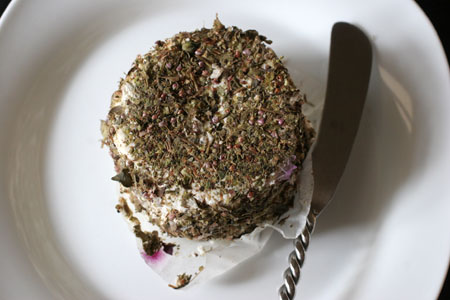
Cevrin is made in the Piedmont foothills of Italy. The goats are allowed to wander about and climb the hilly terrain and munch on whatever they can find growing nearby. After the cheesemaker milks the well-excercised foragers, they scoop the lactic acid-set curds into molds and lets them drain. Once they are properly leached of enough whey, they decides which cheeses are to be sold unadorned and which will be herbed or topped with crushed red pepper. Truth be told, it's easier to taste the true essence of spring milk from unadorned cheeses fresh cheeses. However, I lean toward the herbed ones for my cheeseplate, first, because they're so pretty, and second, because I like the added intensity of tasting the seasonal herbs on top. The pictured one above is named Cevrin Alle Erbe di Montagna. Note- this style of Cevrin is different from the goat and cow's milk blend that is sold under a similar name. In the bay area I've seen Cevrin at the Pasta Shop at Market Hall.
Because of its lively flavors, Cevrin pairs wonderfully with a grassy, citrusy Sauvignon Blanc, or a clean cut Italian or French white, or wit beer. Stay tuned for more goat cheeses for the season!
Have you tasted Chervin? What are some spring goat cheeses that you seek out?
Sonoma Cheese Conference: Cheese Bonding
Last February I headed to my first cheese conference, learned the official handshake and secret word that let me through the door (I can't tell you what it was but can disclose that the secret word started with an L and ended with tose), and learned more about cheese and met more in the community than I ever thought I could in two days. Put on by Delice de la Vallée cheesmaker Seana Davis, the Sonoma Cheese Conference holds a special place in my heart.
Last February I headed to my first cheese conference, learned the official handshake and secret word that let me through the door (I can't tell you what it was but can disclose that the secret word started with an L and ended with tose), and learned more about cheese and met more in the community than I ever thought I could in two days. Put on by Delice de la Vallée cheesmaker Sheana Davis, the Sonoma Cheese Conference holds a special place in my heart. It is small, intimate, and filled with folks who are as eager to share and soak up knowledge. And of course there is beer and wine to aid in soaking up all the knowledge. Remembering the amazing experience last year, I was happy to head up again. It would only be a day this time rather than two, but darn it, it would be worth it to get lost on Sonoma backgrounds in beautiful weather. Despite the five semi-trucks going 20 mph in front of me in a 45 mph zone that made me a tad late, the drive was gorgeous and thoughts of sugar plums and newly released cheese ran happily ran through my head.
I had a couple favorite sessions. The first was titled "Four Routes to Economic & Environmental Sustainability," and was just as much about dads bragging about their daughters as it was about cheese. Yes, I got a little ferklempt when Point Reyes dad said his daughters coming back to the farm made all the trying years worth it. The panel was Bob Giacomini of Point Reyes Blue, George Mc Clelland of Mc Clelland Dairy and Chris Roelli of Dunbarton Blue. It focused on how they built successful dairies that worked within their own environments- by making artisan dairy products and considering how to make agritourism work for them in the future.
All three dairy owners turned to cheesemaking after years in the milk business- either selling it or hauling it- because they wanted control over their own product in a wildly fluctuating market that rarely benefits the farmer. Artisan cheese, or in Mc Clelland's case, butter (cheese will come later for this family) gave them that control because it allowed them to set the final price of their milk- in cheese or butter form. Roelli said that at one point, his family was only making a one cent margin per pound of milk. Unlike commodity brick cheese or milk, artisan cheese prices are set by the farmer or cheesemaker, not dictated by the government or stock market. Now, both Roelli and Giacomini say that even in the recession they can sell as much cheese as they make at the price that they set. It's a great feeling. Yes, artisan cheese rocks on another account.
My favorite quote of the session was when Bob Giacomini shared his family's dairy slogan since 1938: "from She to Me." They still have it printed on old glass bottles displayed in the creamery.
Another favorite session was lead by Seana Doughty- "No Money, No Farm, No Problem." Remember her? She's the Bleating Heart cheesemaker that I interviewed on "It's Not You, it's Brie." in September. Once again, she was hilarious, witty, and inspiring. How many people would actually drive to Wisconsin in the middle of winter to pick up 10 sheep in a flatbed truck without stopping to sleep? I can count one on my index finger. She talked about her trip and how she started her own cheesemaking profession and her determination, story and humor made her slide slow featuring her trip to Wisconsin the best I had ever seen (not that my slide show experience was hard to top, but, now there will never even be competition).
The truth was, those were my two favorite sessions, but all sessions were great and the next day's looked amazing too. The American Cheese Society conference is fantabulous and grand and I'm very much looking forward to this year's, but the Sonoma Cheese Conference gives you a warm feeling and access to cheesemakers and writers that only a smaller conference can. It helps to round out the cheese experience by being cozy AND informative. Like a blanket with pages of non-fiction article stapled to it. Plus, it was mellow enough that Ari Weinzweig of Zingerman's Creamery had time to sign one of his books for my boss, titled "A Lapsed Anarchist's Approach to Building a Great Business."
Thanks Sheana for putting it together!
"It's Not You, it's Brie" Cheese Club at Solano Cellars
It has been a while since I wrote about the glories of the "It's Not You, it's Brie" cheese club, so I thought I'd toss the little fella a (milk) bone and share the latest selection write ups. Every month I put together a pick-up only cheese club in conjunction with Solano Cellars wine shop and wine bar, composed of three of my favorite cheeses that month, plus an accompaniment to pair with one of the selections.
 It has been a while since I wrote about the glories of the "It's Not You, it's Brie" cheese club, so I thought I'd toss the little fella a (milk) bone and share the latest selection write ups. Every month I put together a pick-up only cheese club in conjunction with Solano Cellars wine shop and wine bar, composed of three of my favorite cheeses that month, plus an accompaniment to pair with one of the selections. The following three cheeses are the picks from February (this month I was feeling the domestic love). I hope you have a chance to try some of these beauties near you, and there's some additional info about the club at the end of the post in case you'd like to here more.
Cheese club descriptions:
Bohemian Creamery's Caproncino
Bohemian Creamery is a two-woman organic goat and cow milk cheese dairy in Sebastopol that opened just two years ago but whose wheels are already on the cheese list at French Laundry. Broad in range, they make everything from an asiago style to a cheese shaped like a breast (so says owner Lisa) named Bodacious. Caproncino is a pressed, firm yet lush goat cheese, with sweet cream and light mushroom flavors. Want it a little earthier? Eat the rind- I always do on this one. Drink with a peppery, herbal Crab Franc like the La Tête Rouge “Tête de Lard,” or serve with the sweet olive oil Spanish flatbread included in the club.
River's Edge Chevre Mayor of Nye Beach
I think we’re feeling comfortable enough with each other that we can talk washed rinds now. Washed rinds smell funky. Like socks, but the best socks possible, like Marc Jacobs limited addition cashmere knee highs. As a this style of cheese ages, a cheesemaker rubs down the wheels with a brine that promotes the growth of Brevibacterium linens- a good bacteria that produces a slightly stinky scent with one of the sweetest tastes known to cheeses. This one’s rubbed with water and Rogue’s Dead Guy Ale. Beneath the Mayor of Nye Beach’s orange-red rind is a velvety, thick goat cheese paste just waiting to soften. Leave out an hour before serving and try with an Arend triple Belgian beer (sold in house!).
Pedrozo Dairy Black Butte
The Pedrozos only make their Black Butte Reserve in the spring when their cows are grazing on the lushest Sacramento Delta vegetation- lots of rye grasses. The result is a stunning cheese with grassy, floral notes that develops walnut and brown butter flavors as it ages. Although made in simple, straight-foward traditional manner, it often outshines wheels sold at higher prices. Have in a rocking grilled cheese sandwich or enjoy with chestnut honey and hazelnuts after dinner, with a big California red like T-Vine Grenache or Marietta Cuvée Anglee.
Want to hear a little more about the club? Here goes:
“Do you remember when you were aching to take some of that oozing, buttery triple-crème you had at the wine bar home? What about that seasonal sheep’s milk Pecorino Foglie di Noce wrapped in walnut leaves and rubbed with olive oil you sampled in the Regional Italian Wine and Cheese Class? They remember you too.
In the tradition of Solano Cellars's world famous wine clubs, Solano Cellars is starting a club that brings the world of artisan cheese into your home. Every month, wine bar manager, cheese instructor, writer, and author of “It’s Not You, it’s Brie” Kirstin Jackson, chooses her favorite three cheeses- some wine bar favorites and some club exclusives- for you to sample.
Every club comes with wine recommendations for bottles available on the shop floor and (there’s more!) write-ups similar to the descriptions found on Kirstin’s cheese blog. At least one of the club cheeses will be ripe and ready as Frog Hollow peaches in late July, and the other two will be happy to sit tightly wrapped in your fridge for a couple-three weeks. The club will total $25 and will be available mid-month, every month. Pick up ONLY."
Salvatore Bklyn Ricotta Goodness
The first time I tasted Salvatore Bklyn ricotta, I realized that I had been doing it at home all wrong.


The first time I tasted Salvatore Bklyn ricotta, I realized that I had been doing it at home all wrong. Granted, this wasn't exactly a shock. Even the color of my homemade ricotta paled (or rather, grayed) in comparison to the pictures of the cool kid's white, fluffy dairy glory posted all over the internet.
But Salvatore's version puts nearly any non-whey based ricotta to shame- not just mine. It tastes of fresh buttery cream and rich milk and has notes of lemon and grass or even flowers, depending on what the cows are eating that season. Bonus- unlike like those small pints of bland, grainy goop sitting on chain supermarket shelves trying to pass themselves off as the real deal, it has the perfect amount of salt to highlight its nuances.
Ricotta, like Bellwether's fantastic sheep's or jersey milk versions in Sonoma, is traditionally made from the whey leftover from cheesemaking. Salvatore's, however, is made the way home cooks in Italy craft their take on that cheese. Made from a delicious blend of rich milk from upstate New York, lemon juice, and salt, Salvatore's ricotta tastes like it would if an Italian mother whipped up a creamy batch at home, or, like how it would if the Italian man after which Salvatore ricotta is named made it- with lots of love, and with the best ingredients possible.
Before I recently visited New York city, I emailed Betsy of Salvatore ricotta, told her that I love her cheese, and asked if I could come watch the magic happen. She said yes. She let me take pictures, gave me coffee, entertained me while the milk was heating, and even let me taste granola made by her kitchen partner. Score. Although little is available outside of New York without a high shipping price tag, I thought you might enjoy seeing how the Salvatore team does their thing. Here's a photo tour of that day, less the granola.

First things first- Cheese is only as good as the milk. Owners (and chef) Betsy Devine and Rachel Mark only use uber-rich local milk from Hudson Valley Fresh, a non-profit dairy collective in upstate New York. They go through less than 100 pounds a day. The milk goes into a steam kettle and is slowly heated before the lemon juice or salt is added.
Before starting Salvatore, Betsy refined her cheese skills cooking at Lunetta restaurant in Brooklyn, where she was allowed to experiment with ricotta for the menu and build up clientele for her future brand.


Once the milk is sufficiently warmed and Ken, Betsy's accomplice who, she says, has pretty much become their head cheesemaker, has juiced enough lemons, the acidification process can begin. In goes the lemon juice. The lemon juice is the acid that initiates the separation of the milk solids- the protiens- from the liquid- the whey. This happens pretty quickly.

Once the curds show themselves, it's time to scoop them from the kettle to the tubs so more of the liquid can drain from the solids.
 Next, the plastic tubs are lined with cheesecloth and filled with the fresh and delicate curds. The cheesecloth allows the whey to drain through its tiny holes and supports the setting of large, moisture drenched, rich curds that make this ricotta so darn sweet and creamy. After the cloth is securely wrapped around the ricotta so no curds are lost in the draining process, the tubs are wheeled into the walk in, where they hang out over night until they're ready to be packaged the next day.


New York to Come
Just got back from New York, seeing amazing friends, getting lost walking around Manhattan, eating cheese. Next week: a post on visiting Byklyn Salvatore Ricotta and on how it feels to return to California after wearing 5 layers of clothing to 60 degree weather. Coming soon!
Cheese in a Can: Cougar Gold & Cougar Gold Cheese Balls
Cheese friends are great friends to have. They have a great sense of humor (they have to, to help them navigate all the "cutting the _____" jokes), and an exquisite level of understanding if you come to a party smelling like Roquefort because you'll been plating blues at work all night. Plus, they occasionally send you cheese in the mail, which is infinitely better than receiving postcards from Hawaii.
 Cheese friends are great friends to have. They have a great sense of humor (they have to, to help them navigate all the "cutting the _____" jokes), and an exquisite level of understanding if you come to a party smelling like Roquefort because you'll been plating blues at work all night. Plus, they occasionally send you cheese in the mail, which is infinitely better than receiving postcards from Hawaii. My cheese friends have a special place in my heart (granted, so do my my wine and beer friends, but they actually point out when I smell like Ewe's Blue).
Recently, cheese friend, writer, and author Tami Parr of Pacific Northwest Cheese blog and the book Artisan Cheese of the Pacific Northwest, sent me a regional dairy delicacy to sample. It was a different sort of cheese, she told me. It was cheese in a can.
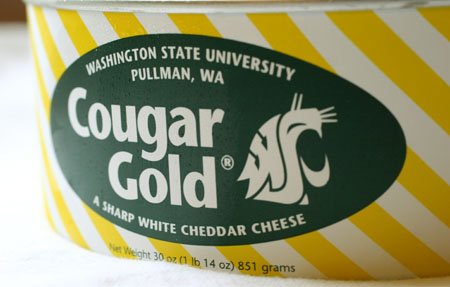
Now, receiving artisan cheese in a can can be confusing. Regardless of whether you've heard that Cougar Gold is delicious, and canned, it doesn't actually hit that the cheese comes in a can until the extra-large tuna fish style tin is sitting on your counter and the cougar fish on the label is eying you. And eye it does.
But you trust that your friends would only send you delicious cheese. So you reach for the can opener. As you work the tool around the lid, you get into a rhythm, and you relax. After you've cut off the top of the container and set the can opener aside, you smell the cheese.
It smells sharp, tangy with lactic acid, and you get a slight whiff of the tin it's housed in. Then, you cut yourself a sliver. And you enjoy it.
Cougar Gold is the color of Straus organic butter made when cows are eating only winter fodder of hay and dried grasses- a slightly yellow, creamy white. Crumbly, the wheel has occasional small pleasant calcium lactate crystals that offer an occasional bite to the cheese reveler. The taste is clean. A little tangy and somewhat sharp, Cougar Gold tastes like fresh buttermilk drizzled over a grassy cheddar.
It's really good. And, according to some Cougar Gold customers, it has tasted delicious upon opening 30 years after it was made.
Why is it in a can? Because when Washington State students developed Cougar Gold in the 1930's for a research/educational project, they wanted to make a cheese that would last for years and needed a strong container to store the cheese in. Plastic wasn't yet introduced as a food storage option. Check out their website for more info; it even has ideas for what to do with the can when you're done with it, such as how to "make it a night to remember with these romantic Cougar Candles."

But back to eating the cheese. The can is 30 ounces- almost two pounds. That's a lot of Cougar Gold. What to do once you've set aside a portion to eat fresh?
Make Cougar Gold cheese balls.
Take the recipe for Farmhouse Cheddar Cheeseballs, second one down on this link, almost to the end of the article. Omit the bourbon, use thyme or lemon thyme instead of rosemary, and use the canned deliciousness as the cheddar.
Then, invite guests over for a Cougar party and say a little prayer of thanks that you have cheese friends in other areas of the country.