
The Cheese Blog
On Writing: 5 Things Not to do When Visiting Cheesemakers for Your Book
Some of you have asked me talk about my experiences writing a book. Of course you still want to hear about what fabulous cheesemakers I've visited and see photos of the cheese, and photos of me getting drunk off the cheese, and hear about what they do to the cheese that makes one drunk (is it the B.linens, is it the raw milk, is it Everclear?), but you also want to know about the book in action.
 Some of you have asked me talk about my experiences writing a book. Of course you still want to hear about what fabulous cheesemakers I've visited and see photos of the cheese, and photos of me getting drunk off the cheese, and hear about what they do to the cheese that makes one drunk (is it the B.linens, is it the raw milk, is it Everclear?), but you also want to know about the book in action.
What's it like to write a [cheese] book? What's it like to travel to visit cheesemakers for research? How do you get a book deal? How do you write a book proposal? How do you kick start the writing process? Well, since I'm still figuring all what to do, I thought that the best way to get started was to first write about what not to do. Let's you and I both say a little prayer that I'm a quick learner.
What Not to Do When Visiting Cheesemakers for Your Book.
If you happen to be visiting cheesemakers (or heirloom bean farmers, or butchers or cobblers, or fashionistas) for book research, the following are things I learned to not do. I hope this advice fares us all well.
1. If you have to rent a car to visit people, don't rent a car from the airport if at all possible. Like buying a burrito for $9 or a yogurt parfait for $6.73 on your way to the plane, it's going to about 5,000 times more expensive here than what it needs to be. Why? Because they know they have you by the ovaries. I saved nearly $200 renting a car around ten miles away from the airport. True, getting from the airport to the car rental place can be a little tricky, but sometimes it's worth the effort. Sometimes you can get a relative to drive you.
2. Sometimes it's not worth the effort. Don't overbook yourself. You think that you're doing you and and your book a service by packing in as many cheesemaker visits that time will allow. It can only make your book better because, oh my, think of the things you will learn! Yet it's important to leave yourself enough time to ask the questions that develop naturally during an appropriately timed visit rather than aim to get through the five you managed to write down in your notebook at stoplights on the way over. If you pack too much in, you're overextending your time, and the cheesemaker's time. And they ain't got much time. And when will you have the time to be there with them again? Plus, if you end up too enthralled during your short visit to leave one place on time, you might be late to your next appointment. Which leads me to number three.
3. Don't think your maps will always work. Leave enough time to get lost. You will get lost. And freeway exits and streets you need to drive on will be closed so you'll need to figure out alternative routes if your GPS doesn't register the closure. Psst.... it won't register the closure. Also, leave yourself enough time to figure out how to use your GPS you just bought before driving.
4. Don't leave your camera manuel at home. When taking photos for your blog, you'll need your camera to work. As statistics show, 9 times out of 10, your camera will malfunction when on a trip. So keep your manuel with you. Your amazing photographer friend MollyD may not be there to answer the phone next time you press the wrong button and mess up your camera for your first two cheese stops. Bless you, Molly.
5. Don't think you won't need "Kirstin time," or "Jennifer time" or "Josh time." Leave enough time to breath. This brings us back to number 2. Not only should you not overbook yourself because it's hard to get the info you need during visits when you're always in a rush, it's also hard to get what you personally and professionally need from the trip when you barely have time to fill up your tank. Or empty your tank. Stop, stretch out your legs, and leave yourself a day to go on a walk around a city or sit in a coffee shop and write. Remember, there are coffee shops and wine bars everywhere that need your support.
Have any writing advice of your own to add?
Limburger Cheese: Just as Stinky as You Like it.
Below I share with you photos from my tour at the Chalet Cheese Co-op- the only remaining Limburger producer in the country. If you see Limburger in the U.S. that is made in the country, it's Chalet. It may have a proprietary label, but it is always Chalet pumping the sweetly funky flavor out. Pick it up and note the dates on the label- they will guide you to finding a cheese age you love. And you will love one of them. More about Limburger in my forthcoming book.
 Remember Monterey Jack on the Chip and Dale Rescue Rangers (Rescue Rangers= the cartoon, not the burlesque show)? Well, Monty, as he was known to his friends, was the Australian mouse who helped chipmunks Chip and Dale fight crime. Yet even though he was darn good at helping to put the right fox, cat, or dog in prison, he was better known for his love for cheese.
There was one cheese in particular that if he got a wiff of it, he was gone. Taken. Impassioned. Spent. Could do nothing else until he found that cheese and made it his own. That cheese was Limburger. Even though Monty was a secure mouse and never cared about what others thought, it was apparent in some episodes that Chip n' Dale thought Monty was crazy for loving a cheese that could smell so strong. Well, Chip n' Dale were not always the brightest, most cultured rodents.
The fussy chipmunks just didn't have the opportunity to taste Limburger at the age that would have pleased them. Oh, but I have. I have.

When I headed to Wisconsin last week to do delicious research for my cheese book, head cheesemaker Myron Olson at Chalet Cheese Co-op tasted us on Limburger at three stages- young & mild, slightly older & soft & sweet, and older & gooey & funky and strong. Amazing. Even though they were all versions of the same washed-rind cheese, the flavors, textures, and strength of the different ages varied like crazy. Honey mustard, rye bread and strawberry jam were also on board too. Young, the Limburger tasted like a fresh, less creamy Red Hawk. Older, the cheese tasted of and had the texture of Tallegio. Oldest, it tasted strong and pungent and begged for its classic pairing of rye bread, honey mustard and onion slices.
Below I share with you photos from my tour at the Chalet Cheese Co-op- the only remaining Limburger producer in the country. If you see Limburger in the U.S. that is made in the country, it's Chalet. It may have a proprietary label, but it is always Chalet pumping the sweetly funky flavor out. Pick it up and note the dates on the label- they will guide you to finding a cheese age you love. And you will love one of them. More about Limburger in my forthcoming book.


Places to find Chalet Cheese (please add to the list in the comments section!):
Bi-Rite, San Francisco
Maple Leaf Cheese Sales, WI (will ship, but not recommended in summer) 608-934-1237
Hefty Creek Specialities, WI (owned by one of Chalet Cheese's award-winning cheesemaker and yodeler), hefticreek@hughes.net, 608/325-6311
Have you had a chance to try Limburger at its different stages? What did you think? Which is your favorite?
Battling the Uninspired Cheese Plate with Honey-Lavender Caramel Guest Post
The rising popularity of the cheese plate as a proper dessert has, in parallel fashion, also given rise to a recurring dilemma for myself. That dilemma being the age-old question: What do I want for dessert?
 As I'm formatting this post at 4:45 am and rubbing the mascara into my eyes that just opened two hours prior, I'm sitting in the Oakland airport wondering why everyone else arrives only 30 minutes before their domestic flight departs while I feel the need to get here at least an hour and a half early. Right about now I'm feeling very thankful that my friend Garrett McCord over at Vanilla Garlic agreed to write this week's post. While I'm playing in Wisconsin dairyland this week doing research for my cheese book, you lucky readers get to experience cheese writing from one of my favorite bloggers in the food world. At Vanilla Garlic, Garret compels his readers with witty writing, beautiful photos, and sexy recipes. Here, Garrett goes beyond the call of describing the downfalls of uninspired cheese plates that he's encountered in restaurants, he one ups the uninspired plates by using his pastry chef skills to create a honey lavender caramel sauce recipe that pairs with blues to address the problem. I'm honored to have him. I know you'll enjoy his post as much as I do. Thank you Garrett!
Garrett on the dessert cheese plate.
The rising popularity of the cheese plate as a proper dessert has, in parallel fashion, also given rise to a recurring dilemma for myself. That dilemma being the age-old question: What do I want for dessert?
A cheese plate of Humboldt Fog, a bitter as hay Torta de Serena, and a brusque tobacco leaf wrapped Cusie di tobacco is simply too much to resist. Yet, right below it is listed a chocolate hazelnut torte with a Chantilly cream. Let me tell you, I do love hazelnuts. And, yes, written right under that is a rhubarb and huckleberry napoleon served with a rhubarb sorbet.
Ugh! The decisions! Such a trialed life I lead with my First World problems.
Now, yes, many of you might say that there is a simple solution: order all of them. Obviously, you readers have more alimentary fortitude than I, and, possibly, a tinier waistline. For me, this just isn’t such an option. Especially if dining alone.
I was trained in pastry so I have a proclivity to pick something unique from a dessert menu so I can analyze it, take it apart, taste it, and marvel at a fellow cook’s skill and training. My work draws me to composed desserts no matter how simple or grand. Yet, as a lover of all things dairy, a well-composed and eclectic cheese plate is always drawing. In my world, an unheard of artisanal cheese has as much pull as any crumble or cookie.
Order the cheese plate, however, and with your cheeses are likely various accoutrements of varying degrees of disappointment. A few Marcona almonds tossed in the corner. Maybe some house made olives that, more often than not, leave an alkaline taste in your mouth more bitter than the third Spider-Man film. Honey – always honey – to go with the blue cheese because no one in the kitchen is feeling creative enough to try something, anything, different. If you’re someplace swanky you might actually score some honeycomb.
It leaves me to wonder: If the cheese plate is being offered as a dessert then why are not more pastry chefs taking the initiative to make it their own?
An unadorned cheese plate is a lazy offering on behalf of the kitchen. It’s a dish that features the work of someone else and that only reflects the personal taste of the composing chef. The accouterments are where the cheesemaker and pastry chef can dance together and weave a dessert that plays to both their strengths. Scratch the nuts and offer a pistachio-cocoa nib brittle alongside a slice of Cocoa Cardona. Perhaps a strawberry-Merlot jam to accentuate the creamy flavors of that Garrotxa? Port syrup reduction with a wedge of Stilcheton? Yes. Please, God, yes.
Caramel, I’ve found, makes an excellent pairing for cheeses. The flavor of a brown sugar caramel echoes the butterscotch tones in aged Gouda. A square of chocolate and Earl Grey caramel candy goes beautifully with an artfully crafted chèvre.
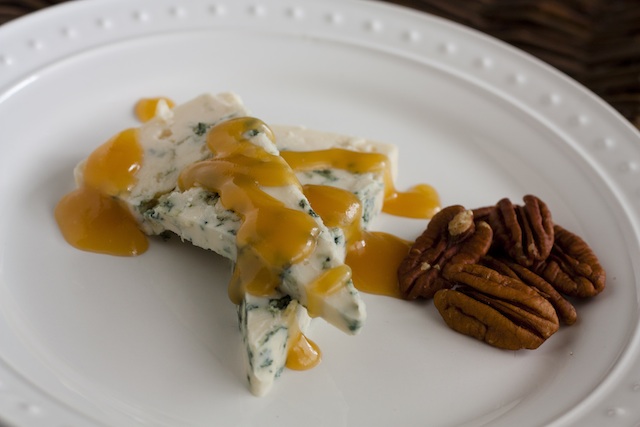
For blue cheeses I rely on this honey-lavender caramel sauce. It does the same job that honey would with blue cheese: cut through the peppery, salty, fatty flavors while accentuating them. The lavender offers a floral quality that mingles well with the milk, and the concentrated sugars of the honey highlights the piquant qualities of the mold.
Any favorite honey will do. Personally, I suggest using dark honeys for the most pronounced flavors; buckwheat honey and molasses-black avocado honey are especially eloquent choices.
Give it a try next time you plan to serve your favorite blue cheese. It’s easy, reliable, and unique way to make your next cheese plate stand apart.
Lavender-Honey Caramel Sauce
1 teaspoon lavender
12 ounces cream
1/2 cup dark honey
1/2 cup sugar
1/4 cup brown sugar
1/2 cup butter
1. Place the lavender and cream in a sauce pan and warm over medium heat until hot to the touch. Cover and allow to steep for 5-10 minutes, depending on how strong you want the lavender flavor to be. Strain out the lavender and set aside.
2. Place the honey, sugar, brown sugar, and butter in a heavy-bottomed 2-3 quart sauce pot. Bring ingredients to a heavy boil, stirring all the while. Slowly pour in the cream. Boil for two minutes, stirring constantly. Boil for two minutes, stirring constantly. Take off the heat and pour into a jar. Cool completely and store in the fridge.
Makes 3 cups of caramel sauce. Also good on fruit, waffles, pastries, and ice cream.
Garrett McCord is a freelance food writer and pastry chef who has worked for Cheese Connoisseur, Gourmet Live, Simply Recipes, and Epi-Log. More of his work can be found at his blog, Vanilla Garlic.
Next week: Wisconsin dairy feedback.
Roccolo Cheese: The Holy Lombardic Trinity
Roccolo is a dream cheese. It is a holy trinity cheese. It is soft and firm and crumbly all in one. It tastes crazily varied from rind to center. It smells a little different in spots.
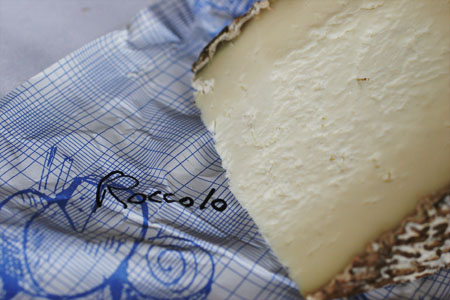 Roccolo is a holy trinity cheese. It is soft and firm and crumbly all in one. It tastes crazily varied from rind to center. It smells a little different in spots. In other words, its three distinct layers offer a cheese lover three cheeses for, well, .... more than a fraction of the price of a block of colby, but you get more than just orange and yellow cheese that tastes nearly the same no matter the hue.
Roccolo comes from Lombardy, Italy. Made by cheesemaking enterprise Arrigoni Valtaleggio, a large family company that helped to spearhead Tallegio imports, Roccolo is a a natural rind cow's milk cheese whose name translates to "bird snare." The cheese's rind echos the hue of the local bird hunter's stone hut they used to set camp in in earlier times.
After being brined in a salt water bath, Roccolo is set to age on pine boards and flipped and rubbed daily with a little extra salt water brine to bring out earthy, B.linen bacteria like those found in other washed rinds.
Yet pick up a slice of Roccolo and give it a good sniff, and you'll only find the scent somewhat similiar to other semi-soft washed rinds. Rather than having a strong, sweetly blaring scent, Roccolo has an earthier scent like a mushroom that's been foraged after a weeks of rain, and maybe dropped in a little dirt before being put in the straw mushroom basket.
Its taste is quite distinct too. It ranges from buttermilk to butter to mushrooms, to oysters to salty beef fat. The center is a little fresher tasting, and the further you get towards the brown, moldy rind, the funkier it gets.
The most interior part of the paste is crumbly and off-white. The layer beyond is smooth and the hue of that manilla folder a teacher holds in elementary school when presenting test scores to parents on Parent-Teacher night. The outside is brown with white and grey mold and an occasional yellow streak. I eat the rind, mold and all. I know that people are washing it and flipping it everyday and this might scare a folk or two who are concerned with others fondling their cheese, but the rind adds so much pizzaz to the tasting experience. If you like less funk, skip the rind.
I like this cheese with a dry Riesling or a balanced, oaked Chardonnay, Viognier or Roussane-Grenache Blanc blend. Or a Champagne. Mmmm......
If Roccolo isn't available near you, also try Salva Cremesco or Tomme Crayeuse, both cow's milk cheeses with an earthy taste and varied texture (although a little creamier than Roccolo).
Any super-layered cheese favorites?
Ombra- Catalonian Sheep's Milk Cheese
Ombra is a firm, Spanish cheese that helps to explain why people fall in love with sheep's milk. Grassy, nutty, slightly spicy, and peppery, it never fails to blow me away with its lingering complexity.
 Because I've been so focused on the cheese girls next door- the dairy domestics in the U.S.- while I'm writing my American cheese book, I've been a little worried lately that my international cheese friends weren't feeling the love. Not the case, my Euro friends and beyond, not the case. I've been sending the love through air kisses from afar.
In case a few of the kisses were lost in transmission (or in the Italian post office system) or my readers were doubting my allegiance to the entire milky world and not just local dairy, I'm devoting the next two posts to two of my Euro favorites. Seek em out.
The first is Ombra.
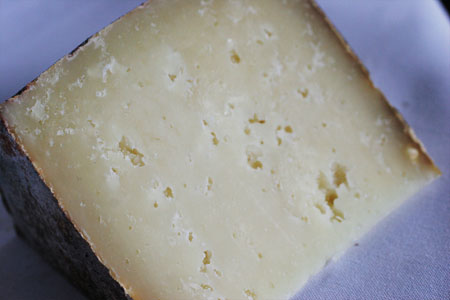
Ombra is a firm, Catalonian Spanish cheese that helps to explain why people fall in love with sheep's milk. Grassy, nutty, slightly spicy, and peppery, it never fails to blow me away with its lingering complexity.
A bite of Ombra lasts far longer than after it's swallowed. It lasts longer than your pair of favorite pair of jeans from the 90's that you just couldn't bear to throw out (because you knew that in 2011, Chloe Sevigny would put on high-waisted denim and you could bust them out again, right?). Like a great Barolo, Ombra changes from the first to last taste. The first bite delivers an herbal, grassy hit. Later, the herbs morph into a buttery, nutty, and well, slightly musky sheepy finish.
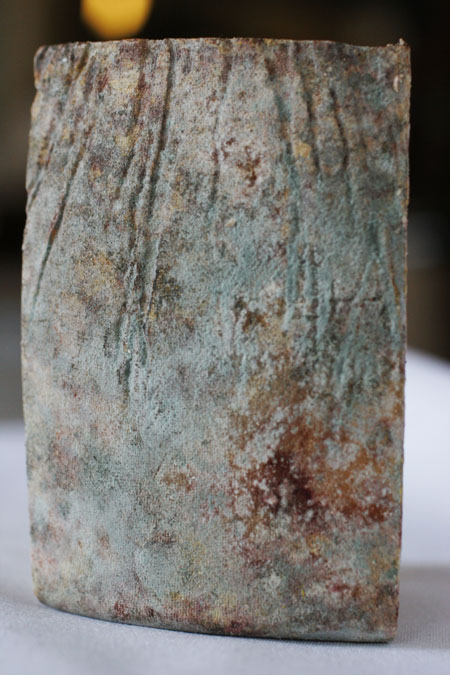
It looks cool too. A gray-blue mold dusts the lightly pleated brown and rusty pattered rind. The interior cracks in just the right places. It has tiny holes that make it look lacy when sliced. Even though a shorter wheel than many cow's milk cheeses, Ombra stands proud and straight at a powerful four inches high.
When having this Catalonian beauty with wine, drink with a rustic Tempranillo- one with plenty of spice and not too much oak, a Rhone blend heavy on Cinsault, a Bordeaux, or a Catalonian red. When enjoying with a side, slice into a low-sugar, classic Spanish fig and almond cake or medjool dates.
Next up- Roccolo. After Roccolo, I'm excited to share a guest post about a certain caramel cheese friend (cheese is a social animal) by Garret McCord of Vanilla Garlic. Big plans, big plans!
What's your favorite sheep's milk cheese from Spain outside of Machego?
Bellwether Farms Cheese Interview: Credit Cards, Seasonality & Raw Milk
The Callahans of Bellwether Farms started the first licensed sheep's milk dairy in California in the late 1980's. There are now five. Considering that I still occasionally get a raised, suspicious, eyebrow when telling people that the cheese before them is made with sheep's milk, and no, it's not Manchego, this is no small feat. Beyond representing high-butterfat, nutty milk in the earthquake state and inspiring others to realize their sheep potential, Bellwether dairy makes the top pecorino-style cheese in the country and the most seductive whey-based sheep's milk ricotta I've had outside Italy.
 The Callahans of Bellwether Farms started the first licensed sheep's milk dairy in California in the late 1980's. There are now five. Considering that I still occasionally get a raised, suspicious, eyebrow when telling people that the cheese before them is made with sheep's milk, and no, it's not Manchego, this is no small feat. Beyond representing high-butterfat, nutty milk in the earthquake state and inspiring others to realize their sheep potential, Bellwether dairy makes the top pecorino-style cheese in the country and the most seductive whey-based sheep's milk ricotta I've had outside Italy. Here, I interview Liam Callahan, who put California's first sheep's milk cheese in the shops in 1990. Thank you Liam!

You were just finishing up a degree in political science at UC Berkeley when your mother invited you to learn about sheep milking and cheese making with the animals she recently brought to the family farm. You left the land of academia and political science to work with sheep, and found yourself loving the life so much you stayed. With so much opportunity elsewhere, what kept you on the farm? Do the same things still inspire you today?
I had approached college as a way to be exposed to interesting ideas and diverse viewpoints rather than as part of a career path. When I was getting ready to leave school I was not sure if I would be staying in the Bay Area. I was not interested in pursuing an advanced degree and was trying to avoid an office job at all costs. I had been helping with our sheep since my mother bought her first ewes in 1986, but it was not until we started planning for the dairy and creamery that it began to make sense for me to stick around. The challenge of making cheese and the process of turning milk into our various products is still exciting. I love having something at the end of the day that I made with my hands.
When you first decided to start making cheese, you were unsure about what style to craft. After doing some traveling abroad and finding your passion, you started crafting the cheeses that you've made your name with today- San Andreas, Pepato, Crescenza and Ricotta. What drew you to these cheeses?
When we first began to make cheese in 1990 we focused on the most basic cheese to make – Fromage Blanc. We would make small batches and add various seasonings to the cheese and sell it at Farmer’s Markets around the Bay Area. We had been selling lamb to local restaurants for a few years by that point and began to sell a bit of our new cheese as well. Several of our chefs pointed us towards the sheep cheeses of Northern Italy when we mentioned our interest in making aged cheeses. In the spring of 1992 my parents took a month long trip to Italy to learn about Tuscan cheeses. They went with the hope of learning enough of a recipe that we could begin to make a Pecorino Toscano. They visited with several small creameries and we began to make our Toscano. I thought people would want more than one type of cheese at the Farmer’s Markets so we added the Pepato and another with crushed red pepper.
I returned to Italy in the spring of 1994 and again in 1996 to increase our general knowledge of cheese making. These subsequent trips helped me get a different perspective on our aged sheep milk cheeses and led to my decision to stop trying to make an ‘Italian style’ pecorino. In Italy you can often find many small cheese makers located very close to one another, making and marketing cheese using the same name. This is the case for Pecorino Toscano. I visited many of these creameries and was struck by how distinct each of their cheeses was from each other. It made me realize that if cheese makers a couple miles apart could not make the same product is was foolish for me to try from 6,000 miles away. When I returned we began to consider what characteristics of our cheese we enjoyed most. We started to vary moisture and acidity, then switched to raw milk and most recently (2 years ago) developed a natural rind for our sheep cheeses. Once this process of experimentation began we started using the San Andreas name. We kept the name Pepato because it was descriptive of the cheese.
Making ricotta was a natural extension of making aged sheep cheeses. All the creameries we saw in Italy made ricotta with their whey and it made sense for us to do so as well. Once we started making our cow’s milk cheeses I developed our recipe for our jersey whey ricotta. We take great care in making our ricotta and within the last 18 months added a whole milk jersey milk ricotta to our lineup. When ricotta is made in the traditional way it is one of the most delicious dairy products you could have. It is a real shame that so much industrial ricotta is out there for such a low price – it is like a different product entirely.
At the time your family started Bellwether, you were one of the first sheep's milk dairies in California. The second, I believe. What kinds of hurdles did you have to overcome to become one of the most highly respected creameries in the state and nation? Did you have to have to preach the gospel of sheep's milk to a public that grew up on cow's milk?
I think we were the first licensed sheep dairy in the State – at least that is what our inspectors always told us. But being the first was never a goal. We had sheep and milking them seemed like an interesting thing to try. We had heard that many millions of pounds of sheep milk cheeses were being imported and discovered that some of our favorite cheeses were made with sheep milk. I think the hurdles for small creameries are similar regardless of the milk type.
It is difficult to get to a size that you can make any money and it is difficult to get money to start.There was not a lot of money out there from lenders and we relied on my father’s life insurance policy and credit cards. If I received a credit card offer in the mail I would take it. At one time I had over $250,000 on credit cards. We used them like a line of credit and eventually paid them all off. When we finally did get a real line of credit from a bank it was for only $15,000.
Another hurdle is that there is a lot of work to do. You are left to do everything at the creamery, and if you have animals, that is a whole different job that needs doing. After all that you need to market your products. Farmer’s markets are great but are very time consuming. Eventually you will need to get your product to stores.
We never tried to market our cheeses as better than cow’s milk, or that sheep milk had some qualities or health benefits that people needed. Rather, we just made cheese and let people decide for themselves. Certainly people were curious and many had preconceived ideas about how it would taste but, most were open to something new, and many were surprised to know that they were already enjoying imported sheep milk cheeses like Feta, Roquefort, Romano and Manchego. We have been very lucky that people have enjoyed our cheeses and supported us over the years. The time really has flown by.
It's spring. Could you speak to the effect of the seasons on sheep rearing, milking and cheesemaking?
The seasons of the year affect the milk from both the cows and the sheep. In the spring the solids drop but the grassy aromas increase as they are in the fresh grass. The milk from the Jersey cows gets even more yellow color. When the animals are on the fresh grass the curd tends to be a bit softer. As the year progresses the solids in the milk increases but the volume decreases – this means you get more pounds of cheese per gallon of milk, but fewer gallons of milk per animal.
As artisan cheese lovers everywhere know, the FDA is scrutinizing (some might say bullying) creameries who focus on raw milk cheeses, and there's been talk of them considering banning raw milk cheeses altogether in hopes of "protecting" American consumers against foodborne illness. How do you feel about this, and as someone who specializes in unpasteurized, aged, sheep's milk cheeses, how do you see this affecting you? How do you see it affecting even smaller creameries around you?
I worry about the affect this FDA action could have on small cheese makers. The position the FDA is in is a difficult one. Obviously, it is trying to protect the public from any threat to their health that cheese potentially presents. Once is identifies a potential threat it must try to ‘solve the problem’. Whenever there are outbreaks of food borne illness fingers are pointed at the regulators. Some of the assumptions that have been made for years about the safety of raw milk cheeses have been called into question. Specifically, it is now in doubt that the ’60 day aging rule’ guarantees no survival of pathogenic bacteria. Some cheese makers produce only pasteurized cheese because they are fearful of the liability issues this situation creates. To date there has not been enough science to determine what aging conditions are ‘safe’ and which are insufficient. However, the problem extends beyond raw milk cheeses. Bacteria can easily come into the creamery on shoes and clothing or dirty hands. Most cases of food borne illness occur due to pasteurized milk being contaminated post-pasteurization. The best a creamery can do is to try and rid their facility of the bacteria that is most threatening, and double check the sanitation program with environmental testing. The necessary testing is a financial burden on the smallest cheese makers – lab work is expensive.
Last spring, when there were several high profile FDA actions against small cheese makers, we were inspected as well. It was the most thorough inspection we had ever had. It lasted more than two days with samples being taken from all over the creamery, even places no cheese can come into contact with. They told me that the huge peanut recall of 2009 had heightened awareness. For days afterwards I was holding my breath because what they were testing for can’t be seen with the naked eye. Fortunately, all tests came back negative. Hopefully, the FDA will develop a standard protocol that can be adopted by both small and large creameries, but any solution will still come down to the diligence of the creamery.
Valley Ford- Sonoma Hills, Baby Cows and Cheese
The cheese trips that I've been going on lately have made be thankful for many things. 1. The cheesemakers. Whether they devote their lives to tending animals and making cheese, or focus primarily on making cheese and leave animal husbandry to others, they make our delicious, daily lives possible. Plus, if they weren't making cheese, I'd have to write about... beans... or .... radicchio.
 The cheese trips that I've been going on lately have made be thankful for many things.
1. The cheesemakers. Whether they devote their lives to tending animals and making cheese, or focus primarily on making cheese and leave animal husbandry to others, they make our delicious, daily lives possible. Plus, if they weren't making cheese, I'd have to write about... beans... or .... radicchio.
2. The animals. They're beautiful, even when they're being a pain in the butt and not going into the right milking stall. They give us glorious milk. And they're soooo.... cute when they're babies (even, I recently found out, when they blow snot rockets that have a three-foot projectile).
3. Friends. I love having other people who are also passionate about cheese attend my cheesemakers trips. Because I love them, sure, but another reason is because when they're in the car with me, they become official navigators. This is priceless because I get lost quicker than a child left alone in a supermarket. But even better- when my friends come along, they serve as photographer while I pester cheesemakers with questions. In the case of my professional photographer friend, Molly DeCoudreaux, this is the best news possible for everyone. All photos featured on this post are by her.

Recently my pal MollyD and I drove up to say hello to cheesemakers Karen Bianchi-Moreda and her son Joe Moreda at Valley Ford on possibly the prettiest day ever. Do you remember Valley Ford? They were the cheese company that I wrote about in the LA Times this October that switched from being "just" a dairy farm to also making cheese to be able to cope with the ridiculous pressures of the milk market.
We found Karen pressure-hosing the barn when we arrived. Now, even though I was already impressed by her ambition and passion, I'm now also impressed by her guns. But back to the farm. Karen also introduced us to her cheesemaker son, Joe Moreda, who graduated from Cal Poly with an emphasis on cheesemaking and decided to return to the farm to join the family business. He and Karen are a two-person mean cheese machine.


Then, she showed us her cheese room, and let us sample a bite or too from tasty wheels, like Estero Gold, Highway One, and the future release, Grand.


Next, with eyes lit up like a kid in Willi Wonka's Chocolate Factory, Bianchi-Moreda told us that she wanted to show us something. She led us towards a green and brown barn, the only original structure left from the first of the five Bianchis generations to live on the farm, and paused to glance at us with a wide smile. She slowly slid open the heavy door. Inside was around twenty stalls of calves. After waving us in, she introduced us to a two-day old Jersey that I like to call Ginger. When Karen opened her gate so we could scratch her a little under her chin, Ginger suckled. After a minute or two more of shyness that faded away with every chin scratch, Ginger got her visitor legs on and started polka-ing around her stall. Then she tried to prance out of her pen. "Oh, not so shy anymore are you?," said Bianchi-Moreda, shaking her head and laughing. "Tthis is why I do this."
All hail the baby cows.


All photos on this post are by DeCoudreaux. Note to readers- she is a rockin full-time photo professional, and this sort of photo excellence is only linked to Molly navigating my cheese trips. But, if you want her to navigate your own photo trips, weddings, portrait sessions, food shots, you can contact her here.