
The Cheese Blog
And They Called Them Stinky
Stinky is relative. My fainting friend — who admits the only cheese she’ll eat is fresh burrata or mozzarella and who made me keep all cheese I purchased while visiting her on the balcony where she couldn’t smell it — has a very low tolerance level for stinky cheese. Let’s classify it as zero on a scale of 1 to 10 (I still love her though; she sends me home with jars of her granmother’s quince jelly). My stinky tolerance level is 8. Another friend’s level is 13.
 "And They Called Them Stinky," {by me} originally published on the Menuism Cheese Blog.
The first time I heard someone call Comté “stinky,” my jaw dropped. Comté, a semi-hard lightly washed rind from France’s jura region, is a sultry, sweet wheel with flavors of butter, toasted walnuts, caramel, and from time to time, notes of caramel or beef. I would have sooner called a rose stinky than Comté. It wasn’t until that French friend told me that on one of the many gastronomic field trips that French children take during elementary school, she fainted in a Comté cave because the scent was so fierce, that I really thought about the term stinky.
Stinky is relative. My fainting friend — who admits the only cheese she’ll eat is fresh burrata or mozzarella and who made me keep all cheese I purchased while visiting her on the balcony where she couldn’t smell it — has a very low tolerance level for stinky cheese. Let’s classify it as zero on a scale of 1 to 10 (I still love her though; she sends me home with jars of her granmother’s quince jelly). My stinky tolerance level is 8. Another friend’s level is 13.
In honor of cheeses everywhere, I thought I’d take some time to mention some of my favorite stinkies, as in, they stink so good. Their scent comes from cheesemakers washing them in a brine of salt and water or a blend of water and alcohol that encourages growth of the sultry Brevibacterium linens bacteria. It’s a good bacteria that keeps the bad ones away.
Below are some of my favorite choices, in varying degrees of stinkiness. I rate the funkiness possibilities from 1-10. Taste at your local cheese shop if you want to rate your specific slice before taking home.
Writing a Book: Proposal & Prepublishing
People ask all the time, "how does one write a book?" Well, to start, it's correct to ask "how does one," because one writes it- alone. Holy bejesuses it gets lonely writing a book. During the last two months while I was writing the first draft of my manuscript, I didn't go out, I pretty much ate only the recipes I made for the book, and only saw people when they came over to test recipes. I
 Well, folks, my agent's been urging me to post more about the process of writing this book and others are emailing me wondering how book's are actually published, so I thought we'd take a brief trip into book publishing land. Feel free to let me know if you want more or less of these type of posts in the comments.
People ask all the time, "how does one write a book?" Well, to start, it's correct to ask "how does one," because one writes it- alone. Holy bejesuses it gets lonely writing a book. During the last two months while I was writing the first draft of my manuscript, I didn't go out, I pretty much ate only the recipes I made for the book, and only saw people when they came over to test recipes. I squirreled away in front of my computer in my bedroom. I had to physically detach myself from the twitter platform because it so satisfied my need for people. My social time was going to yoga, and then pilates, where I could listen to others breathe in two different ways, which helped me feel like I was hanging out while I corrected my posture from writing curled over a keyboard. It's slightly pathetic.
So that's the actual writing part. Before that, I traveled and interviewed and got to hang out with baby animals and cheesemakers I respect. That was awesome. The research part was cool too. And when I was getting enough sleep, the writing was cool too.
But of course one must work up to that point. First things first- one must write a book proposal to write a non-fiction book. If you are seeking an agent (I was) and a publisher (yes), you'll need one. A book proposal is anywhere from 15-60 pages long. Non-fiction writers write book proposals then their agent seeks a publisher to support the writing process and the book to come. Fiction writers write books, then submit a proposal to a publisher or agent to see if they want to see the book.
I took a class with the awesome Dianne Jacob to learn how to write a proposal. I'd suggest you seek out books to help you too (there's no way I have it in me to explain the process in full in this tiny blog). I liked Writing a Book Proposal and The Essential Gudie to Getting Your Book Published. My agent recently made me buy the second because it also explains what an agent is supposed to do for a writer and I wasn't asking her to do anything. Shame.
So that's how one starts to write a book. I'd be happy to explore more or less of this here, just let me know what you're curious about, and write little bits here and there as they come to mind.
Don't Call it a Come Back: Cheesy Recipes Return
It’s been a while since I posted recipes on “It’s Not You, It’s Brie.” When I get busy, as freelancers often do, I fall out of the habit. It’s not that I haven’t been cooking or cooking with cheese, it’s just that sometimes when I’m absorbed in cooking, especially as a release, I forget to wipe off my cheesy kitchen fingers and record what I’m doing.

Southern Cheese & Whiskey Fever
Southern cheese, my friends, has arrived. Or rather, it has been thriving, and the rest of us are finally noticing its presence. This last Sunday I taught the Cheese School of San Francisco's first Southern Cheese & Spirits Class. Quite an honor. It was great. We ate. We drank. We marveled at the jug of corn whiskey.
 Southern cheese, my friends, has arrived. Or rather, it has been thriving, and the rest of us are finally noticing its presence. This last Sunday I taught the Cheese School of San Francisco's first Southern Cheese & Spirits Class. Quite an honor. It was great. We ate. We drank. We marveled at the jug of corn whiskey.
The idea of the class arose one day when I was telling Kiri Fisher, co-owner of the Cheese School, how excited I was about the region and its dairy goodness as a result of my cheese book research, a friend from Tennessee who's introducing me to its bounty, and a new distributer to the bay area bringing in southern cheese. We were chatting right before I was about to start teaching a class, and I was just rambling my little heart away when Kiri said, "You know, I like the idea of a southern cheese class."
Although southern cheese is thriving in the south, it's still hard to find a lot of the small production stuff around here. Plus, it's spring, when many mama animals need more of the milk that might otherwise go into our cheese to feed their young- there's just less of the small-prouction cheese around in general. So to source enough cheese, we had to diversify. We ordered four of the eight cheeses from my friend Kathleen Cotter who owns The Bloomy Rind in Nashville, Tennessee (beautiful cheeses, arrived in perfect condition, even though they were FedExed all the way from Nashville). We ordered others through Darren, the owner of Cream and the Crop cheese distribution, and Tomales Bay. All beautiful.

And did I mention we served booze? Whiskey heaven, plus New Orlean's own Abita beer.
1792 Ridgemont Reserve Bourbon, Templeton Rye Whiskey, Platte Valley Corn Whiskey (a.k.a especially tasty legal "moonshine"), Abita IPA.

Here's a a little look at our favorite pairings from that night.
1. Lambert Hoja Santa ♥ St. Abita IPA & Platte Valley corn whiskey
2. Capriole Kentucky Tomme ♥ St. Abita IPA & Platte Valley corn whiskey
3. Sweet Grass Green Hill ♥ Platte Valley corn whiskey
4. Cumberland, Sequatchie Cove ♥ Templeton Rye Whiskey, Platte Valley corn whiskey
5. Chapel Hill Calvander ♥ St. Abita IPA, Templeton Rye Whiskey
6. Looking Glass Chocolate Lab ♥ Platte Valley corn whiskey, Templeton Rye Whiskey
7. Blackberry Farm Singing Brook ♥ 1792 Ridgemont Reserve Bourbon
8. Sweet Grass Asher Blue ♥ 1792 Ridgemont Reserve Bourbon
Moonshine shined bright, folks. A lightly oaked pure corn whiskey stole the pairing show.


Again, thanks to The Bloomy Rind for getting us amazing cheeses at the drop of a hat!
What are your favorite southern cheeses? What do you drink them with?
Classes Galore & California Cheese Fest
Alas, it's been a very full couple of weeks. So in the middle of this fury, I'm very happy to announce today two things.1 I'm teaching a ton of classes this spring (some listed below, more on way). 2- The California Artisan Cheese Festival is back. Yay local dairy and cheese education!
 Well, readers, it's been a heck of a last two weeks, and right now, I'm all about spreading all the [cheese] love possible. About two weeks ago my house was burglarized, and a fair amount was stolen- computer, camera, sentimental jewelry, etc. And some Moroccan hair oil and a pillow case (so if you see someone with luscious, sweet-smelling hair that looks like they had a good night sleep, call the Oakland PD). But alas, I have renters insurance, and although my claim involved a wealth of paperwork, having that insurance has been a godsend. A case of odd timing- the day after the burglary I was supposed to get my book manuscript back and had 3 weeks to edit it. Computer-less, I was in a little bit of a bind. But my lovely editor (bless her) held off for a few days until I got a replacement computer. So now I'm busting my booty editing to meet the new deadline for that and other things. Good news- the book draft is looking pretty good, for a draft! And, the other things that are keeping me busy are work related, and are fabulous. There are just a lot of them. And, hey, I'm healthy, and I ate an awesome plate of carnitas last night while sipping mezcal.
Alas, it's been a very full couple of weeks. So in the middle of this fury, I'm very happy to announce today two things.
1 I'm teaching a ton of classes this spring (some listed below, more on way).
2- The California Artisan Cheese Festival is back. Yay local dairy and cheese education!
I'm very happy to be teaching these classes, and I'll have more to announce shortly. Plus, the Southern Cheese one will be a rare class- you don't hear about this region's cheese often, there's amazing stuff to be tasted, and there's moonshine to drink. Exciting points all over. Second, I'm happy about the the California Cheese fest in Sonoma because it is a fabulous way to meet small-production cheesemakers, indulge in vast amounts of dairy, and take some classes. If I were free that weekend, I'd go. I highly suggest it. There will even be a cheesemaker there from Utah who milks Icelandic sheep.
CLASSES GALORE (more to come)
Southern Cheeses & Spirits, Mar. 25, Sunday: The Cheese School of San Francisco
Let’s name the great cheesemaking regions of the US: California,Wisconsin, Vermont,... Georgia? The South is indeed rising again. Creameries like Georgia’s Sweet Grass Dairy, Texas’ Mozzarella Company, and Alabama’s Stone Hollow are turning out great cheese and getting national attention for it. Cheese blogger and wine maven Kirstin Jackson will lead and pair her selections with her favorite Southern spirits.
Spring Sparklers, April 16th, Monday: The Cheese School of San Francisco
It’s springtime, the birds are chirping and the blossoms, blooming! Love is in the air. What better way to celebrate than with some milky nibbles, light sparkling wines, and hopefully, someone charming and attractive with whom to share in the bounty. This class is a fresh and lively guided tour through some of the best cheeses and bubbly wines spring has to offer. Charming and attractive date not included.
Summer Cheese & Wine, June 20th, Wednesday: The Cheese School of San Francisco
In summer, foodie daydreams linger on sunshine, fabulous cheese, and thirst-quenching wines. ‘It’s Not You, It’s Brie,’ blogger and oenophile Kirstin Jackson will lead you in a fantasy tasting of summer’s best. Think fresh and just ripe cheeses and light, fun wines. You’ll find some pairings to inspire your summer gatherings.
CHEESE FESTIVAL
The California Artisan Cheese Festival
March 23rd- 25th
March 23rd- all the Friday Farm tours are sold out. Sign up quick for the Laguintas beer & cheese dinner.
The rest of the goods.
Great Dessert Cheeses & Their Buddies
No offense to my other great dessert loves, carrot cake with orange-cream cheese frosting, or peanut butter and chocolate ice cream, but I’ve never been of the mindset that one needs to end the night with a sugary bang. Maybe just a light ka-boom. For me, cheese supplies enough of that ka-boom. A little sweet, a little salty, and creamy and loving to everyone that it meets, cheese is its own dessert. Plus, it requires less time than carrot cake, souffles, cupcakes, tarts, and even fruit salad (if you count that as a dessert) to put together.
 So I have a new regular writing gig, dear readers. Every 4-5 weeks I will be writing for Menuism as their new expert cheese blogger. This is good for three reasons. 1. I get to meet new cheese lovers. 2. I get to be on the list of awesome menusim writers like chocolataire and rock and roll cake-designer extraordinaire, Kate Steffens 3. They come up with ideas that they'd like me to write about. This means that you also get new topics that I might not have thought up myself. Which is very good- by the way, I'm ALWAYS open to writing suggestions.
Below is my latest post for Menuism, Great Dessert Cheeses originally published on the Menuism Cheese Blog. And here is my interview with them.
Abbaye de Belloc- Finding Comfort in Fermented Sheep's Milk
Sometimes, after a long day of tasting wine, eating artisan cheese, talking about new and novel cheeses, and slicing the said sophisticated pieces of fermented milk for others (following the one-for-them/one-for-me rule), I like to return back to my comfort cheese- the Basque Abbaye de Belloc. This is the French cheese that got me into sheep's milk.
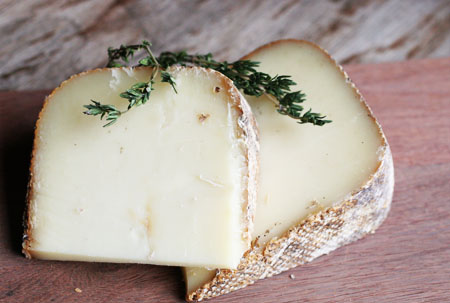 Sometimes, after a long day of tasting wine, eating artisan cheese, talking about new and novel cheeses, and slicing the said sophisticated pieces of fermented milk for others (following the one-for-them/one-for-me rule), I like to return back to my comfort cheese- the Basque Abbaye de Belloc. This is the French cheese that got me into sheep's milk.
Now, I love all styles, but sheep's milk cheese is likely my favorite cheese genre. I love sheep's milk's buttery, sweet, rich, spicy notes. But back when I first started eating cheese, my dear friends, I leaned towards the more mild sheep's milk cheeses. It's true. Maybe you were the same. It's a common progression- start light, then, later, reach deeper. You hear a similar story in wine- people tend to lean on the fruit-foward, smooth finish, friendly styles and work their way towards the high-acidity, more complex, even funky wines.
The first sheep's milk cheese that I fell in love with (this was back when sheep's milk dairies numbered under 1 or 2 in Cali) was Abbaye de Belloc. It's rich, creamy, tastes of brown butter and caramel, and is as comforting as being swaddled in a towel fresh from the dryer. It's also good for sheep's cheese novices because underneath all that butter and sweetness, it has a little of that sheep meatiness that sometimes people need a little time to learn to love. Abbaye helps edge them in.
What does the sweetness come from, you ask?
Among other things, the high quality milk, and the washing and cooking of the curds. After cheesemakers have seperated the curds from the whey, they can do a number of things. Washing, or rinsing, the curds with warm water rids the curds of some of their lactose, which will later turn into lactic acid. Many Basque cheesemakers wash their curds. Cheddar cheesemakers, on the other hand, actually let their curds sit to develop more lactic acid to increase sharpness in their cheese. If you wash some of the lactose off early on, you limit how sharp your cheese can become. Even though "washing" doesn't increase the actual residual sugar in the cheese, the cheese ends up tasting sweeter. With Abbaye, they also cook the curds at low temperatures. This helps to sweeten the milk by slowly caramelizing the sugars (lactose). These three things make for a lovely, friendly, comforting sheep's milk cheese.
I love eating this cheese with Pinot Noir- domestic styles, because they're rich like the cheese, but a more robust wine works too, like a Madiran from the Pryenées region. A fuller-bodied Chardonnay, white Rhone or Champagne also scores big points.
As for eating- bring to room temperature and just go at it. Slice thin. Doesn't need any condiments, but it sure does make one of the best mac n' cheeses and grattins I've ever had. It melts like a dream. As might your heart when you dig in.
What's your comfort cheese, and did you have a specific cheese that showed you the beauty of sheep's milk?