
The Cheese Blog
Melt: the Art of Macaroni and Cheese, An Interview
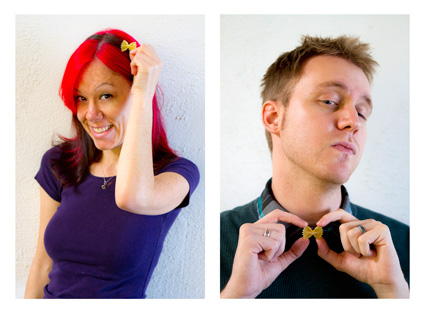
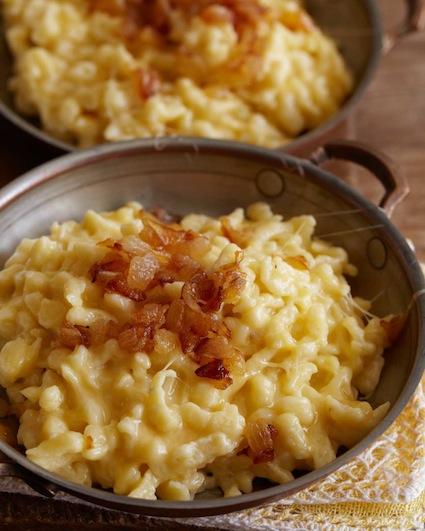 In the theme of the general cheesiness of "It's Not You, It's Brie" and the blog's series of interviews with people in the Cheese Biz who are writing and educating about, making, selling, and cooking with cheese, I'd like to introduce you to my friends, Stephanie Stiavetti and Garrett McCord. They're authors of very popular blogs, writers who have been published in NPR's Kitchen Window and beyond, and next Tuesday, they are publishing a cookbook.
Melt: the Art of Macaroni and Cheese is about... Mmm hmm. Mac n' cheese. But not just any mac n' cheese. Artisan mac n' cheese. The book is a wealth of recipes that combine artisan cheese with hi and lo ingredients that make them sing in the often cooked and bubbly, browned-top form. Not to leave the classic world behind, Stephanie and Garrett include traditional recipes like a creamy stovetop classic, but they mix it up and introduce inventive dishes like Humboldt Fog with Grilled Peaches and Orzo. My roommate, who commandeered my copy, is still lamenting the end of stonefruit season because of this recipe that combined sweet peaches with the bloomy-rinded goat cheeses and mint. In full disclosure, I also consulted for the book. We talked cheese styles and I helped with the food and wine pairing recs that follow recipes. It was very fun. Following is the interview.
Thank you S & G for making the time. Have fun on your book tour!
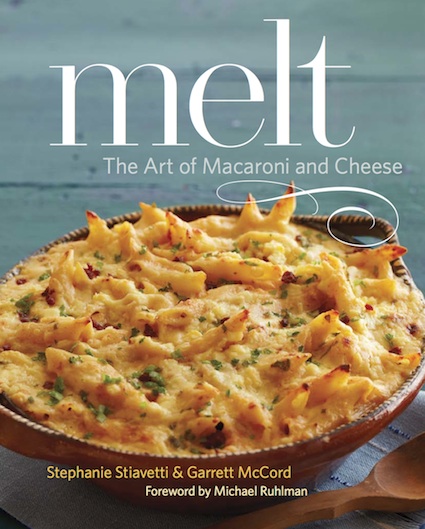
This is your first cookbook. What surprised you the most about writing a cookbook, and what was exactly how you expected it to be? Did you realize you'd have month's worth supplies of mac n cheese in your freezer after testing recipes, for example?
Garrett: I think two things I didn't expect were the stresses of testing and the sheer amount of food. We had about 85 testers working with us who were going through the recipes. It was like herding 85 cats with food allergies. Still, it was a wonderful experience because I got that chance to know a lot of bloggers, moms, students, chefs, and other people passionate about food. They were testing our recipes and taking them to funerals, baby showers, and office potlucks and telling us stories from their lives. It was enriching and enthralling.
As for the sheer amount of food? I had a rule: Tuesdays, Thursdays, and Saturdays there is food at my house. Come by.
Steph: I think that I was most surprised by how many moving parts there were. Working with Garrett made the process a lot easier, as we could share the load. I'm eternally grateful to him for wrangling the testing process - it was one of those things that was best handled by one person, and he jumped in and took the bull by the cojones. I enjoyed the recipe testing process a lot, which I was expecting. And the writing was a lot easier than I thought, because the pressure of such a large project really pushed me to perform.

You both had been exploring artisan cheese on your own, in your writing, on your blog, for some time now. What made you want to write a cookbook on cooking with artisan cheese in particular? And why did you choose noodles as it's accomplice, rather than, say, write a book about how to do melt cheese between two slices of toasted bread?
Steph: Back in the early days of the book process, Garrett and I were on the phone tossing out ideas for our book proposal. One of us came up with the cheese angle, and then the other person said, "Wait. What about macaroni and cheese?" We looked up all the other mac & cheese books on the market - at the time there were only one or two - and they were very much downhome-type cookbooks with recipes like "Yankee Doodle Lobster Mac," and other dishes like that. Our cooking styles are a little more adventurous, so we knew we didn't necessarily want to cater to that demographic.
We both love cheese, so it made sense to expand the mac & cheese idea to include a wide variety of cheeses, but as we wrote the proposal, the topic sort of focused itself to primarily involve the artisan cheese world. It was really neat to watch it evolve, as if it had a life of its own.
You two have some very adventures recipes in your book- this isn't just an ordinary mac n cheese book. You must have learned a lot about what flavor combos work and don't. Why did you decide to go beyond the norm?
Steph: We realized early on that if we were going to cook with artisan cheese, we were really going to have to "bring it" with the recipe style. When you're working with fine cheese at a higher price point, you don't want people to feel meeeehhhhhh about your dishes. And with macaroni and cheese, there are pretty much two ways people are familiar with it: creamy or baked. We really wanted to elevate the American classic by thinking out of the [blue] box, so to speak, and that pushed us to explore many global flavors that people might not automatically associate with macaroni and cheese.
While we have lots of classic dishes in Melt, we also borrowed flavors from a vast number of cuisines: Greek, Mexican, Indian, French, and even Chinese cooking made an impression on our recipe developing process. Some of my favorite dishes blend more than one culture's cooking style. And of course there were lots of flavor combos that just didn't work and ended up on the cutting room floor. Like, thyme and soy sauce do NOT go well together. ;)
With so much adventure comes a lot of experimentation. What flavor combos didn't work? Any absolute bombs? Any heartbreaks?
Garrett: There's a great polenta recipe with Sottocenere al Tartufo that didn't make it into the book. I was bummed about that. There was also a spiced red wine bechamel sauce that, oh god, was so bad. It smelled like Cthulhu's butthole. I actually pitched it into the yard because I didn't want it to go down the drain and continue fouling my kitchen with the stench.
I also learned you have to treat chocolate pasta as a savory item. The cocoa makes it bitter, not sweet. Going down the sweet route just won't yield the delightful results a savory sauce will.

With two authors, what was your creative process in writing this book? Did you discuss base flavors together, or play around with recipe ideas and techniques separately?
Garrett: Steph and I balance each other out quite well. We both have our own strengths and weaknesses, not just in cooking, but in organizational skills, tech skills, editing, writing, everything. So when one of us needed help or felt weak in a certain area, the other would leap right in. This isn't to say we didn't clash or have a few debates (with only one major fight, but perhaps too much bechamel will do that), but each resulted in the book being better than it was before and us understanding each other better.
We worked off of Google Docs so we could see and review each other's work constantly. A master recipe list was written up by us both and we would add or edit to it often, usually leaving comments for the other and having the phone call when it was needed. We also made sure to connect in person at least once a month.
Steph: In the beginning, we spent a fair amount of time on the phone or in person, dreaming up and testing flavor combinations. When we first wrote the proposal we had to come up with a nearly complete list of recipes, which changed a ton over the course writing the book. I'd say we tossed at least half the recipe from that original list, or morphed them into something else.
A lot of the recipes in Melt are true collaborations, meaning one of us would call the other and say, "Hey, what do you think of…" And then we would each weigh in, adding and extracting ingredients and methods during the conversation. Sometimes recipes would get handed off from one of us to the other, after realizing that it played upon the strengths of the other person. There's even one recipe in the book that someone didn't want to make, but then after much, um, discussion, they ended up making it anyways. And they loved it despite their vocal hatred for the dish in the beginning. Ha.
There are actually some parts of the book where we can't figure out who wrote what, because our writing and editing styles blend so well. That's definitely a trip - to read a passage and not be able to remember who originally wrote it. How did Garrett's pastry background play into the book?
Garrett: When I worked in pastry, caramel was the albatross around my neck. I burned it. A lot. In fact, at one kitchen the cooks and chefs would call out that anytime something burned, "Garrett's making caramel!" My pastry instructor, Elaine Baker, made me make caramel every. Single. DAY. Now I can do it in my sleep - both wet and dry caramels, by the way. So of course I was hellbent on adding it in to Melt. I made sure that the instructions for these things that used to intimidate me were easy and approachable. There's nothing to be scared of with baking techniques when you've read through the directions. It'll go as directed and, poof, it's done!
The book has a lot of favorite ingredients, like rhubarb and cacao nibs. I also got to deep-fry, which I used to never do at home and now have started doing too much.
As an author who is still on Level 1 of social media, I'm amazed and inspired by the ways you two are going about promoting this book on social media and beyond. I heard the other day that your book even got picked up by Walmart and Target. Wow. Congratulations! What would you advise writers with books who would like to get placement as great as yours, and, can you talk about some of the ways that you're promoting your book that you're especially excited about?
Steph: To be truthful, I have no idea how the book got picked up by Walmart. ;) I chalk that up to the awesome sales people at our publisher, Little, Brown & Co. What we did have a hand in, however, is the social media energy that is starting to stir. But we can't really take the credit for that, because it's due to our amazing circle of writing and blogging friends spreading the word.
My advice to writers is to ensconce yourself in a broad circle of media-savvy colleagues, making friends and doing all you can for the people in that group. Be friendly, generous, and genuine, reaching out whenever someone else needs help with promotion or anything to do with their own projects. That good will always comes back in spades. So go find your tribe and love them with all you've got. The organic excitement of your friends is more infectious than any viral campaign cooked up by a publicist! Lastly, if any readers want to catch you around the country, where can they look to see if you'll be in their area?
Garrett: We'll be doing the West Coast tour circuit, and hopefully diving into New York, South Carolina, Missouri, and a few other spots. We're still working out the details, so stay tuned to the Melt website. =)
Bohemian Creamery- An Interview with Lisa Gottreich

This interview with Bohemian Creamery kicks off a series that I'm very excited about here on It's Not You, It's Brie. Called, (well.... I'm a little behind on this part, recs are welcome!...) the series will follow and detail the lives of those involved in the varied and vast cheese world. I'll interview cheesemakers, cheesemongers, educators, distributers, importers, writers, and more, to give behind the scenes look at those that make, house, peddle, and love our cheese and make our fermented world happen. It will share insights to how our cheese comes to be, gets from the farm to our table, and maybe even provide food for thought for those thinking about entering the cheese world themselves. I'm going to focus entirely on those making or working with American cheese for the month of October because... it's American Cheese Month, after all.
Lisa Gottreich is my first interviewee. The cheesemaker for Bohemian Creamery , Lisa is located in Sebastopol, California, land of grapes, apples, and.. an incredibly inventive cheesemaker. You can also read about her Capronico in my book. I think you'll enjoy reading Lisa's thorough and thoughtful answers. Photos were supplied by Gottreich.
Your resume includes cheesemaker, Italian instructor, and writer. How do these passions play into each other and inspire your main career as cheesemaker?
I am basically unemployable after years of working on my own terms. My last pay-check job really ushered in the creation of the creamery. I worked for a large multi-county oncology practice. It was a disaster on my psyche. Sad to see the death and dying, which I expected to be profoundly touched by, but found myself instead embattled every day by the ins and outs of group dynamics, politics, and the dueling wastefulness and dearth of heath care policy. And so the writer-goat-herder (I had goats and made cheese at home for many years before I ventured into commercial production) kind of hung up the towel. Helped along by a mid-life crisis husband who was backing out on our 18 year marriage. The thread here is really just a question of disposition. I am idealistic and head strong (ok, stubborn), and so the rushing waters run a course more solitary and self-determined.
Bohemian Creamery makes cheese with all the milks under the California sun- goat, cow, sheep, and buffalo. From whom do you source all these milks, what inspired such a broad milk range, and do foresee keeping your own animals for milk in the future (or do you now?)?
I absolutely love goats and have had them around for almost the past two decades. In fact, cheese-making is probably my rationalization for having goats. That being said, I also buy my milk. To run a dairy that would produce the amount of milk I consume would be a full time occupation in itself. Yet I am at an awkward size ---too large to produce enough with my own herd and too small to be able to take advantage of any economy of scale. I will always have my goat herd, and I will continue to source my milks from the wonderful dairies of Sonoma County.
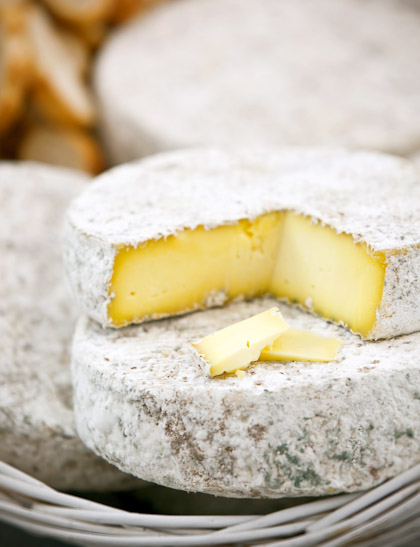
To give people an idea of what happens at Bohemian Creamery, describe a typical work day for you.
I've been jumping on my bike lately and biking with my dog up to the creamery, enjoying the cooler autumn air and feeling sick of needlessly regurgitating spent fuel. SO that happens around 6:00 am. I get up the creamery, look out over the santa rosa laguna and Mt St Helena and sigh. Push troubles to the side, temporarily. GO into the creamery, listen to NPR and start my day which consists of either jumping into the milk truck to pick up milk, turn on NPR until the news swings back then turn on Pandora, make cheese, do affinage, pack and wrap orders, clean. Clean and clean. I don't think people realize how little time cheese makers spend actually making cheese compared to their gargantuan lifetime of cleaning. Then the afternoon I dedicate to the goats, feeding, hoof trimming, mandatory petting.
What would you say is the most exciting cheese that you make, for you? For some, it might be your fresh goat, bloomy-rinded Bodacious cheese- one of my favorite quotes of yours from the LA Times article I wrote that featured Bodacious was- “it’s modeled after a boob, though it’s not always the most thrilling boob, the mold is food grade, stainless steel.” For others it might be your Bo-Peep, a sheep-goat blend washed with Russian River’s Consecration beer. But I know you have a new one you’re working on too. What’s the first cheese you know you’ll be looking forward to making or tending most after coming back from your upcoming two-week writer’s retreat?
I really like working with the water buffalo milk. It's so different from anything I've ever touched. It's hard to separate the animal from the product and those bufale are really like nothing I've ever faced down before...I have roped and cut cattle, herded goats, kept sheep. But these girls, they are like staring into the eye of a whale...they penetrate you. I lived for years in Italy and for me it is very very special to be able to have this milk. That being said, I am working on a crazy idea for a cheese...sort of a secret of this point, but I like inventing. Like my cowabunga, a fresh lactic cow cheese I make then stuff with cajeta I make from my goat's milk. So when I get back from my residency, I am going to set to work on the newest crazy combo...
Who and what is inspiring you at the moment?
I am inspired by the people I get to work with. I have two wonderful women who work with me and I really respect and cherish their input. We are working together to build out the creamery into an agrotourism destination where people can sit back and dive into the incredible view, eat cheese, bread cheese plates, make a cheese pizza, hang with the goats, see cheese being made, maybe also drink a little wine. I think that the more people taste and understand cheese as a living entity that, like us, is born, throws its colors, then fades, concepts of consistency will gain a more holistic context.
Thank you so much for your time, Lisa!
Any ideas for the name of the series welcome in the comments section!
Cheesemaker events, Volcanic Classes &, Beer.
A few clases and event that have caught my eye around San Francisco, including one I'm teaching (last, on Volcanic wines, Shepherd Cheeses. They're listed in order of date. Hope to see you at some!
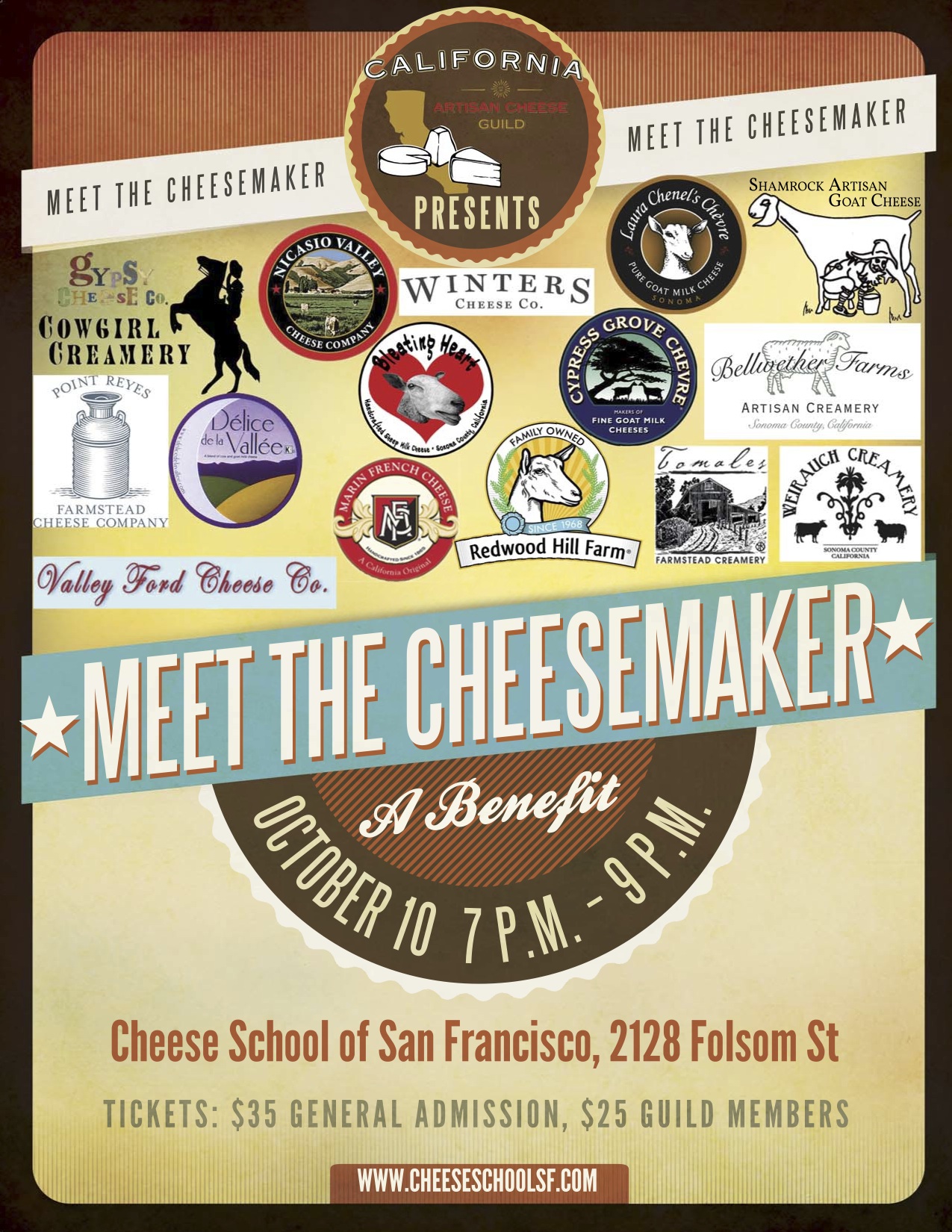
Meet the Cheesemakers Fundraiser: Thursday, October 10, 7-9 p.m.
The California Artisan Cheese Guild - an organization that helps cheesemakers with education, scholarships, marketing and beyond- is holding their annual fundraiser next week. Cheesemakers from Bellwether Farms, Cypress Grove, Cowgirl Creamery, Pt Reyes Farmstead, Redwood Hill, Valley Ford, Weirauch Farms, Bleating Heart, Laura Chenel, Nicasio Valley, Marin French, Shamrock Artisan, Gypsy Cheese, Delice de la Vallee and Tomales Farmstead will be there to chat, along with beer and wine, and even a demo or two. Always an awesome place to be. At the Cheese School's new location
Cheese and Cider, Thursday, 6:30pm, October 17th
Like beer, cider is experiencing a renaissance. Delightful and complex small-batch ciders are popping up in stores and bars throughout San Francisco. More forgiving than wine and sweeter than beer, cider is an ideal foil for the creamy complexity of fromage. Author and SF Chronicle columnist Janet Fletcher will pair her favorite examples of the hard stuff with an array of cheeses. This is a pairing class sure to be easy on the palate.
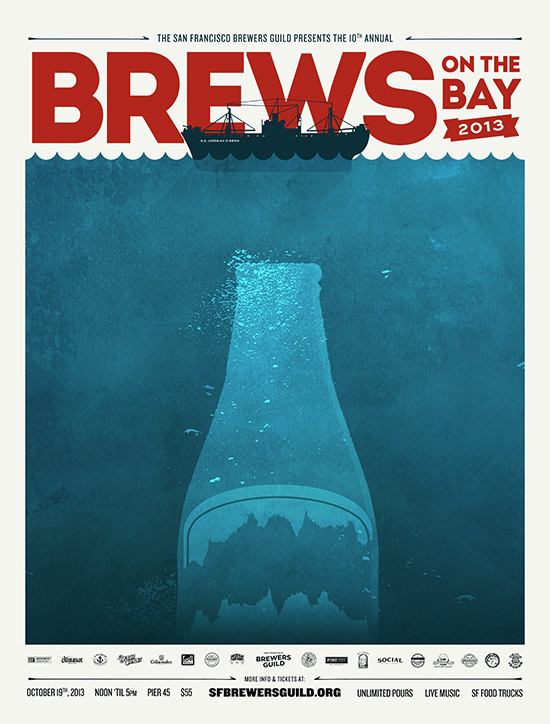
Brews on the Bay, Saturday, October 19th, from 12-5pm
Put on by the San Francisco Brewers Guild, Brews on the Bay features the wares of fifty different breweries, like 21st Amendment, Almanac, and more.... with music. On the ocean. On a Boat. Brewers present.
Breakfast for Dinner: Tuesday, October 22 at 7pm
Four courses, and just to start: frittata, pork belly rancheros with lager, french toast with porter. Maple syrup with porter and pork belly had me, but who knows, maybe there will be cheese in the frittata. Either way- beer with breakfast. Go.
Shepherds and Volcanos: The Magic of Mountain Cheeses and Wines, Wednesday, Oct 30th, 6:30pm
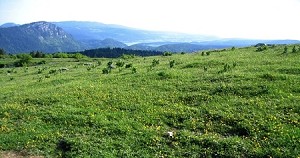
Despite the treacherous climb (and even the threat of volcanic eruption), people have been making cheese and wine in volcanoes, on mountains, and in the Alps for centuries -- and not just because the views are picturesque. Alpine and mountain style cheeses are celebrated for their hearty textures, heavenly taste, and exceptional nutritional content. Kirstin Jackson, cheese and wine educator and author of It’s Not You, It’s Brie will explore the who and how of the mountain cheese, and explain why the finest cheeses and wines around come from uneven or even dangerous ground. The cheeses will be vibrant, the wines will be weird, and the class will be delicious.
Feel free to share any not-t0-be-missed cheese events in the comment section!
Kaasboerderij Captein Gouda: Or, Dutch Suitcase Cheese
 People bring back cheese for me from other countries in their suitcase.
This is awesome for two reasons. First, it means that they are thinking of me when doing fun, wonderful things, like eating cheese and traveling. While at UC Berkeley, one of the things I studied during my cultural anthropology tenure was changing funerary rites. Because of this I can tell you first hand that having people say they thought of you while traveling or enjoying cheese can be more enjoyable than hearing you came to mind when they said goodbye to their Aunt Tilly, or, when they read the latest article about caskets being sold at Costco. This is good for my ego.
Second, it is awesome because once the cheese is released from their suitcase, I get to eat it. Even cooler, most queso, fromage, kaas that is brought back for me tends to be from traveler’s cheesemaker friends or family. This means if they hadn’t brought it back, I might have never have had a chance to try it. Or write about it.
Such is the story with this Kaasboerderij Captein Creamery gouda, brought back for me by a lovely lady named Lidewey who visited her friend’s farm and creamery.

Made from the milk of cows on her friend’s farm in Zoeterwoude, Holland, this gouda is boerenkaas.
In order to be labeled boerenkaas, the cows that are producing the milk for the gouda have to be grazing on grass. Both because winters are so harsh in Holland so the animals are kept indoors, and because boerenkaas producers believe that cheese made with the milk of animals eating the greenest, tastiest grass is the best, boerenkaas is only made in spring summer - for quality’s sake.
This Kaasboerderij Captein gouda is also Boeren-Goudse Oplegkaas, meaning that it’s been aged from two to four years. That’s when the gouda crunch comes in. As a cheese ages, lactose turns to lactic acid, and amino acid protein starts to crystallize. The older it gets, the more crystallization can happen. The crystals aren’t sweet, but because the cheese itself gets more flavorful and often sweeter with age, the crystals give the perception of sweetness.
This particular aged gouda that Lideway brought back is made by the Kaasboerderij Captein Creamery in Zoeterwoude, Gouda, Holland. The family has been maintaining their area of grassland in Zoeterwoude, on the edge of an area known as the "Green Heart" of Holland, for many generations.
As is traditional with goudas of this style, the women in the family craft this cheese. If it's a day when the animals are out grazing, one can also find the mother and daughter turning the milk from their "Fries Roodbont vee" (Friesian red-and-white cows) into curds that will later be pressed into their Boeren-Goudse Oplegkaas. After the curds have been pressed into traditional wooden molds lined with linen, and the wheels have been aged for a couple years, a cheese is revealed that tastes like intense cultured butter made in summer, grass, a little meaty, and surprisingly even though very aged, still rich and not grainy or crumbly.
Though the family's pride, and the favorite cheese of chefs in Holland is this style of wheel, they also make young cheeses too- six week-old little freshies that are consumed waaaay before they'd have a chance to land on U.S. shores.
And I have no idea where to tell you all to find this cheese in the U.S.. In Holland you can find it at Michelin-starred restaurants. Here, you can find it… in my fridge. At least this week. As of yet it’s not available for purchase. But maybe, just maybe, if we cross our fingers, someone will import it. Once that happens, you'll have have to go buy some dark bread, smother it with sweet butter, and, as Lidewey tells me the Dutch do, so I should also be doing, have it for breakfast. Suitcase optional.
"Comté Shows There's More Than Gruyere In The Alps"

While I'm waiting for a Dutch cheese brochure translation so I can tell you a little bit more next week about a sexy Boerenkaas gouda that a lovely, lovely, person brought home for me from her friend's creamery in Holland, I wanted to share my latest article on NPR's Kitchen Window. I had a lot of fun writing it.
Here's the lead from "Comté Shows There's More Than Gruyere In The Alps"
"Known for its fondue-ready texture and nutty taste, Swiss Gruyere has long been the cheese of choice for cooks who want something as smooth melting as mozzarella but with more complexity. But in the mountains just across the French border, there's another Alpine-style cheese that just might one-up this standard.
With flavors of fresh butter, citrus, hazelnuts, caramelized onions or chocolate, Comte is a cheese with more range than Meryl Streep and a texture just as seamless."
Read the rest here, where you'll also find the three recipes for Comté that I created, including the one for the grattin number in the above photo.
Comments on the NPR website are welcome, and very appreciated.
Until next week!
My favorite 3 new cheese books

One of the things that makes me happiest is to see a big pile of cheese books greeting me when I enter a book shop. It means people are paying proper attention to one of the best food groups in the world.
Editors are understanding that cheese is worth the word-count, writers and anthropologists are realizing that cheese's delicious, culture and history are worth studying, and readers are willing to pay for knowledge shared by an expert or obsessed enthusiast. I’m game. I’m reading, I’m buying, and I’m writing (I’m also launching a campaign to convince people that cheese is its own food group,….. how am I doing?).
The following three books are new or somewhat new ones that I’m making a home for in my overstuffed cheese bookcase.
Di Bruno Brothers: House of Cheese
Tenaya Darlington, food writer and author of the Madame Fromage blog, teamed up with Philadelphia’s esteemed Di Bruno Brothers to write a cheese guide book. Covering all sorts of cheese deliciousness from the world, Darlington offers cheese party advice, explores different styles and flavors, and shares some pretty tasty recipes. The book is stuffed with gorgeous pictures, approachable writing, and looks pretty sexy on a coffee table. Besides, I just love Darlington. She’s a vibrant writer and person.
There’s something magical that happens to one’s soul when they have the chance to meet someone whose writing and research they’re enamored with and realize that…. gasp… they’re also an awesome person. Doesn't always happen that way. After being blessed with the opportunity to hear Heather Paxson speak at the ACS conference in Madison, I’m all the more excited to recommend her book. It’s a serious look at cheese’s socio-economic and cultural role in society. Paxson is an anthropologist who spent years doing ethnographic research with cheesemakers in the northeast asking what cheese means to those that make and eat it. A beautiful, thorough, thoughtful consideration, written by an MIT anthropologist in a readable and engaging style (i.e. - non-academics can still enjoy the hell out of this book).
Cheese and Beer San Francisco Chronicle’s cheese columnist and food writer Janet Fletcher looks at two of the most awesome craft products in the United States right now. I’ll let you guess what they are. This is a great first look at the ins and outs of beer and cheese pairing. Lovely pictures (though I admit I always try to dust the photographed bread crumbs off the cover) and lively overviews on beer styles. A great reference.
Thistle Power: Torta de Trujillo
 The general basics of cheesemaking go like this:
1. Have milk. Warm milk.
2. Add cultures and acid or rennet to milk - start curd coagulation.
3. Start curd separation from whey by cutting or scooping.
4. Cook and drain curds.
5. Do something with the curds! Strain, mold, press, age, ....
There are as many different ways to do the aforementioned as there are sensible black pumps in a government office. Different cheeses get different cultures for different flavors. Some curds get briefly warmed, some get their sugars caramelized, some get nearly all of the whey pressed out of them by being squished in a machine.
Rennet also comes in many forms. Natural, traditional animal- from the stomach lining of a cow. Microbial. Thistle. Some rennet is made in a lab. In whatever form it comes, rennet is what coagulates the curd into a sort of thick custard before it's separated from the whey. After the curds are cut, they are cooked, the whey is expelled, and what remains is the protein, fat, and deliciousness than will later become cheese.
Since curds are crucial to making cheeses that are aged even a little bit, it's fair to say rennet is pretty important. In the Extremadura region of Spain, the choice of rennet type is considered crucial.

I'd like you to officially meet Torta de Trujillo. He's made with rennet from the thistle flower. How does being flower powered affect Trujillo, you ask? In the case of this little torta, in several ways.
1. First, thistle rennet encourages a soft, silken paste. Traditional animal rennet (cow, stomach, lining) can help age a cheese into a firm style but from what I've heard, thistle rennet helps form a softer, creamier paste that doesn't firm as much as it ages. How the curds are cut (this torta's curds are kept large so less whey is expelled and more moisture is retained in the final cheese) makes a difference, but the word on the cheese street is that thistle rennet prefers to stay.... loosey goosey.
2. Second, thistle rennets produces floral flavors in a cheese. Really. And vegetable ones. A taste of Trujillo reveal flavors that are floral, sweet, and even artichoke heart-like. Prettttty delicious...
The traditional way to eat this style of cheese, like Torta la Estrella or Serena, is to wait until it is really ripe. The rind will still be firm, but the inside will be soft, and the top of the cheese will give when pressed. Then, cut off the top like it was a sourdough bread bowl, and spoon out the cheese on pieces of bread as you snack.
Many people ask me about the affects of different types of rennet. Trujillo is a great example of what thistle can do. This plant has been used to centuries in Spain and Portugal and occasionally by American cheese makers to great success.
Do you like the flavor of thistle rennet?
What are your favorite thistle flower powered cheeses?