
The Cheese Blog
Rauchbiere Triple Whammy: Pairing Smoke & Cream
 Like Mike Reis, educator and beer writer at Serious Eats, discusses in Smoked Beers: Your Secret Weapon for Beer Pairing, I detested my first sip of rauchbiere (smoked beer). And my second. And my fifth.
Smoked beer, made with smoked rather than toasted barley malt, is a force. Some of it tastes as light as the breeze wafting by on spring day after a neighbor lights a bbq. Some taste like they have been vigorously stirred with a just-charred stick. And others unabashedly flaunt their resemblance to a late-night camp fire pit that's just been doused with a bucket of water before folks retire to their tents.
That is to say that it has quite a presence. Beer used to all be made this way. Prior to the days of electricity, propane, or coal, all barley was cooked (and inadvertently, smoked) over open flames, so it all had a smoky note to it. Now people make smoked beer as a nod to those days, or because they genuinely like the flavor. Admittedly, that "genuinely like the flavor" part is hard for some to grasp. Because my first and second sip of it made me think more "ashtray" than "artisan" or "lost art," I can understand why. But now, my friends, I'm a believer. And a drinker.
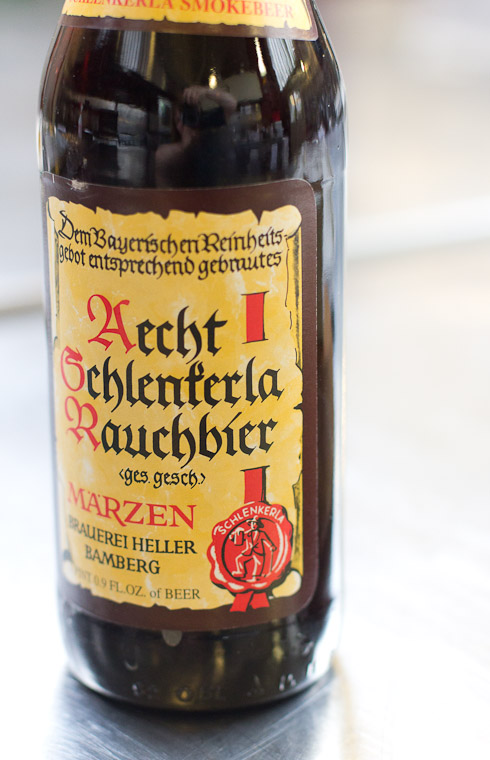
I like smoked beer. Especially with triple-creme cheese.
A few months after my fifth unappreciated taste of the smoked one, I picked up a rauchbiere that pleased me. Though I wasn't sure I would finish a second bottle, I sensed skill in the subtle smoky application, and definitely finished the first bottle. Then I saw Reis's article Smoked Beers: Your Secret Weapon for Beer Pairing in which he talked about how anyone could grow to love a smoked beer with the right food pairing. And what my friends, is the right food pairing? Cheese! Always, cheese!
Because he suggested pairing rauchbiere with heavy, smoky foods, grill-ables, or rich, sweet foods like pie, I thought, hey, maybe a triple creme would work. It's in-your-face rich, sweet, and, I thought, might be able to stand up to the ferocity that is a smoked beer.
So when teaching a "Perfect Pairings" class at The Cheese School of San Francisco, I decided to test this theory. Reis helped me select the lightly smoked beauty above, because, well, I had no idea what I was doing. The Schlenkerla It's a lightly smoked, wheat, marzen beer.
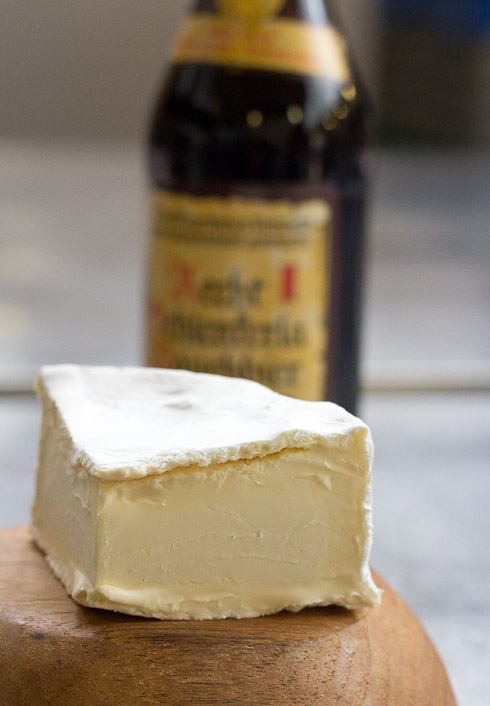
The class loved the pairing. Not all of them liked the rauchbiere immediately on its own, but even those that didn't liked it with the triple creme. I guess 75% butterfat helps make even the smokiest of ( delicious) medicine go down. And those whose favorite style of cheese wasn't a triple liked the buttery wheel better with the beer. Together they tasted like… smoky ice cream, which I can tell you, is pretty darn impressive.
The triple we chose that day was Brillat Savarin. Creme fraiche is added the whole milk when the cheese is made, hence amping up the butterfat factor to a velvety 75%. Other triples I'd turn to are: Nancy's Camembert, Delice de Bourgogne, Mt Tam, Kunik, or… do you have any ideas for this pairing?
Next time you're heading to a bbq, think of picking up a couple rauchebieres for your party. One to try with the grill-ables, and another, to serve with a creamy cheese for a triple-whammy pairing.
Breaking it Down: 80 Pounds of Parmesan
 Did you ever waltz by a wheel of Parmigiano Reggiano in a cheese or Italian goods shop and wander how they'd cut that huge, eighty pound wheel into tiny little chunks so you could take it home and grate it? As far as you knew, the FDA didn't allow chain saws in food establishments. Or maybe you never even realized Parm was such a sizable wheel since you bought it in small pieces. It was like that for me for a long while- kind of like the tuna fish equation. If you never saw the original fish's glorious hundred or so pounds, you'd never guess that what fit into that itty bitty canned disc came from a finned animal that could knock you, and your lifeboat, over in the water.
Well, my friends, someone's got to break down this huge beauty. It's done with daggers. The Sunday before last I co-taught the Ultimate Pairing class with Juliana Uruburu from Oakland's Pasta Shop at the Cheese School's Three Day Intensive course. When I heard that if I arrived a little early, I could witness the famed Parm break-down, I hoped on Bart as quickly as I could and stationed myself in front of that huge wheel of cheese above. Though I worked in cheese shops before, I had never been around on the day that The Wheel was broken down- something I sorely regretted.
Did you ever waltz by a wheel of Parmigiano Reggiano in a cheese or Italian goods shop and wander how they'd cut that huge, eighty pound wheel into tiny little chunks so you could take it home and grate it? As far as you knew, the FDA didn't allow chain saws in food establishments. Or maybe you never even realized Parm was such a sizable wheel since you bought it in small pieces. It was like that for me for a long while- kind of like the tuna fish equation. If you never saw the original fish's glorious hundred or so pounds, you'd never guess that what fit into that itty bitty canned disc came from a finned animal that could knock you, and your lifeboat, over in the water.
Well, my friends, someone's got to break down this huge beauty. It's done with daggers. The Sunday before last I co-taught the Ultimate Pairing class with Juliana Uruburu from Oakland's Pasta Shop at the Cheese School's Three Day Intensive course. When I heard that if I arrived a little early, I could witness the famed Parm break-down, I hoped on Bart as quickly as I could and stationed myself in front of that huge wheel of cheese above. Though I worked in cheese shops before, I had never been around on the day that The Wheel was broken down- something I sorely regretted.
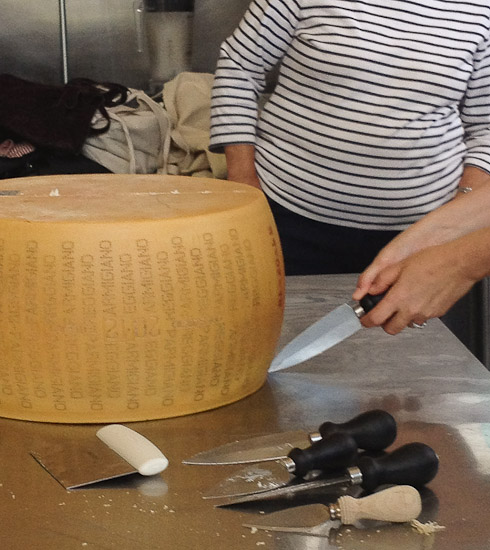 To soothe my regrets and to satisfy our Parm curiosities, here is a step-by-step photo break-down of Parmigiano Reggiano, being broken down by Juliana and the Three-Day Cheese Intensive Student Crew. Please, any cheesemongers who do this every month, every week, every Tuesday, feel free to comment any hints of the trade in the comment section! We'd love to learn more about your big wheel skills. Step 1: Score. Using that cheese dagger shown above, score a straight line all around the center of the wheel. This cheese belt will help to guide you as you dig in.
 Keep in mind: As shown by Juliana, use your whole body when you dig in with the daggers and break down any wheel of cheese. Cheesemongers can easily injure themselves if they only really on their hands, wrists, elbows, shoulders to provide the muscle. Breaking down a big wheel of cheese should be a whole body work-out.
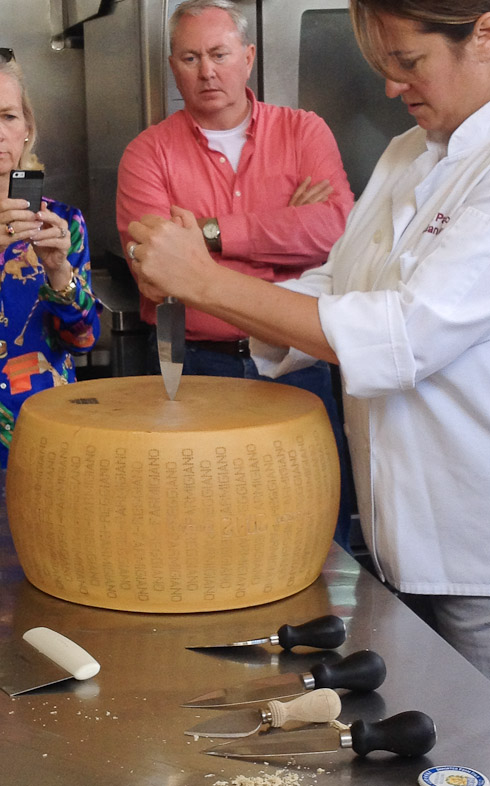 Step 2: The first attack. You go in first with the thinnest, longest dagger blade (in case you're wondering whether Juliana carries her own blades wrapped in linen around with her, she does. Don't mess with this woman) to create the initial fracture. Wiggle it around a little.
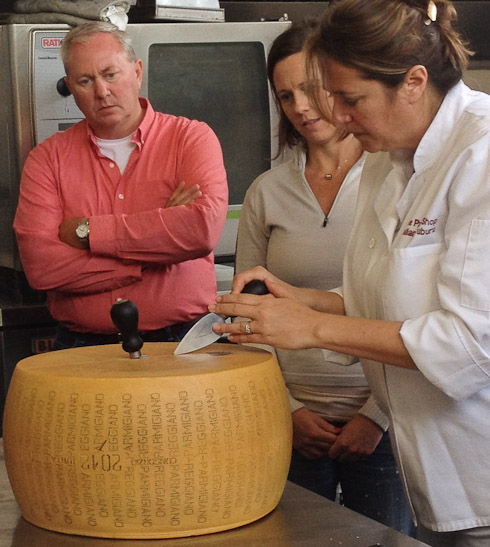 Step 3: Keeping the first blade in, reference where you earlier to scored to decide where to put the next knife. Juliana likes the next blade inserted to be shorter and wider. Not sure how other cheesemongers prefer their next hit.
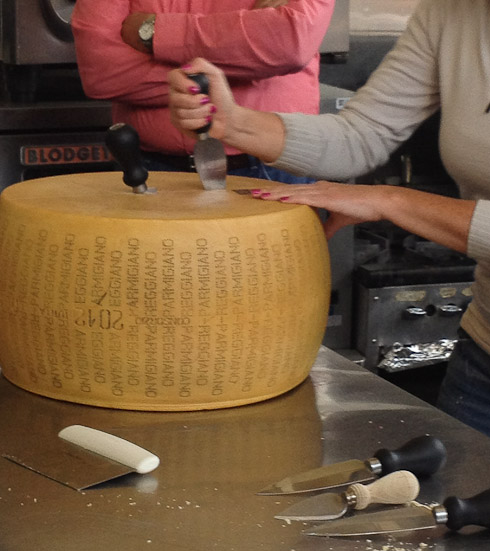 Step 4: Dig in. Insert that blade, and push it down all the way. More wiggling is encouraged. After you wedge the dagger in, push the handle away from you so the blade is helping to form a bigger crevice in the Parm.
 Step 5: Repeat: Insert, wiggle, pull, push away.
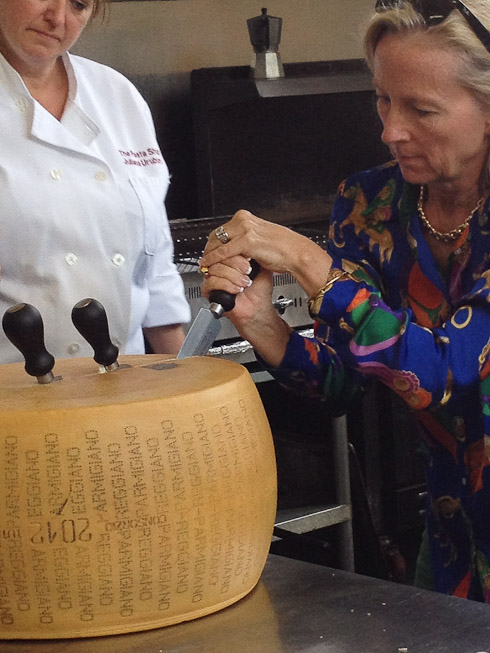 Step 6: Drag: Now get in there and round the edge. Pull that third dagger towards you and the bottom of the wheel that's resting on the table. Put your knees into it! Sometimes cheesemongers use much more than just three blades.
Step 7: Flip that wheel over and repeat. Dagger the other side and score again if need be. The point is to wedge a crevice into the cheese that will eventually part the cheese in two. Step 8: Failed to get a pic of this (sorry guys), but after both the top and bottoms are sufficiently daggered as shown, above, pull the wheel to the edge of the table and repeat Step 6 on the side of the cheese until you reach the very bottom of the wheel that rests on the table. By this point, you've formed a crevice on that extends throughout the entire cheese. Now you have a wedge that… breaks the wheel in two!
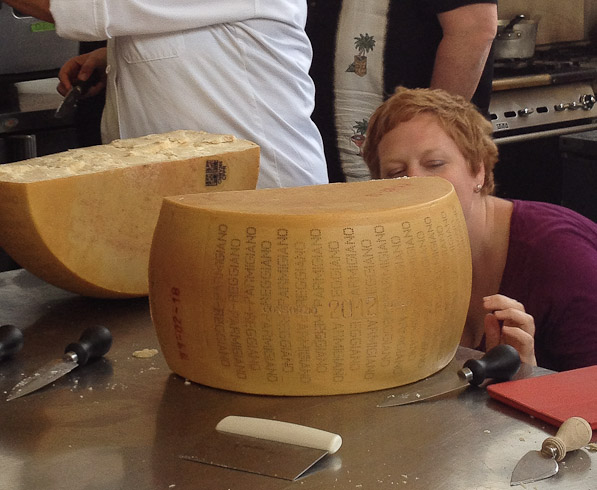 Step 8: Enjoy. Have you ever smelled a freshly cut wheel of Parm? Heaven. Even more heavenly? Tasting a fresh flake from that wheel. This is your reward.
A little advice: make friends with your local cheesemonger and ask to be there when they cut their next wheel of Parm. Some do it away from the main cheesemongering area, but many shops like to do it in front of customers so they can appreciate the glory. If your shop does it publicly, make sure to pay a visit one day when they're daggering so you can buy a chunk fresh from the wheel. It's a life changing sensory experience.
Apricot Quickles - Quick-pickling in the name of cheese
 There's always something important I seem to forget to do when jamming- sanitize the ladle, buy a funnel so that the jam doesn't drip over the lip of the jar, mix the calcium with the water, or stir the pectin in with the fruit in the beginning so that there aren't huge chunks floating around with the peaches at the end. And since I only do it once or twice a year, every year I forget the same things. A buddy system would be a key, but most times my friends with jam experience aren't always available the weekend I happen to find a flat of FrogHollow peaches at a discount.
Because I'm a little nervous about the jam dripping over the lip of jar because I forgot to buy a funnel last year (and the year before), and don't quite understand how to wipe it off the lip (if everything needs to be sanitized, can you use a cloth, a paper towel to wipe it, or would you be endangering your jam gift-tees with paper towel lint bacteria??? Really, I want to know), I keep jamming casual- at least the first time I attempt it every year. Luckily, I have friends who are willing to take jars of sweet fruity goodness from me with specific directions- "refrigerate and eat within two months." It's kind of a bossy a gift, but hey, it's still delicious jam!

Considering my issues with jamming, one might understand why I have a fear of real pickling. That sh#*$'s serious. I had family members who were willing to show me the ropes (Aunt Becky and Teresa, here's looking at you), but the large amount of canning equipment necessary frightened me. Knowing that you had to have that much special equipment, be even more sanitization-minded than with jamming, and then also consider how to balance differences in acidity and water content in vegetables gave me chills and visions of impending bacterial contamination takeover.

So the way I roll with pickles? Quickly! With quick pickles! Or, with quickles, as my friend Abby named them. With quickles, you only have to pickle them, let them sit overnight, and then they're good to go in your fridge for a couple months. I can handle that.

Now the cheesy part-
Ever since I’ve noticed the balance that a tangy, lightly tart pickle offere to a piece of rich cheese, I’ve been in love with the coupling. The acid in the pickle offers a bright contrast to the concentrated umami and fat content of an aged cheese. And as has been proven for centuries with the ploughman’s lunch, pickles and Cheddar fancy each other’s company. I've paired these sweet pickles with Fiscalini and Montgomery Cheddar, rich semi-soft cheeses like Abbaye-de-Belloc, and even fresh goat cheese. These pickles, fresh chèvre, on a pulled pork on a sandwich? Yeah, I'd eat one of those.
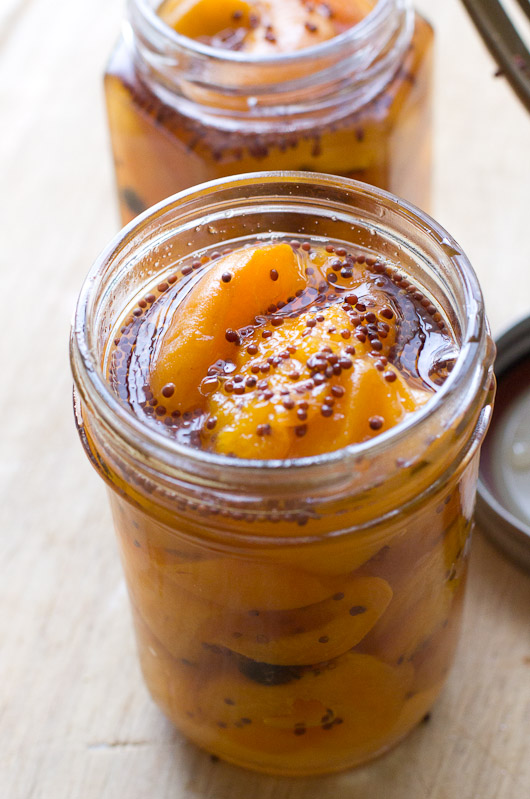
Apricot quickles
2 cups apple cider vinegar 1 ¼ cup white sugar 3 star anise 1 tablespoon mustard seed 2 whole allspice 1 ¼ lb apricots
Have 3 small mason jars cleaned and ready to fill.
In a medium sized saucepan, stir together the vinegar, sugar, anise, mustard and allspice. Bring to a boil. Once boiling, stir vigorously, lower the heat, and simmer for ten minutes. Add the apricots to the simmering water, and let cook for five to seven more minutes until the fruit is lightly softened.
Turn of the heat. Using a slotted spoon, remove the fruit from the pan and nestle into the jars. Tap the bottom of the jar against a countertop lightly to settle the fruit. Return the pickling liquid to the pan and bring once more to a boil, then simmer for five more minutes. Pour the liquid and the spices over the fruit in the jars, and let sit for at least twelve hours before eating.
Artisan Cheese Industry Damning: FDA Says No to Wooden Cheese Boards
 Someone asked me on twitter yesterday how many artisan cheesemakers age their cheese on wooden boards and would be affected by the recent FDA mandate that wooden board are unsanitary, and therefore banned from the aging room. Let's just say this- all the artisan producers that I've visited (50-60) throughout my cheese days who make semi-soft to hard cheese rest their wheels on wooden planks while they're aging. And this is only semi-soft to hard cheese. Like that creamy, spoonable Mont' D'Or stunt double made in the United States? Chances are that it's aged on wood too.
Why wood? It's a nod to the European cultural and historical cheesemaking practices that shaped our own industry- a lively, fantastic industry that is now in turn influencing European cheesemaking too. More importantly, wood is also used because it imparts flavor. There's a reason why certain French cheese appellations require fruitiers and affiineurs to use only specific species of wood (mainly from their own appellation) when aging wheels. Specific woods impart particular flavor characteristics to cheese. What will happen if our prized and adored cheeses in the United States are switched to being aged on plastic and metal boards? Their flavor, texture, composition will change. Even the difference in air circulation from resting wheels on plastic or metal will influence a cheese's taste. The act of cheesemaking is a symbiotic process, and everything- from molds to humidy to board type- affects how a cheese will end up.
Contrary to FDA thought, it's also safe. Years of cheesemaking in Europe and recent studies have proven this.

If the FDA is allowed to go forth in its ban in the aging room, our artisan cheese industry will suffer because our cheese won't be as good. It won't be up to its full potential that we're experiencing today. Cheesemakers will have to pay to revamp their aging rooms and spend a lot of money trying to figure out how to make it as good as it was before- which many question is even possible with a switch like this.
Keith Adams, Cheesemaker at Alemar Cheese is worried. Though he now focuses on soft cheeses, he recently decided to move west to California to make Cheddar. This August he heads to Britain to study with Cheddar's fore-bearers, where every artisan version of the cheese is aged on planks. Same goes for our artisan Cheddars here.
"I'm deeply concerned with the FDA ruling," says Adams, "and if you're a cheesemaker and you're not concerned with this, you're not paying attention."
Even European cheesemakers should take note. As summed up in the fantastic look at FDA's actions by Jeanne Carpenter on Cheese Underground, this law doesn't just apply to American cheesemakers. According to the FDA, it applies to anyone's cheese that are imported to the U.S. If the FDA gets serious about it, people making Parmesan, Gruyere, and may other of the European greats would have to have a section of their cave where their wheels are just aged on plastic for the U.S. market in order for the wheels to be imported. Would they do this? Would it taste similiar?
So this is not only harmful to our burgeoning industry, it could be damning to other's as well. As cheese lovers, let's keep an eye on this. If cheesemakers ask for folks to sign petitions or support them politically by stowing up to rulings, let's lend a hand. They do a lot for us, our tastebuds, the land, and the economy by making their cheese - the delicious and safe way that it is made now.
Chèvre Chaud: A tale of hot, toasted cheese & French salads
 The first time I went to Paris was with my ex-husband. We weren't married yet, that happened about a year after he slipped a ring on my finger in a park that June in Paris. Then, we were still just dating and it was our first trip to Europe. Perhaps fueled by us stopping at cafes every hour or so for espresso breaks or the long twilight walks we'd spend swirling the arrondissements, we were very happy. There were also carafes of wine involved. It was a good trip.
Even though we were equipped with manuals to help us order at restaurants and my three semesters of college French to guide us, we stumbled around a bit. A bit. We learned what chicken gizzards were, for example, by accidentally ordering them over handfuls of lettuce with a side of grated carrots. But our stumbles were actually blessings. Chicken gizzards cooked in duck fat, it turns out, are delicious. Ordering this also led us to understand that bistro salads in France were more about the meat or cheese served with the vegetables than the vegetables themselves. We began to order more salads.
The first time I went to Paris was with my ex-husband. We weren't married yet, that happened about a year after he slipped a ring on my finger in a park that June in Paris. Then, we were still just dating and it was our first trip to Europe. Perhaps fueled by us stopping at cafes every hour or so for espresso breaks or the long twilight walks we'd spend swirling the arrondissements, we were very happy. There were also carafes of wine involved. It was a good trip.
Even though we were equipped with manuals to help us order at restaurants and my three semesters of college French to guide us, we stumbled around a bit. A bit. We learned what chicken gizzards were, for example, by accidentally ordering them over handfuls of lettuce with a side of grated carrots. But our stumbles were actually blessings. Chicken gizzards cooked in duck fat, it turns out, are delicious. Ordering this also led us to understand that bistro salads in France were more about the meat or cheese served with the vegetables than the vegetables themselves. We began to order more salads.
One of our favorites was chèvre chaud. "Hot goat," we determined was pretty much perfect. Served in about 3,001 different ways by waiters who all mastered the art of flirtatious mocking, chevre chaud was essentially this: a thick (it's gotta be thick, thick, thick) slice of goat cheese warmed over a toasted crostini, served with some sort of vegetables and other goodness. The vegetables almost always included lettuce and grated carrots, and often included green beans, tomatoes, potatoes. Tossed in the salad were also commonly olives, hard boiled eggs, or bacon lardons. My favorite was with the bacon lardons. Sometimes a bistro even spread the crostini with olive tapenade before plopping the thick slices of goat cheese on it. The goat cheese was normally a Loire Valley style - Lingot de Quercy, Bucheron, or crottin.
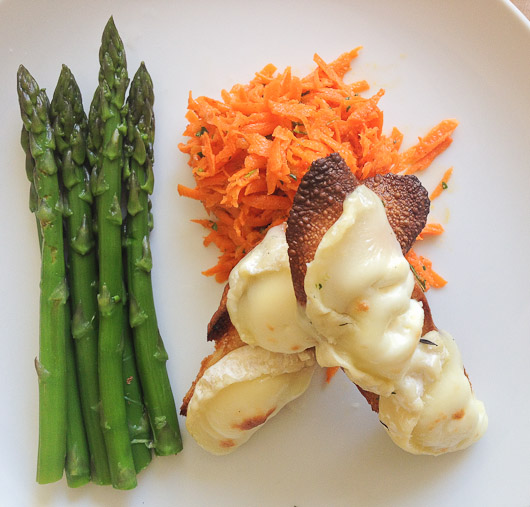
My chèvre chaud recipe below incorporates my favorite parts of the hot goat Parisian salad. Except the bacon. I'm sorry about that, I don't know what happened, I must have had bacon for breakfast, lunch and dinner the day before and felt overwhelmed. Add bacon if you'd like. My version features a thick hunk of goat cheese over crostini, grated carrots and herbs, and asparagus, bien sur, because it's the season! It was also the recipe I created for my cheese club members to feature Redwood Hill Farm Terra, but you can use any goat cheese you'd like. The only goat involved is the cheese.
"Hot Goat Salad"
Serves 2
12 asparagus, trimmed
1 teaspoon dijion mustard
1 tablespoon lemon juice, freshly squeezed
4 1/2 tablespoons extra virgin olive oi
l 1/4 teaspoon salt
1 tablespoon chopped tarragon
2 carrots, grated
1/8 teaspoon salt
4 baguette slices, sliced lengthwise
4 ounces Terra
Method
Prepare an ice bath. In a large sauté pan, bring 1 1/2 inches of salted water to a boil. Once boiling, gently lower in the asparagus, return to a boil, and blanche for three minutes. After three minutes, remove the asparagus from the pan and drop immediately into an ice bath- this will keep the asparagus tender and help keep their bright green color. Once chilled, remove from the ice bath and let dry on a clean towel.
Preheat your broiler or turn your oven to 450 degrees.
Add the dijion and lemon juice to a small bowl. Stir vigorously with a whisk or a fork to emulsify. Add three tablespoons of olive oil, 1/4 teaspoon salt, tarragon, and mix again. Place the carrots in a small mixing bowl. Stir in the dijion dressing, 1/8 teaspoon of salt, and 1/2 tablespoon of olive oil. Set aside.
Place your baguette slices on a cooking sheet and brush both sides with olive oil. Broil for 2-5 minutes, until the bread's edges start to turn golden. Remove. Slice the four ounces of Terra into equal sized peices and divide equally amoung the crostini. Return the crostini to the broiler for two more minutes until the cheese has melted.
While cheese is melting, place half of the carrot salad in a mound on a plate. Sidle the asparagus next to the carrots. Rest the Terra crostini against the carrots, repeat with the other plate, and serve.
Valley Ford's Estero Gold Reserve, Ridge-Style

A break-out star at Ridge winery's Montebello tastings this past weekend? The 2000? The 1998? Sure, sure, the Montebellos were mighty tasty, and the Petit Verdot charmed a few who didn't know of the grape's finesse, but on the cheese end, Valley Ford's Estero Gold Reserve earned a gold star.
Every year, Ridge winery has a series of Montebello tastings to celebrate the release of the Estate Bordeaux blend. They go a little something like this:
- First weekend: Component Tasting- a barrel tasting of the Bordeaux varietals that make up Montebello, and, tasting of older vintages.
- Second weekend: First Montebello Sample. They've mixed a sample of the current release (2011) and the public can taste it, and previous vintages. One can buy futures, but shouldn't get too attached- the blend can be changed.
- Third: Tasting the final Montebello blend. Buying futures, and tasting Zinfandel galore.
- All weekends: Cheese, cheese, cheese, and, charcuterie.
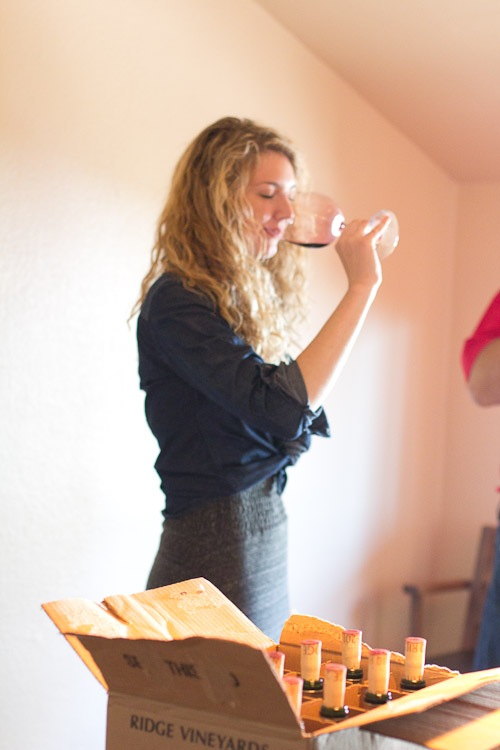
Tasting through the big daddy Montebellos to make sure the bottles aren't flawed. It's a tough job, but Jenny's go to do it.
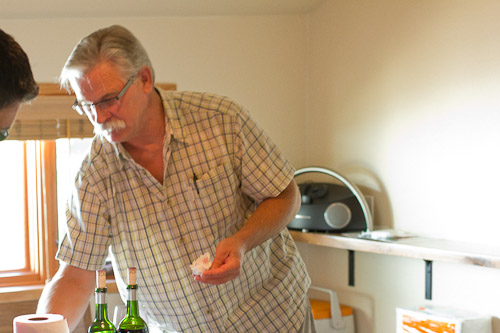
Obviously the fourth item on the list is of the upmost importance. And, that's where this lucky girl comes in. Ridge hires me to curate the cheese for the event. The rules are simple: the cheese must come from California, and it must highlight the Montebello grapes (with an exception for one triple creme or softie per event to pair with the Chardonnay).

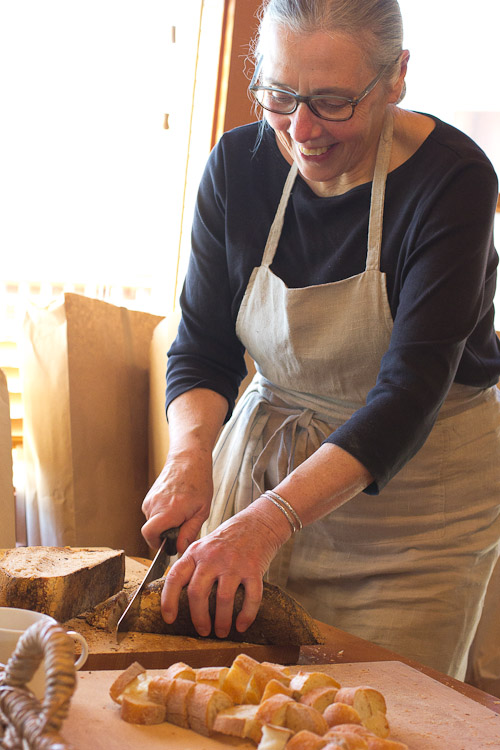 Project semi-firm to hard cheese, go!
In my book, the best pair-ers for Bordeaux varieties are semi-firm sheep's milk cheeses and mixed milks, and older cow's milk cheeses. While all the cheeses served were stunners (how could they not be, with cheesemakers like those at Garden Variety, Pennyroyal, Fiscalini, and Cowgirl Creamery, for example, at the helm), one that caught people off guard with its unusualness was the Estero Gold Reserve.
Estero Gold Reserve is made by Joe and Karen Bianchi Moreda at Valley Ford Cheese in Sonoma. If the name sounds familiar with this blog, that's because the family stole my cheese heart back in 2011. But back then, they only had Estero Gold. The reserve was just a baby.

Ridge Chef Ingrid halving the Estero.
Like with many aged cheeses that come about, the family decided to simply keep a wheel longer than the six or so months they normally would to see what would happen. With fingers and toes crossed, the family waited. Then they tasted. Results? This raw cow's milk cheese is gorgeous. The Bianchi-Moreda family started out making cheese in attempt to keep their third-generation dairy alive, but their cheesemaking skills have put them on the map amongst some pretty stiff competition. Everything they make just keeps better every year. One would certainly hope this would be the case with everyone, but truth be told, sometimes folks just get in a rut.
On their website, Valley Ford says that Estero Gold Reserve is a Montasio style wheel. Hard and crumbly when sliced, the resemblance is clear. Like a Parmessean, the Reserve also has delicately salty, spicy, beefy notes, and an occasional amino acid crystal crunch. It's wonderful grated, served in thin slices as done at the Ridge event, or in chunks like parm.
Estero Gold Reserve was fantastic with the tannic, high acidity Montebellos. People kept coming back to it with re-filled glasses. Hell, I came back to it even without a glass, but it really shined with the wine. The cheese's spicy bite and concentrated flavors firmly stood up to the young wines, whereas a younger cheese might have not yet have had the backbone to hold its ground.
So, Estero Gold Reserve, many raised (and emptied) their glasses to you this weekend. And the Fatted Calf Charcuterie wasn't bad with a sliver of you either.


Have you tried the Estero Gold Reserve yet? What's your favorite hard cheese with Bordeaux grapes?
To Butter: A Love Letter
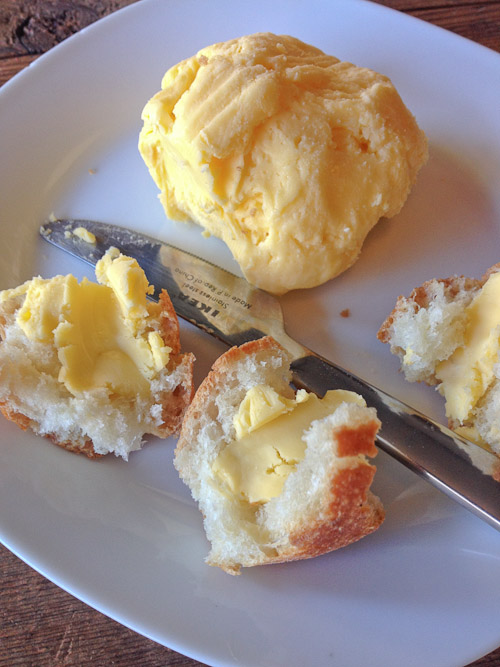 After years and years and years of posting about cheese, I woke up this morning and decided to write about butter. Or more specifically, to butter. This post is a love letter to butter. But unlike many love letters, this one is public. Feel free to read it, consider how its adoration fits into your own dairy devotion, or add your own notes of love or requests for my address so you can send me butter samples in the comment section.
Dear Butter,
I just wanted to say that, besides duck fat, you are my favorite fat. Lardo comes a close third. Extra virgin olive oil is also delicious. But if we were to rank, you'd be first not only because you're delicious, but also you are good to both cook with and slather on bread. Duck fat, not so much.
This love isn't new. I've been smitten with you all my life. When my aunt used to babysit me after elementary school and it came time to request after school snacks, my cousin would ask for apples and peanut butter. I would request a slice of bread spread half an inch high with butter. Then sometimes I would ask for a second slice, at which point my aunt would suggest I make my own, and then I'd mix it up by slicing a "pat" of cold butter from the fridge instead of just using her preferred room temperature stick. Variety! You always kept it fresh, butter.
And back then, you were just the butter next door. You were simple, rich, and wrapped into sticks with waxed paper. Now, you're pretty sophisticated. Some might say cultured. When I walk into a gourmet shop, dear butter, and see you there, all salted and bright yellow, cultured, often wrapped with artisan paper, and inspiring people to spend hard-earned dairy money on you, I tear up a little bit. Because you're worth it. But you were always worth it, butter.
Though until recently, not everyone thought so. Despite your deliciousness, you were damned because of puritanical fears. But now, dear butter, people realize your worth, and their own dairy bigotry. Even though I never needed a study to know how special you were, I was happy when they came out with this and this anyway.
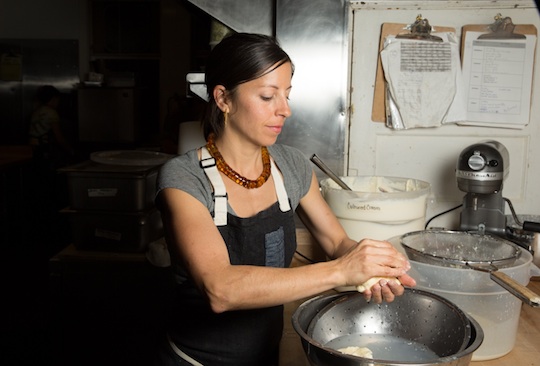
I don't know if you know this, butter, but sometimes I like to make a cultured version of you. Here is a photo taken by my friend Molly DeCoudreaux of Co-chef Cortney Burns at Bar Tartine making you (for an article for Culture magazine), with Burns's recipe to culture you.
In closing, I wanted to say that you make my world better. I love you more than duck fat on my bread.
xoxo,
Kirstin
(In case you're wondering, that lovely butter pictured at top is Animal Farm's jersey milk butter. And nope, I didn't make it more yellow in photoshop. Some of my other favorites American butters are McClelland Euro butter with sea salt, FarmHouse Kitchens hand-rolled Amish butter, Sierra Nevada Butter, and Vermont Creamery's cultured butter. To start.)